
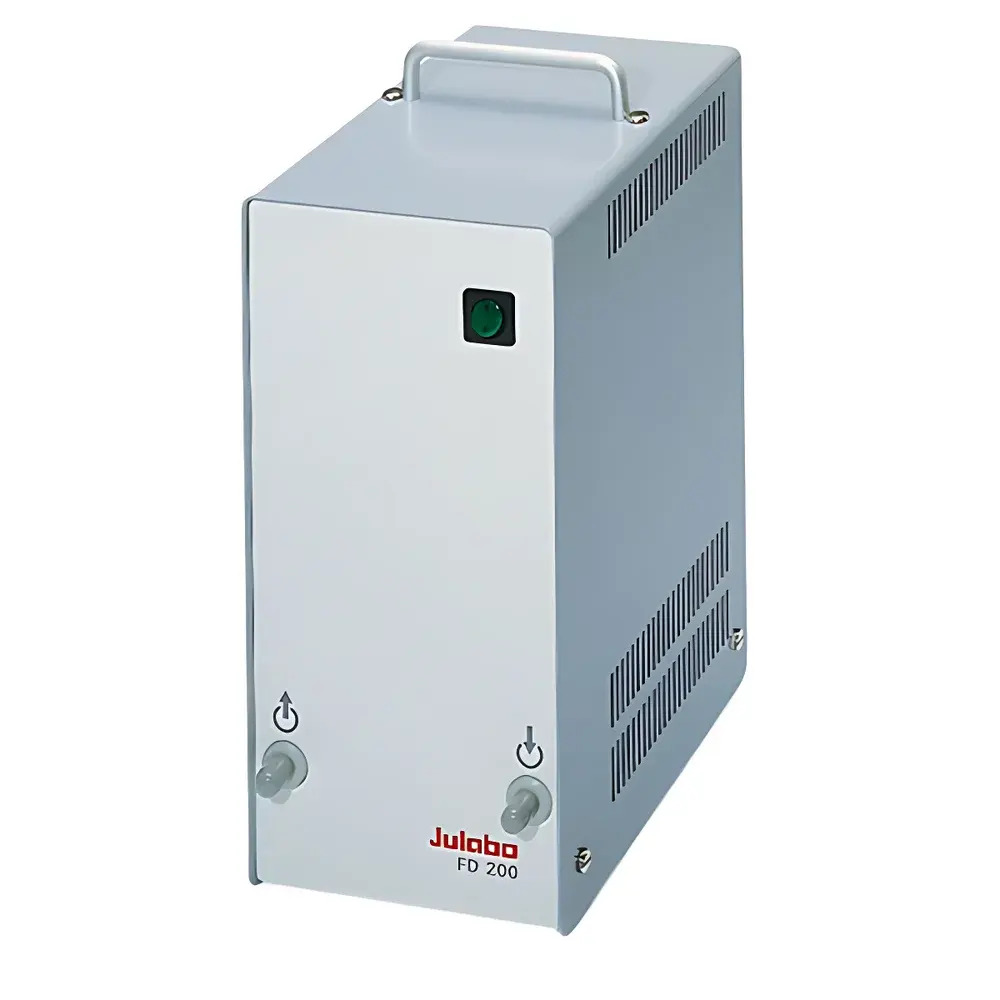
JULABO FD200 Flow-Through Cooling Circulator
| Brand | JULABO |
|---|---|
| Model | FD200 |
| Origin | Germany |
| Temperature Range | 10 to +30 °C |
| Stability | ±0.2 °C |
| Refrigeration Power | 220 W |
| External Cooling Head Dimensions | 18 × 27 × 39 cm (W × L × H) |
| Weight | 16 kg |
| Connection Type | Flow-through (pumpless, requires external circulation controller) |
| Compliance | CE, RoHS, ISO 9001 certified manufacturing |
Overview
The JULABO FD200 Flow-Through Cooling Circulator is an engineered thermal management solution designed for precise, low-power cooling in laboratory environments where temperature control near ambient conditions is critical. Unlike self-contained recirculating chillers, the FD200 operates on a flow-through principle: it cools fluid supplied by an external pump—typically integrated into a heating circulator, viscometer bath, or automated material testing system—and returns the conditioned fluid without internal circulation. This architecture eliminates redundant pumping stages, reduces heat load and energy consumption, and enhances long-term reliability in continuous operation. Its nominal operating range of 10 to +30 °C makes it especially suited for applications requiring gentle, stable cooling—such as viscosity measurement systems, rheometer temperature jackets, spectroscopic cell coolers, and thermal equilibration stages in QC/QA workflows. Built in Germany to JULABO’s ISO 9001-certified quality standards, the FD200 features a compact footprint (18 × 27 × 39 cm), passive anti-freeze protection, and thermally optimized heat exchanger geometry for high heat-transfer efficiency at low ΔT.
Key Features
- Pumpless flow-through design—integrates seamlessly with external circulation controllers (e.g., JULABO F25, E25, or third-party viscometer thermostats)
- Stable temperature control within ±0.2 °C across full operating range (10–30 °C), verified under steady-state load conditions
- Integrated frost protection logic prevents freezing of coolant (e.g., 30% ethylene glycol/water mix) even during intermittent use or low-flow scenarios
- Energy-efficient refrigeration system with 220 W nominal cooling capacity at 20 °C ambient; no compressor cycling under typical lab loads
- Compact housing (16 kg) minimizes benchtop footprint—ideal for space-constrained analytical labs and automated test stations
- Corrosion-resistant stainless steel cooling head and EPDM-sealed fluid pathways ensure compatibility with common heat transfer fluids
Sample Compatibility & Compliance
The FD200 is not a standalone bath but a dedicated cooling module intended for integration into closed-loop thermal systems. It accepts inlet fluid temperatures up to 40 °C and delivers cooled output at user-set points between 10 and 30 °C. Compatible with water, water-glycol mixtures (up to 50% v/v), and other non-aggressive, low-viscosity heat transfer media meeting ISO 6743-20 lubricant classification HEES or HETG. The unit complies with EU directives 2014/30/EU (EMC), 2014/35/EU (LVD), and 2011/65/EU (RoHS). All electrical and thermal safety interfaces conform to IEC 61010-1:2010 for laboratory equipment. While not classified as medical or GMP-grade hardware, its traceable calibration history, stable thermal performance, and audit-ready operational logs support GLP-compliant environments when deployed in validated instrument configurations (e.g., ASTM D445 viscometry setups).
Software & Data Management
The FD200 operates via front-panel push-button interface with LED display—no embedded software or network connectivity. Temperature setpoint, status indicators (cooling active, low-flow warning, overtemperature lockout), and error codes are communicated locally. For automated data capture and remote monitoring, integration is achieved through analog (0–10 V or 4–20 mA) process signals or dry-contact relay outputs (optional accessory). When paired with JULABO’s TR/TC series controllers or third-party PLCs, full audit trails—including setpoint changes, runtime hours, and thermal deviation events—can be logged per FDA 21 CFR Part 11 requirements if the host system provides electronic signature and record retention functionality.
Applications
- Viscosity measurement: Primary cooling unit for automated Ubbelohde or Cannon-Fenske capillary viscometers requiring stable bath temperatures per ASTM D445 and ISO 3104
- Rheometry support: Secondary cooling stage for temperature-controlled measuring geometries in rotational rheometers (e.g., Anton Paar MCR series)
- Spectroscopy: Thermal stabilization of cuvette holders and detector housings in UV-Vis, FTIR, and fluorescence instruments
- Calibration labs: Reference cooling source for temperature probe validation baths operating near ambient
- Process simulation: Component in multi-zone thermal control rigs replicating industrial cooling profiles for polymer or pharmaceutical formulation studies
FAQ
Does the FD200 include an internal circulation pump?
No—the FD200 is a pumpless, flow-through device. It must be connected downstream of an external circulation pump, such as those built into JULABO heating circulators or viscometer control units.
What coolant types are recommended for use with the FD200?
Deionized water or aqueous glycol solutions (ethylene or propylene glycol, ≤50% v/v) are approved. Avoid oils, solvents, or chloride-containing fluids.
Can the FD200 operate below 10 °C?
No—it is thermodynamically and mechanically rated only for 10 to +30 °C. Sub-ambient operation requires a different model (e.g., JULABO F25 or PRESTO series).
Is the FD200 suitable for GMP-regulated environments?
While not GMP-certified as a standalone device, it may be included in validated systems where thermal stability, maintenance records, and calibration documentation meet ICH Q7 and Annex 11 expectations.
How is thermal stability verified during installation qualification (IQ/OQ)?
Stability is confirmed using NIST-traceable PT100 probes placed at both inlet and outlet ports under defined flow rate (typically 1–3 L/min) and load conditions per manufacturer’s IQ/OQ protocol guide.



