
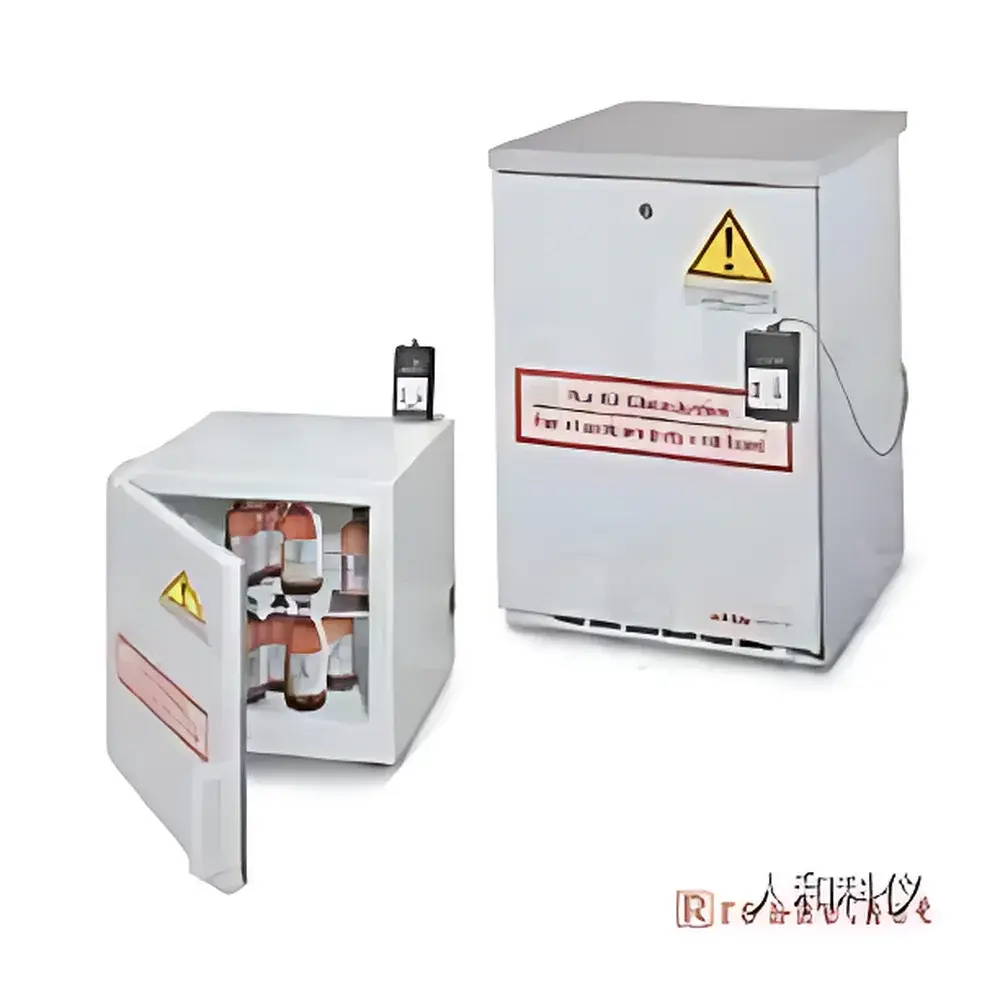
JULABO KRC50 Explosion-Proof Laboratory Refrigerator
| Brand | JULABO |
|---|---|
| Origin | Germany |
| Model | KRC50 |
| Type | Upright |
| Capacity | 50 L |
| Operating Temperature Range | −2 °C to +12 °C |
| Temperature Stability | ±1.0 °C |
| Display | 7-segment green LED, 0.1 °C resolution |
| Temperature Sensor | PTC |
| Overtemperature Protection | 105 °C |
| External Dimensions (W×D×H) | 53 × 63 × 54 cm |
| Internal Dimensions (W×D×H) | 42 × 31 × 39 cm |
| Net Weight | 23 kg |
| Ambient Operating Temperature | 0–35 °C |
| Power Supply | 230 V / 50 Hz |
| Safety Classification | DIN 12876-1 compliant |
Overview
The JULABO KRC50 Explosion-Proof Laboratory Refrigerator is an intrinsically safe, upright refrigeration unit engineered for the secure storage of flammable, volatile, and pyrophoric chemicals—including solvents such as acetone, ethanol, ether, and ethyl acetate—in regulated laboratory, pharmaceutical, and industrial R&D environments. Designed and manufactured in Germany, the KRC50 complies with DIN 12876-1, the internationally recognized standard governing safety requirements for laboratory refrigerators and freezers used in hazardous locations. Its core safety architecture eliminates ignition sources through a fully spark-free interior: no electrical components—wiring, switches, or lighting—are installed inside the storage chamber. All control electronics, including the compressor circuitry and dual-sensor monitoring system, are housed externally in a protected enclosure. The unit employs a hermetically sealed, explosion-proof compressor with integrated thermal overload protection, ensuring continuous operation without risk of arc generation or surface temperature exceedance under normal or fault conditions.
Key Features
- Fully intrinsically safe design: Zero internal wiring or electrical interfaces within the storage compartment—eliminating potential ignition pathways for Class I, Group D (NEC) or Zone 2 (ATEX) atmospheres.
- Dual independent temperature sensing: A primary PTC sensor for precise digital temperature control and a redundant safety sensor for independent overtemperature cutoff at 105 °C.
- External analog + digital control panel: Analog dial for coarse setting and high-contrast 7-segment green LED display (0.1 °C resolution) for real-time monitoring and setpoint verification.
- Active acoustic-optical alarm system: Audible buzzer and flashing LED indicator activate automatically during compressor failure, sensor fault, door-open timeout (>60 s), or temperature excursion beyond ±3 °C of setpoint.
- Static-dissipative interior construction: Interior walls, shelves, and door liner fabricated from non-sparking, electrostatically dissipative polymer materials (surface resistivity <10⁹ Ω/sq), preventing static charge accumulation.
- Structural safety buffer layer: Insulated cavity walls incorporate a flame-retardant, shock-absorbing composite layer that mitigates pressure rise and thermal propagation during unexpected exothermic events.
- Diagnostic self-test function: Dedicated “Safety Test” key initiates a controlled simulation of critical fault conditions (e.g., sensor disconnect, overtemperature event), validating alarm response latency and shutdown integrity per GLP audit requirements.
Sample Compatibility & Compliance
The KRC50 is validated for long-term storage of Class I flammable liquids (flash point <60 °C), per NFPA 30 and OSHA 1910.106 guidelines. Its certified temperature range of −2 °C to +12 °C supports stable preservation of reagents requiring cool-but-not-frozen conditions—such as peroxide-forming ethers, chlorinated solvents, organometallic catalysts, and select biological standards. The unit meets DIN 12876-1 Category 3 (Explosion-Protected Appliances), and its electrical certification aligns with EN 60079-15 (Non-incendive “nA” protection) and IECEx standards. It is suitable for installation in laboratories operating under ISO/IEC 17025, FDA 21 CFR Part 11 (when paired with JULABO’s optional data logger interface), and EU GMP Annex 15 environmental control frameworks.
Software & Data Management
While the KRC50 operates as a standalone analog-digital hybrid unit, it features a standardized RS-485 interface (optional accessory) compatible with JULABO’s LabSoft Connect software suite. This enables remote temperature logging, alarm event timestamping, and configurable email/SMS notifications—supporting ALCOA+ data integrity principles. Audit trails include operator ID, parameter changes, alarm acknowledgments, and test-mode activations. When integrated into a validated laboratory infrastructure, the system satisfies FDA 21 CFR Part 11 requirements for electronic records and signatures, including role-based access control, electronic signatures, and immutable archive export (CSV/PDF).
Applications
- Storage of low-flash-point organic solvents in synthetic chemistry labs.
- Secure holding of peroxide precursors and unstable intermediates in process development.
- Cool-chain maintenance for temperature-sensitive reference standards in QC/QA laboratories.
- Controlled environment for flammable gas calibration mixtures in analytical instrument support areas.
- Compliant cold storage in university teaching labs handling hazardous materials under EH&S oversight.
FAQ
Does the KRC50 require special electrical installation or grounding beyond standard lab outlets?
No—its 230 V / 50 Hz input is compatible with standard European and international lab circuits. However, dedicated circuit protection (B10 miniature circuit breaker) and functional earth continuity testing per IEC 61000-6-4 are recommended prior to commissioning.
Can the internal temperature be calibrated traceably to national standards?
Yes—the PTC sensor is factory-calibrated against PTB-traceable references. A NIST-traceable calibration certificate (Option CAL-KRC50) is available, including as-found/as-left data across three points (0 °C, 5 °C, 10 °C) per ISO/IEC 17025.
Is the KRC50 suitable for storing lithium battery cells or electrolyte solutions?
Yes—its spark-free interior, thermal runaway mitigation design, and strict temperature control make it appropriate for UN 3480 lithium-ion cell storage and LiPF₆-based electrolyte handling, provided ambient lab ventilation meets local fire code requirements.
What maintenance intervals are specified for regulatory compliance?
JULABO recommends biannual verification of alarm functionality, door gasket integrity, and temperature uniformity (per ISO 10573:2022 Annex B). Full preventive maintenance—including refrigerant pressure check and condenser coil inspection—is required annually by authorized service personnel.



