
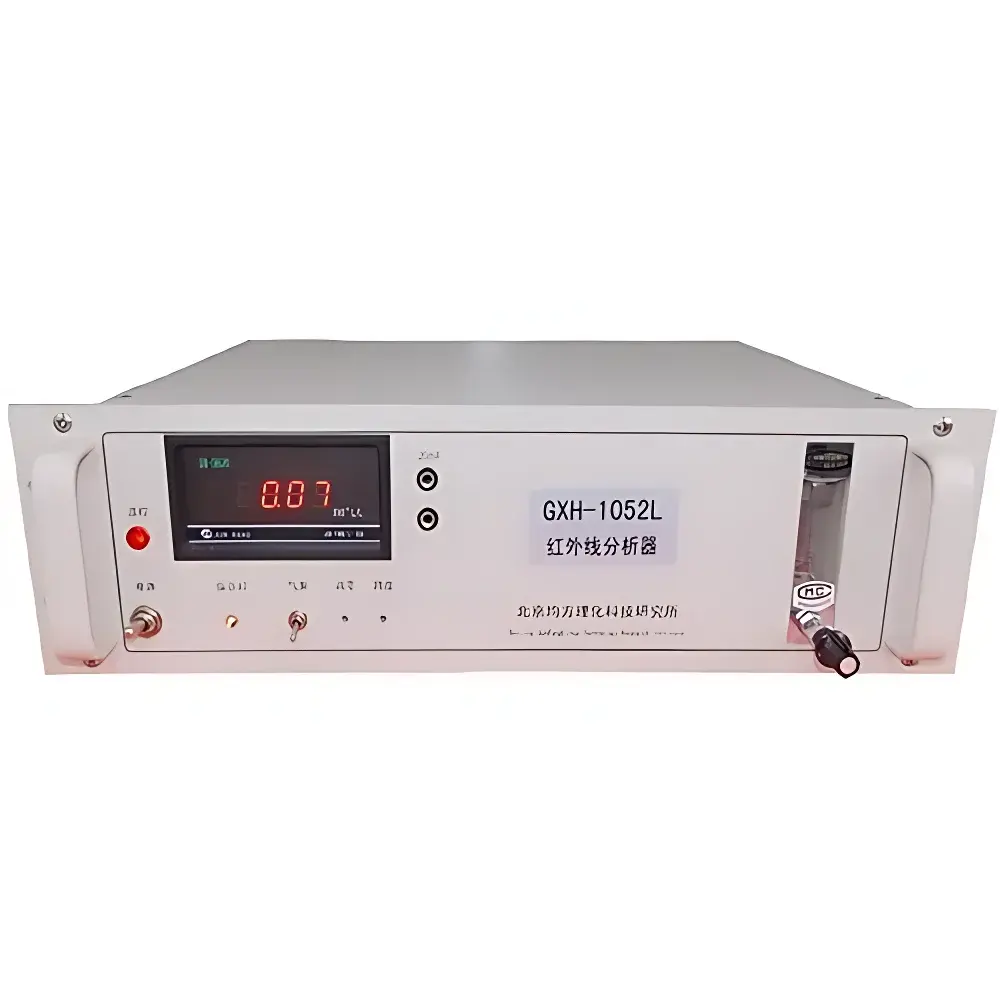
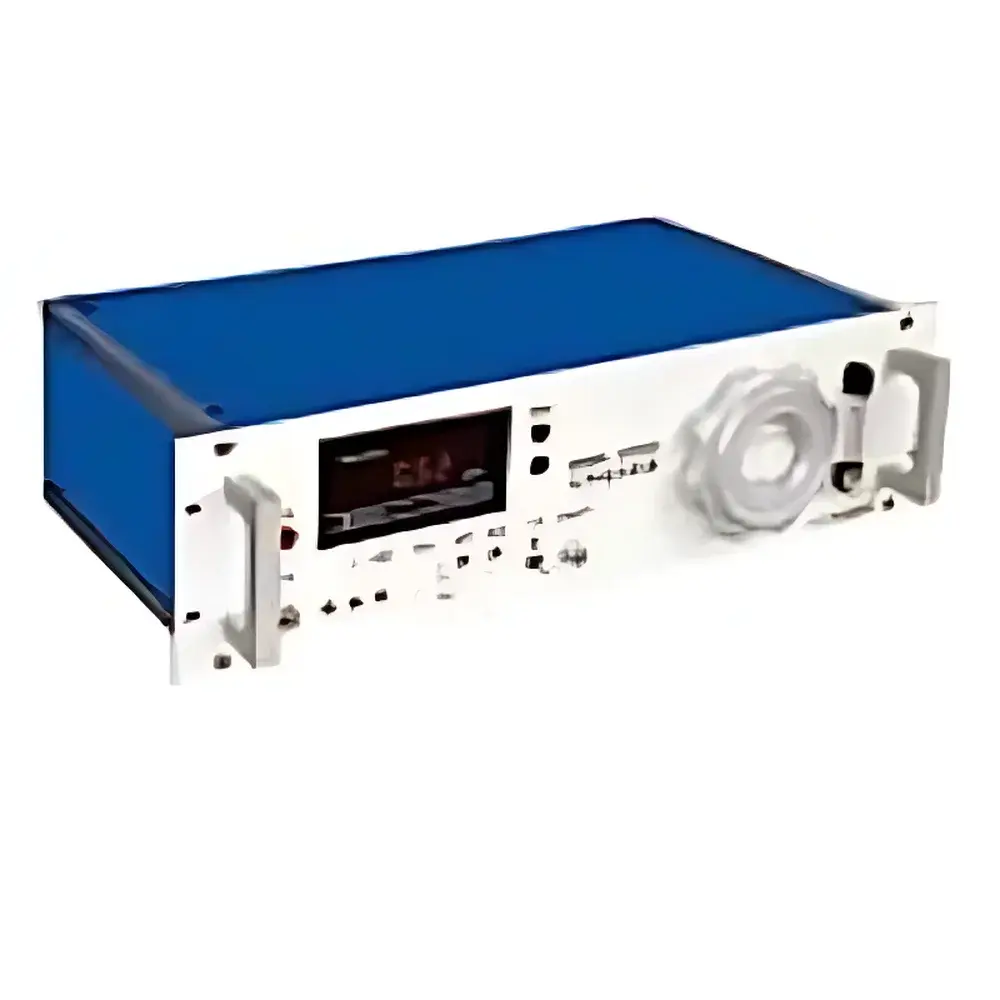
Junfang Lihua GXH-1052L Online Non-Dispersive Infrared (NDIR) Carbon Dioxide Analyzer
| Brand | Junfang Lihua |
|---|---|
| Model | GXH-1052L |
| Origin | Beijing, China |
| Instrument Type | Online Gas Analyzer |
| Measured Gas | CO₂ (single-component) |
| Range | 0–500 ppm (standard), customizable up to 0–100% vol |
| Resolution | 1 ppm |
| Repeatability | ≤ ±1% FS |
| Linearity Error | ≤ ±2% FS |
| Zero Drift | ≤ ±2% FS / 8 h |
| Span Drift | ≤ ±2% FS / 8 h |
| Response Time (T₉₀) | ≤ 60 s |
| Warm-up Time | ≤ 60 min |
| Operating Humidity | ≤ 90% RH (non-condensing) |
| Power Supply | AC 220 V ±10%, 50 Hz ±5% |
| Output Signal | 4–20 mA analog |
| Internal Sampling Pump | Integrated |
| Enclosure Type | Rack-mountable embedded chassis |
Overview
The Junfang Lihua GXH-1052L is an online process gas analyzer engineered for continuous, real-time measurement of carbon dioxide (CO₂) concentration in industrial, environmental, and laboratory applications. It employs the non-dispersive infrared (NDIR) absorption principle—where CO₂ molecules selectively absorb infrared radiation at a characteristic wavelength near 4.26 µm—enabling highly specific, interference-resistant detection without chemical reagents or consumables. Unlike electrochemical or catalytic bead sensors, NDIR technology delivers inherent stability, long-term calibration retention, and immunity to poisoning or sensor saturation. The GXH-1052L is designed for integration into fixed monitoring systems—including stack emissions control, indoor air quality (IAQ) networks, bioreactor off-gas analysis, soil respiration studies, and combustion efficiency optimization—where regulatory compliance, data traceability, and unattended operation are critical. Its embedded chassis architecture supports DIN-rail or panel mounting, and the integrated sampling pump ensures consistent flow control across variable backpressure conditions.
Key Features
- True NDIR optical path with temperature-stabilized detector and dual-wavelength reference compensation to minimize thermal drift and enhance signal-to-noise ratio
- Internal thermoelectrically controlled optical chamber maintaining constant measurement temperature—critical for reducing zero and span drift under ambient fluctuations
- Integrated diaphragm sampling pump with adjustable flow rate (0.5–1.5 L/min), enabling direct connection to sample lines without external vacuum sources
- 4–20 mA isolated analog output with HART protocol compatibility for seamless integration into DCS, SCADA, or PLC-based control systems
- Robust stainless-steel and anodized aluminum housing rated IP54 for operation in industrial environments with moderate dust and humidity exposure
- Factory-calibrated with certified CO₂ standard gases; user-accessible zero and span adjustment via front-panel interface or remote command set
Sample Compatibility & Compliance
The GXH-1052L is optimized for clean, dry, non-corrosive gas streams. For applications involving particulate-laden, humid, or acidic samples (e.g., flue gas, fermentation off-gas), optional pre-conditioning modules—including particulate filters, Nafion™ dryers, and heated sample lines—are recommended to maintain optical path integrity and extend service intervals. The analyzer complies with GB/T 17626 (China’s electromagnetic compatibility standards) and meets functional safety requirements aligned with IEC 61508 SIL 1 for basic process monitoring. While not intrinsically safe certified, it may be deployed in Zone 2/Class I Div 2 areas when installed with appropriate barrier systems. Data logging and audit trail capabilities support GLP and ISO/IEC 17025 laboratory accreditation frameworks, and its analog output design facilitates validation under FDA 21 CFR Part 11 when paired with compliant data acquisition software.
Software & Data Management
The GXH-1052L operates autonomously without embedded firmware-based data storage. Its 4–20 mA output enables direct connection to third-party historian systems (e.g., Ignition SCADA, Siemens Desigo, or LabVIEW DAQ) for time-stamped, high-resolution trend recording. Optional RS-485 Modbus RTU interface (available on request) permits remote configuration, real-time diagnostics, and alarm status polling. All calibration events, zero/span adjustments, and fault logs are timestamped and accessible via serial command—supporting full traceability for quality audits. When integrated with validated enterprise platforms, the device satisfies data integrity requirements per ALCOA+ principles (Attributable, Legible, Contemporaneous, Original, Accurate, Complete, Consistent, Enduring, Available).
Applications
- Continuous emissions monitoring (CEMS) of CO₂ in municipal waste incinerators and cement kiln stacks per GB 13223 and HJ 75–2017
- Indoor air quality surveillance in schools, hospitals, and office buildings per GB/T 18883–2022
- Biological process control in anaerobic digesters, yeast fermentation tanks, and cell culture bioreactors
- Soil CO₂ flux measurement using dynamic closed-chamber methods in ecological research
- Calibration verification and leak testing in HVAC-R systems and CO₂-based fire suppression installations
- Teaching laboratories for physical chemistry and environmental engineering courses requiring stable, repeatable gas-phase IR spectroscopy demonstrations
FAQ
What gas interferences affect CO₂ measurement accuracy on the GXH-1052L?
Water vapor (H₂O) and carbon monoxide (CO) exhibit overlapping IR absorption bands near 4.26 µm. The instrument mitigates this through optical filtering, temperature stabilization, and dual-wavelength referencing. For streams with >2% H₂O or >100 ppm CO, pre-drying or cross-interference correction tables are advised.
Can the GXH-1052L measure CO₂ in 100% nitrogen or argon backgrounds?
Yes—the NDIR method is matrix-independent for inert carrier gases. Accuracy remains within specification as long as the total pressure is stable and no condensables are present.
Is field recalibration possible without specialized equipment?
Zero calibration can be performed using certified zero air (N₂ or synthetic air); span calibration requires a traceable CO₂ standard gas cylinder (e.g., 500 ppm in N₂). No optical alignment tools are needed.
What maintenance schedule is recommended for uninterrupted operation?
Filter replacement every 3 months in dusty environments; optical window inspection and cleaning every 6 months; annual verification against certified standards per ISO 6141.
Related Products







