
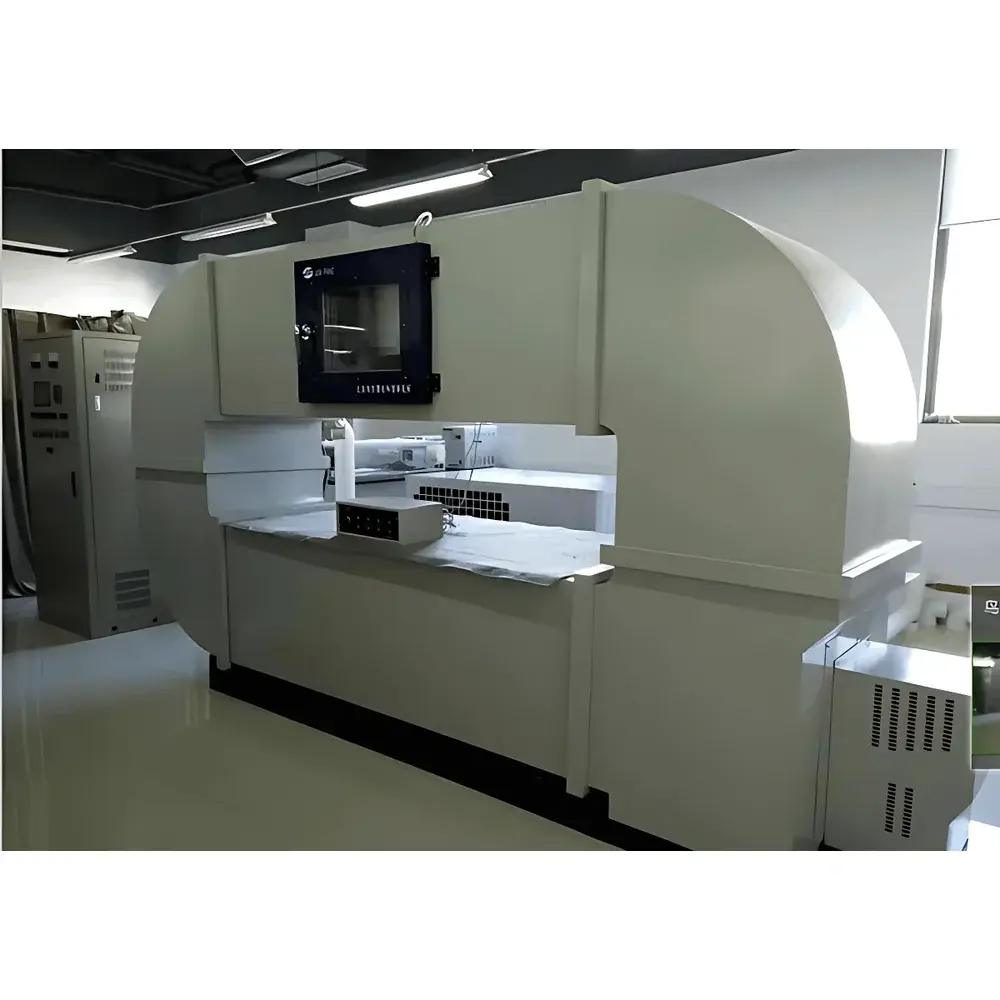
Junfang Lihua HXPQX-2013 Circular Gas Mixing & Environmental Simulation Chamber for Flammable Gas Detector Calibration and Performance Testing
| Brand | Junfang Lihua |
|---|---|
| Origin | Beijing, China |
| Manufacturer Type | Authorized Distributor |
| Regional Classification | Domestic (China) |
| Model | HXPQX-2013 |
| Price Range | USD 42,000 – 70,000 |
Overview
The Junfang Lihua HXPQX-2013 Circular Gas Mixing & Environmental Simulation Chamber is an engineered test environment designed specifically for the calibration, functional verification, and environmental stress testing of flammable gas detectors under controlled, repeatable, and traceable conditions. Unlike standard climate chambers, this system integrates closed-loop airflow dynamics with precise gas dilution capability, enabling simultaneous regulation of temperature (–40 °C to +90 °C), relative humidity (10–95 %RH), air velocity (0–8 m/s), and combustible gas concentration within a sealed, leak-tight recirculating duct. Its measurement architecture is grounded in volumetric flow control, thermodynamic equilibrium modeling, and real-time feedback from calibrated Pt100 temperature sensors and capacitive humidity transducers—ensuring compliance with ISO 8573-1 (compressed air purity), IEC 60079-29-1 (gas detector performance), and GB/T 34004–2017 (Chinese national standard for flammable gas detection equipment testing). The chamber’s circular configuration eliminates stagnant zones and ensures uniform gas distribution—critical for evaluating detector response time, alarm threshold consistency, and cross-sensitivity behavior across varying thermal and aerodynamic boundary conditions.
Key Features
- Recirculating wind tunnel design with 1.1 m³ effective test volume and 400 × 400 mm cross-sectional area, supporting continuous closed-loop operation without external air exchange
- Wide-range environmental control: temperature stability ±2 °C across –40 °C to +90 °C; humidity control 10–95 %RH with ±3 %RH accuracy; air velocity adjustable from 0 to 8 m/s ±0.5 m/s
- Dual-stage refrigeration system using BITZER or Copeland S4T-5.2Y compressors and R404A refrigerant, compliant with EU F-Gas Regulation (EU No 517/2014)
- Explosion-safe gas handling architecture: intrinsically safe heater terminals, segregated heating zones with independent overtemperature alarms, and welded stainless-steel internal surfaces (1.2–1.5 mm thick) with leak-tested seams
- Integrated electrothermal steam humidification (Dürr MK5 series) and direct-expansion dehumidification (Danfoss CAJ9510TMH/HR compressor), both validated per ISO 17025 calibration protocols
- Programmable logic controller (PLC) with industrial touchscreen HMI, supporting multi-segment ramp-soak profiles, real-time data logging (timestamped, CSV export), and audit-trail-enabled parameter history
Sample Compatibility & Compliance
The HXPQX-2013 accommodates fixed-mount, portable, and point-type flammable gas detectors—including catalytic bead (pellistor), infrared (NDIR), and semiconductor-based sensors—up to 300 mm in maximum dimension. Mounting fixtures are configurable via standardized DIN rails and non-magnetic stainless-steel brackets to avoid electromagnetic interference. All operational modes adhere to GLP-compliant documentation requirements, with full traceability of sensor exposure conditions (temperature, humidity, flow rate, gas concentration, dwell time). The system meets mechanical safety standards per GB/T 20935–2007 and electrical safety per GB 4793.1–2018 (equivalent to IEC 61010-1). Optional integration with certified gas mass flow controllers (e.g., Brooks 5850E) enables traceable methane/propane dilution down to 100 ppm, satisfying calibration verification requirements outlined in EN 45544-2 and UL 2075 Annex B.
Software & Data Management
Control and monitoring are executed via a CE-certified PLC platform with embedded 7-inch resistive touchscreen interface. The software supports up to 99 programmable test segments, each with independent setpoints for temperature, humidity, airflow, and runtime. All measured parameters—including actual chamber temperature (0.1 °C resolution), RH (0.1 %RH resolution), static pressure differential, and heater/cooler status—are logged at user-defined intervals (1–60 s) to internal flash memory. Data export is available via USB 2.0 in comma-separated values (CSV) format, compatible with MATLAB, Python pandas, and LIMS platforms. Audit trail functionality records operator login/logout events, parameter changes, alarm triggers, and system resets—meeting FDA 21 CFR Part 11 requirements when paired with optional electronic signature module and network time protocol (NTP) synchronization.
Applications
- Performance validation of catalytic bead sensors under thermal cycling (–40 °C ↔ +90 °C) and high-humidity soak conditions
- Response time benchmarking of NDIR methane detectors at varying air velocities (0.8–5 m/s) to simulate ventilation effects in confined spaces
- Alarm threshold drift analysis during extended exposure to 50 %LEL propane in 85 %RH at 40 °C, per IEC 61779-1 Clause 7.3
- Environmental stress screening of detector housings and seals per IP65/IP66 ingress protection verification protocols
- Inter-laboratory comparison studies requiring metrologically traceable environmental conditioning, as referenced in ILAC-G8:2021
FAQ
Does the chamber support certified gas standard delivery?
Yes—optional integration with traceable mass flow controllers and certified gas cylinders (ISO 6141) enables direct introduction of CH₄, C₃H₈, or H₂ at defined concentrations, with uncertainty budgets documented per ISO/IEC 17025.
Can the system operate continuously for 72+ hours?
Yes—the dual-stage refrigeration architecture, redundant safety interlocks, and industrial-grade PLC firmware support unattended long-duration testing with automatic fault recovery and email/SMS alerting (via optional GSM module).
Is third-party calibration documentation provided?
All factory-installed sensors (temperature, humidity, airflow) are supplied with NIST-traceable calibration certificates; on-site verification services are available through Junfang Lihua’s ISO/IEC 17025-accredited service center in Beijing.
What maintenance intervals are recommended?
Compressor oil and filter replacement every 12 months; humidity sensor recalibration every 6 months; full leak integrity test (helium mass spectrometry) annually per ISO 13849-1 Annex K.
Is remote monitoring supported?
Standard Ethernet port enables Modbus TCP communication for SCADA integration; optional cloud gateway supports secure HTTPS-based telemetry and dashboard visualization via browser or mobile app.







