
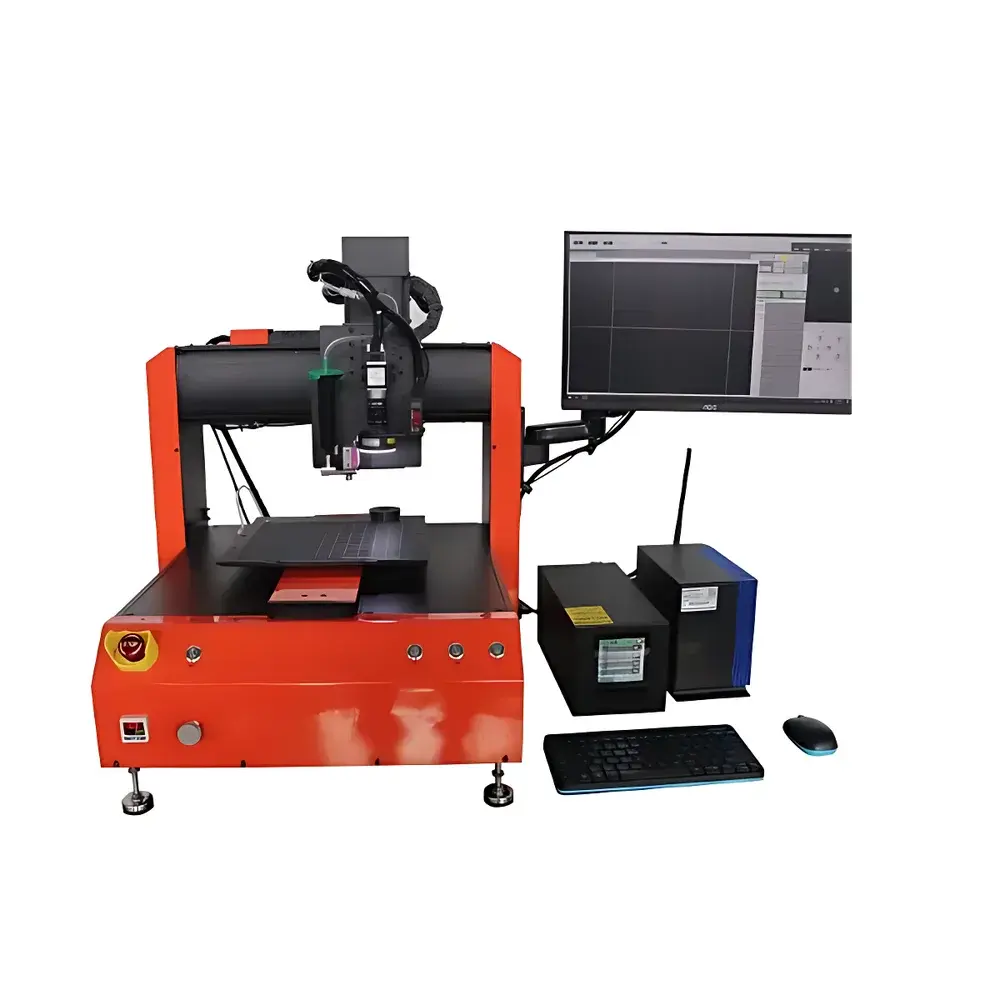
Junjin J2-W300TIII Desktop Direct Ink Writing (DIW) 3D Printing Robot
| Brand | Junjin |
|---|---|
| Origin | Guangdong, China |
| Model | J2-W300TIII |
| Max Build Area | 100 mm × 100 mm |
| Z-Axis Load Capacity | 2 kg |
| Y-Stage Load Capacity | 10 kg |
| XYZ Travel Range | 300 mm × 300 mm × 100 mm |
| Repeatability | ±0.004 mm per axis (X/Y/Z) |
| Max Speed | 500 mm/s |
| Max Acceleration | 0.8 G |
| Drive System | Servo Motors + High-Precision Linear Modules |
| Vision System | 5 MP @ 14 fps |
| Light Source | Single-Channel Red LED Ring Light |
| Input Air Pressure | 0.4–0.7 MPa |
| Total Power Consumption | 1.2 kW |
| Motion Control | 3-Axis Synchronized Interpolation Supporting Linear, Circular, Helical, Elliptical, Involute, Conical, and B-Spline Trajectories |
| Optional Add-ons | UV Curing Lamp, Machine Vision Inspection, Laser Height Probing, Vacuum Bed |
Overview
The Junjin J2-W300TIII is a precision-engineered desktop Direct Ink Writing (DIW) 3D printing robot designed for laboratory-scale additive manufacturing of functional microstructures using viscoelastic pastes, gels, colloidal suspensions, and particle-laden inks. Unlike photopolymer-based stereolithography (SLA) systems, the J2-W300TIII operates on a material-extrusion principle—mechanically dispensing shear-thinning or yield-stress fluids through a fine nozzle under controlled pneumatic or servo-driven pressure, followed by in-situ or post-deposition curing (e.g., thermal, solvent evaporation, or optional UV exposure). Its rigid 3-axis + N modular architecture enables high-fidelity deposition of complex 2.5D and 3D architectures—including lattices, microfluidic channels, electrochemical electrodes, and biomimetic scaffolds—with sub-10 µm feature resolution achievable under optimized rheological and process conditions. The system is not a light-curing printer; it is a motion-controlled extrusion platform compatible with non-photocurable materials, making it especially valuable for ceramic, metal, hydrogel, and composite ink development where UV sensitivity or monomer toxicity are constraints.
Key Features
- High-repeatability 3-axis Cartesian motion system with ±0.004 mm per-axis repeatability, enabled by industrial-grade servo motors and preloaded linear modules.
- Configurable multi-axis extension (N-axis option) supporting rotational or tilt stages for conformal printing on curved substrates or multi-angle deposition strategies.
- Dual-load capability: 10 kg rated load on Y-stage for heavy substrate handling (e.g., silicon wafers, alumina plates, or glass slides), and 2 kg Z-axis payload for integrated tooling (e.g., UV lamps, laser height sensors, or contact probes).
- Real-time vision-guided positioning via a 5-megapixel camera operating at 14 fps, calibrated for pixel-to-mm mapping and enabling automated fiducial alignment and layer registration.
- Programmable pneumatic extrusion control (0.4–0.7 MPa input pressure range) with optional closed-loop pressure regulation for consistent volumetric flow across varying backpressure conditions.
- Advanced motion interpolation firmware supporting G-code-compatible trajectory generation—including spatial helices, elliptical contours, involute gears, conical spirals, and custom B-spline curves—critical for graded porosity or functionally graded material (FGM) fabrication.
Sample Compatibility & Compliance
The J2-W300TIII accommodates a broad spectrum of printable materials, including but not limited to aqueous hydrogels (alginate, gelatin-methacryloyl), ceramic slurries (Al₂O₃, SiO₂, HA), metal pastes (Ag, Cu, Ni), conductive polymer composites, and food-grade edible inks. Nozzle compatibility spans 100 µm to 800 µm internal diameters, with stainless steel, ruby, and hardened tungsten carbide options available. The system complies with CE safety directives for low-voltage equipment (2014/35/EU) and electromagnetic compatibility (2014/30/EU). While not certified for ISO 13485 or FDA 21 CFR Part 11 out-of-the-box, its open G-code architecture supports integration into GLP/GMP-compliant workflows when paired with validated third-party software and audit-trail-enabled controllers.
Software & Data Management
Control is executed via a Windows-based proprietary interface supporting CAD-to-path conversion (STL, DXF, SVG import), layer-by-layer parameter assignment (flow rate, speed, pause duration, Z-gap), and real-time jog/teach functionality. All motion commands, extrusion triggers, and sensor inputs (e.g., vacuum status, pressure feedback) are logged with timestamps in CSV format. Raw vision frames and trajectory logs can be exported for offline metrology (e.g., ImageJ, MATLAB) or statistical process control (SPC). The platform supports Python API access for custom automation—enabling integration with rheometers, environmental chambers, or inline optical coherence tomography (OCT) systems for closed-loop adaptive printing.
Applications
- R&D of microbattery electrodes and solid-state electrolyte architectures requiring precise interfacial control between active material and current collector.
- Fabrication of patient-specific tissue engineering scaffolds with spatially modulated stiffness and pore geometry.
- Prototyping of microfluidic devices with embedded valves, mixers, or gradient generators using multi-material co-extrusion (with optional dual-nozzle upgrade).
- Deposition of piezoelectric or ferroelectric inks for MEMS transducer development under inert atmosphere glovebox integration.
- Process validation studies for ASTM F3184-16 (Standard Practice for Characterizing Extrusion-Based Additive Manufacturing Systems) and ISO/ASTM 52900:2021 definitions of material extrusion AM.
FAQ
Is the J2-W300TIII capable of printing photopolymers?
No—it is a DIW platform, not a stereolithography system. Photopolymer resins require UV curing during or immediately after extrusion; while an optional UV lamp can be mounted, the system lacks real-time DLP or laser scanning optics required for voxel-level photopolymerization.
What is the minimum feature width achievable with this system?
Feature resolution depends on ink rheology, nozzle diameter, and print speed. With a 200 µm nozzle and optimized shear-thinning paste, line widths down to 180–220 µm are routinely achieved; sub-100 µm features require specialized micro-nozzles and rheological tuning.
Can the system operate inside a nitrogen glovebox?
Yes—the compact footprint (650 × 600 × 600 mm) and modular electrical/pneumatic interfaces allow full integration into Class 1000 or better inert-atmosphere enclosures, provided feedthroughs for power, air, and data lines are installed.
Does the controller support external sensor synchronization?
Yes—TTL-triggered I/O ports enable hardware-level synchronization with external devices such as load cells, pyrometers, or high-speed cameras for in-process monitoring and adaptive control loops.
Is technical documentation available in English?
Yes—full English-language user manuals, mechanical drawings (STEP files), electrical schematics, and G-code command reference guides are supplied with each unit.



