
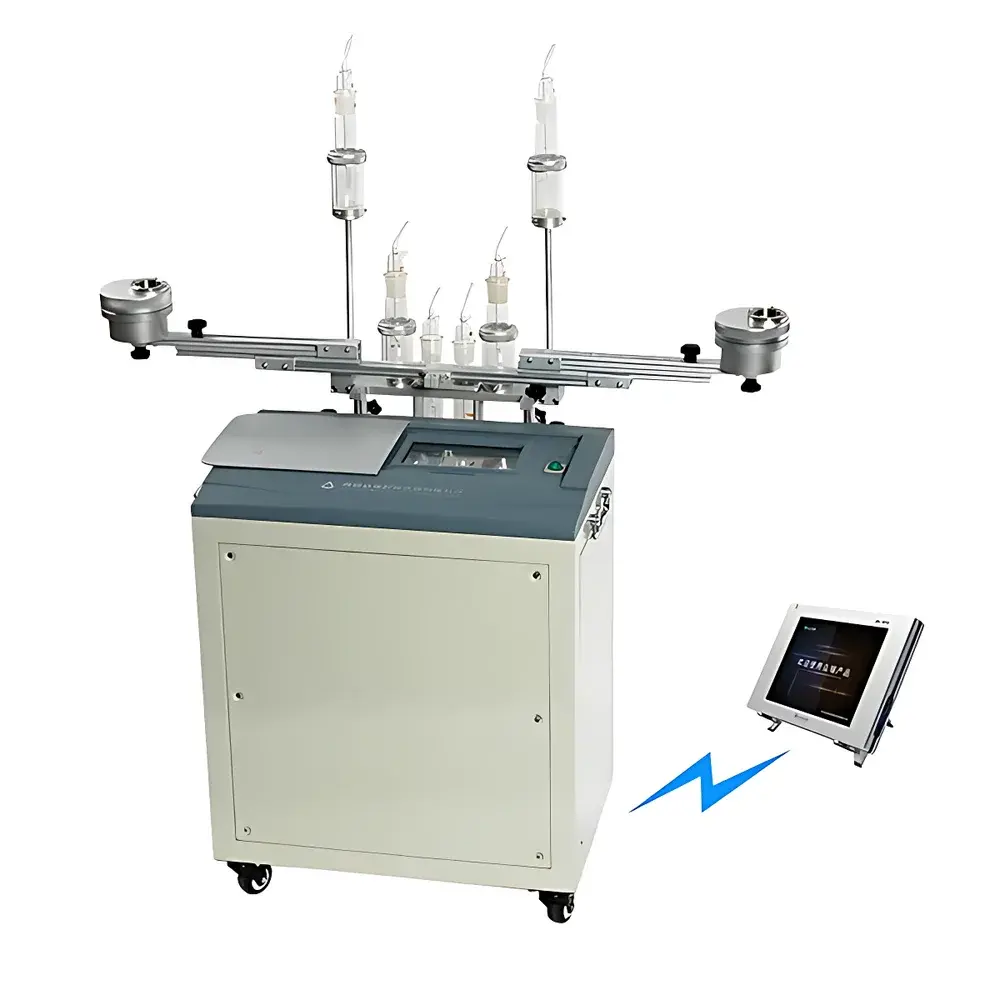
Junray ZR-1012 Intelligent Biological Safety Cabinet Performance Tester
| Brand | Junray |
|---|---|
| Origin | Shandong, China |
| Manufacturer Type | Direct Manufacturer |
| Product Category | Domestic |
| Model | ZR-1012 |
| Instrument Type | Automated Biological Safety Cabinet Challenge Tester |
| Detection Throughput | 10 simultaneous sampling points |
| Filter Cup Capacity | Standard microbiological filter holders (not applicable for filtration volume) |
| Filter Membrane Diameter | 50 mm (standard for impactor/slit samplers) |
| Aerosol Generation Rate | Up to 200 L/min (calibrated with PAO or Bacillus atrophaeus spore aerosol) |
| Compliance | YY 0569–2011, GB/T 16292–2010, ISO 14644-1 Class 5 equivalent containment verification |
Overview
The Junray ZR-1012 Intelligent Biological Safety Cabinet Performance Tester is a fully integrated, automated challenge-testing system engineered for quantitative verification of personnel, product, and cross-contamination protection in Class II biological safety cabinets (BSCs). It operates on the principle of controlled aerosol challenge—using viable Bacillus atrophaeus (formerly B. subtilis) spores or non-viable polyalphaolefin (PAO) particles—to simulate worst-case microbial dispersion scenarios. The instrument delivers traceable, repeatable aerosol generation, multi-point impaction and slit-sampling, and real-time positional control—all synchronized under embedded industrial computing architecture. Designed in strict alignment with YY 0569–2011 “Class II Biological Safety Cabinets” and complementary standards including GB/T 16292–2010 (cleanroom airborne particle testing) and ISO 14644-1 (cleanroom classification), the ZR-1012 enables laboratories to perform full functional validation required for commissioning, routine maintenance, and regulatory requalification of BSCs.
Key Features
- Integrated triple-function aerosol challenge module: six-channel Andersen-type impactors + dual rotating slit samplers + programmable aerosol generator—enabling concurrent evaluation of all three protection modes (personnel, product, cross-contamination).
- Zigbee-enabled wireless control console for remote initiation, parameter adjustment, and status monitoring—eliminating operator presence inside containment zones during test execution.
- Motorized 30-minute full-rotation motion of dual slit-sampler Petri dish carousels ensures uniform deposition geometry and statistically robust colony-forming unit (CFU) recovery per ISO 14698-1 Annex C guidance.
- Height- and width-adjustable structural frame accommodates Class II A1, A2, B1, and B2 cabinet configurations (depth: 600–900 mm; work surface height: 750–950 mm), with precision-machined mounting interfaces for reproducible probe positioning.
- Calibrated spore aerosol generator with digitally adjustable flow rate (10–200 L/min) and validated droplet size distribution (MMAD: 1.0 ± 0.2 µm), compliant with USP <71>, EP 2.6.12, and FDA guidance on microbial challenge protocols.
- Embedded high-speed industrial microcomputer with deterministic real-time task scheduling—ensuring sub-second synchronization across aerosol release, sampler actuation, and rotational indexing.
- 8-inch sunlight-readable capacitive touchscreen with intuitive GUI supporting multilingual operation (English, Chinese, Spanish), audit-trail enabled session logging, and GLP-compliant timestamped metadata tagging.
- Dual USB 2.0 ports for encrypted U-disk data export (CSV/Excel format); supports FAT32 and exFAT file systems with automatic folder structuring by test ID, date, and cabinet serial number.
- Modular, tool-free disassembly design: main chassis, aerosol head, and sampler arrays separate into ISO-standard transport crates (IP54 rated) for field service and inter-laboratory transfer.
Sample Compatibility & Compliance
The ZR-1012 is validated for use with standard 50-mm diameter polycarbonate or mixed-cellulose-ester (MCE) membranes, 90-mm nutrient agar plates (TSA, SDA), and sterile glass Petri dishes. All sampling media comply with ISO 11737-1:2018 requirements for microbial recovery efficiency. The system satisfies national and international regulatory expectations for BSC performance verification—including CNAS accreditation criteria (CNAS-CL01:2018), NMPA Medical Device Technical Review Guidelines (2022 Edition), and WHO TRS 961 Annex 2 (Good Manufacturing Practices for Sterile Products). Its test methodology is referenced in ASTM E1821–22 “Standard Practice for Testing Biological Safety Cabinets Using Viable Aerosols” and aligns with FDA 21 CFR Part 11 data integrity requirements via built-in electronic signature support and immutable session logs.
Software & Data Management
Firmware v3.2.1 includes embedded database management with role-based access control (admin/operator/viewer), configurable pass/fail thresholds per protection mode, and auto-generated compliance reports (PDF + XML) containing raw CFU counts, calculated protection factors (PF), uncertainty budgets per GUM (JCGM 100:2008), and graphical airflow vector overlays. Data export supports CSV import into LIMS platforms (e.g., LabWare, STARLIMS) via ODBC drivers. Audit trails record all user actions—including parameter edits, calibration events, and report generation—with SHA-256 hashing and time-stamping traceable to NIST UTC via optional GPS-sync module.
Applications
- Validation and periodic requalification of Class II BSCs in pharmaceutical QC labs, biologics manufacturing facilities, and clinical diagnostics centers.
- Third-party certification testing for manufacturers seeking NMPA registration or CE marking under MDR 2017/745 Annex I, Section 10.2.2.
- Training and competency assessment for biosafety officers under ISO 22000:2018 and GB/T 27426–2011 laboratory biosafety management standards.
- Root-cause analysis of containment failures during process deviation investigations (e.g., unexpected sterility test failures).
- Research applications in aerosol science, HVAC system validation, and PPE effectiveness studies requiring spatially resolved bioaerosol deposition mapping.
FAQ
What aerosol agents are compatible with the ZR-1012?
The system is validated for Bacillus atrophaeus spore suspensions (10⁶–10⁸ CFU/mL) and PAO oil aerosols; alternative challenge agents (e.g., MS2 bacteriophage) require prior method qualification per ISO 14644-3 Annex B.
Does the ZR-1012 meet FDA 21 CFR Part 11 requirements?
Yes—electronic records include digital signatures, audit trails with tamper-evident hashing, and role-based permissions; optional 21 CFR Part 11 compliance package includes IQ/OQ documentation templates and validation protocols.
Can the ZR-1012 be used for Class III glovebox testing?
No—it is specifically engineered for Class II BSC geometries and airflow profiles; Class III validation requires differential pressure decay and tracer gas methods per ISO 10648-2.
Is external calibration required annually?
Yes—annual metrological verification of aerosol mass concentration (gravimetric), impactor cut-off diameters (cascade impactor calibration), and rotational timing accuracy is recommended per ISO/IEC 17025:2017 Clause 6.5.
What training is provided with purchase?
Junray delivers on-site installation qualification (IQ), operator certification (8-hour hands-on workshop), and annual refresher webinars covering YY 0569–2011 updates, troubleshooting, and report interpretation.



