
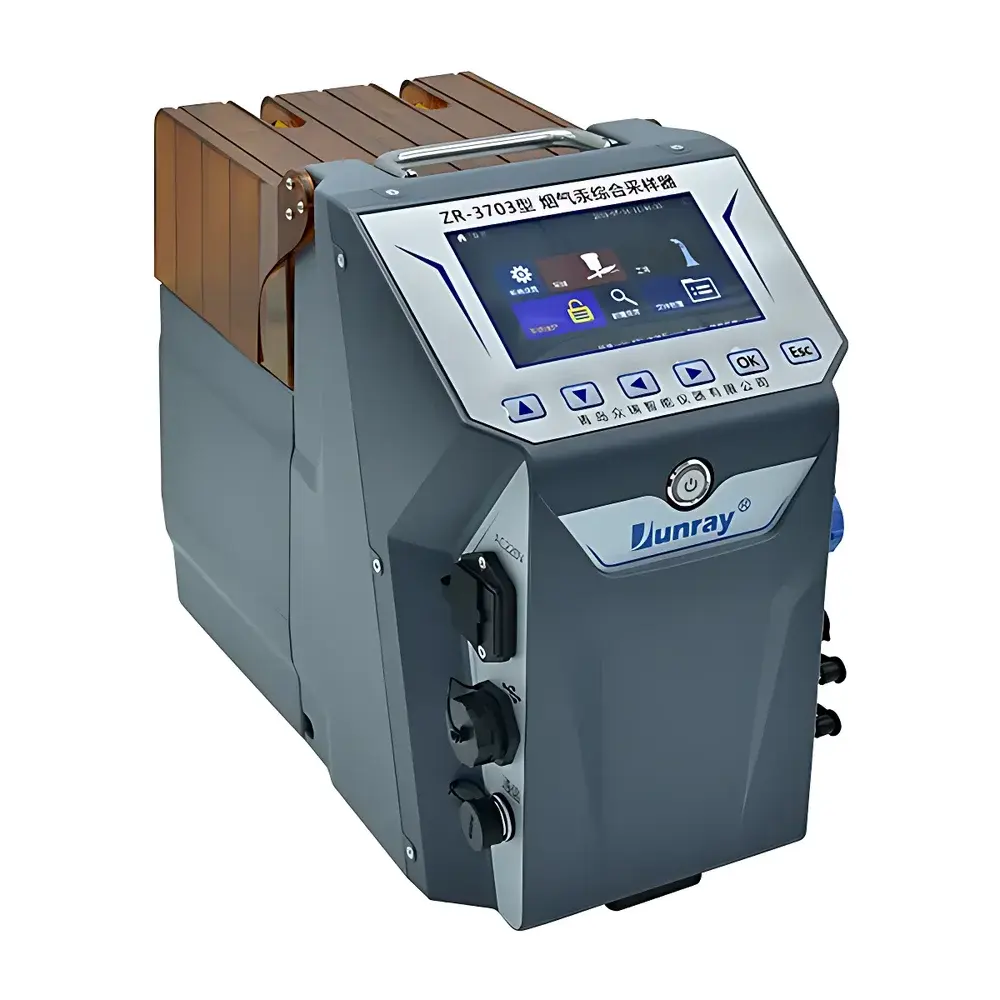
Junray ZR-3703 Integrated Flue Gas Mercury Sampler
| Brand | Junray |
|---|---|
| Origin | Shandong, China |
| Manufacturer Type | Direct Manufacturer |
| Model | ZR-3703 |
| Sampling Flow Rate | 0.1–1.0 L/min |
| Flow Accuracy | ±2.0% |
| Operating Temperature Range | −20 to 50 °C |
| Sample Types | Elemental Mercury (Hg⁰) and Oxidized Mercury (Hg²⁺) |
Overview
The Junray ZR-3703 Integrated Flue Gas Mercury Sampler is a field-deployable, regulatory-compliant instrument engineered for the simultaneous collection and speciation of gaseous mercury emissions from stationary combustion sources—including coal-fired power plants, waste incinerators, and industrial boilers. It operates on the principle of isokinetic sampling coupled with dual-path, temperature-controlled capture: one path employs heated adsorption (e.g., gold-coated quartz or activated carbon traps) for total gaseous mercury (TGM), while the other utilizes chilled impinger trains with selective absorbents (e.g., KCl solution for Hg²⁺ and SnCl₂/HCl for Hg⁰) to enable redox-speciated quantification. Designed to meet stringent stack testing requirements, the ZR-3703 integrates real-time flue gas velocity measurement via pitot tube-based differential pressure sensing and concurrent temperature monitoring—ensuring volumetric flow correction per ISO 9096 and EPA Method 1.
Key Features
- Triple-standard compliance: Fully supports HJ 543–2009 (Cold Vapor Atomic Absorption Spectrometry), HJ 917–2017 (Activated Carbon Adsorption/Thermal Desorption-AAS), and ASTM D6784–02 (Ontario Hydro Method) protocols—enabling method-switching without hardware modification.
- Speciated mercury collection: Dual independent sampling channels allow parallel capture of elemental mercury (Hg⁰) and oxidized mercury (Hg²⁺) using validated absorbent chemistries; ice bath compartment accommodates two sets of 14-bubble impingers with precise temperature control (0–4 °C).
- Heated sampling train: Entire gas pathway—from probe tip to trap inlet—is actively heated (up to 180 °C, adjustable in 1 °C increments) using PTFE-sheathed heating elements to prevent mercury condensation and wall loss; all wetted surfaces are constructed from inert, non-adsorptive polytetrafluoroethylene (PTFE).
- High-stability flow control: Digital mass flow controller with corrosion-resistant ceramic sensor ensures ±2.0% full-scale accuracy across 0.1–1.0 L/min range; supports both time-weighted and volume-weighted sampling modes with programmable ramp profiles.
- Field-ready operation: Integrated 12.6 V/12,000 mAh lithium battery enables >8 h continuous operation; 5.0-inch capacitive touchscreen interface with intuitive icon-driven workflow; automatic leak-check sequence prior to sampling initiation per EPA Method 5 requirements.
- Robust data integrity architecture: Onboard non-volatile memory retains all calibration logs, flow records, temperature traces, and error flags; USB 2.0 port enables encrypted CSV export; optional 4G LTE module provides secure TLS-encrypted remote telemetry and over-the-air firmware updates.
Sample Compatibility & Compliance
The ZR-3703 is validated for use with EPA Method 30B (sorbent trap-based TGM), Ontario Hydro Method (speciated aqueous absorption), and Chinese national standards HJ 543–2009 and HJ 917–2017. Its sampling configuration satisfies ISO/IEC 17025 traceability requirements when paired with NIST-traceable flow calibrators and certified reference materials (CRMs) such as NIST SRM 3133 (Hg in aqueous matrix). All electronic components comply with IEC 61326-1 (EMC for laboratory equipment) and IEC 61000-4-2 (ESD immunity). Optional GPS module delivers geotagged sampling metadata compliant with China’s “Pollutant Emission Monitoring Data Transmission Technical Specification” (HJ 212–2017).
Software & Data Management
The embedded firmware implements audit-trail functionality aligned with GLP principles: every parameter change, calibration event, and sampling start/stop is timestamped, user-ID logged, and immutable in internal flash memory. Data export includes raw sensor outputs (differential pressure, thermocouple mV, flow sensor frequency), calculated stack parameters (velocity, O₂%, dry/wet basis volume), and QC metrics (leak test pass/fail, flow stability index). PC software (Windows/Linux/macOS compatible) supports automated report generation in PDF format conforming to HJ 75–2017 CEMS validation templates and includes built-in uncertainty propagation per GUM (JCGM 100:2008).
Applications
- Regulatory stack testing for coal-fired and biomass-fired power plants under GB 13223–2011 and EU IED Annex V requirements.
- Mercury speciation profiling during catalyst performance evaluation in selective catalytic reduction (SCR) and activated carbon injection (ACI) trials.
- Method validation studies comparing sorbent trap vs. impinger-based recovery efficiencies across varying flue gas moisture and SO₂ concentrations.
- Long-term trend monitoring at municipal waste-to-energy facilities where chloride-induced Hg⁰ re-emission must be quantified.
- Field intercomparison campaigns supporting ISO/TC 146/SC 1 working group activities on harmonized mercury measurement protocols.
FAQ
Does the ZR-3703 support isokinetic sampling verification?
Yes—the system calculates required isokinetic sampling rate in real time using pitot tube-derived velocity data and allows manual or auto-adjustment of pump speed to maintain ±5% isokinetic tolerance per ISO 9096.
Can the instrument store calibration certificates internally?
Yes—up to 20 calibration records (flow, temperature, pressure) can be imported via USB and associated with specific sensor IDs and expiration dates.
Is the heated probe compatible with high-moisture flue gases (>15% v/v)?
Yes—PTFE-lined probe assembly and vapor-phase heating eliminate condensate formation; optional heated filter housing prevents particulate clogging at dew points up to 80 °C.
How is data integrity ensured during power interruption?
All active sampling parameters and accumulated volume are written to protected EEPROM within 100 ms of mains loss; resumption occurs automatically upon power restoration without manual reinitialization.
What QA/QC functions are embedded for field use?
Built-in zero/span checks using certified span gases, dynamic leak detection (±0.5 kPa sensitivity), and real-time flow stability monitoring with configurable alarm thresholds (e.g., ±3% deviation over 60 s).







