
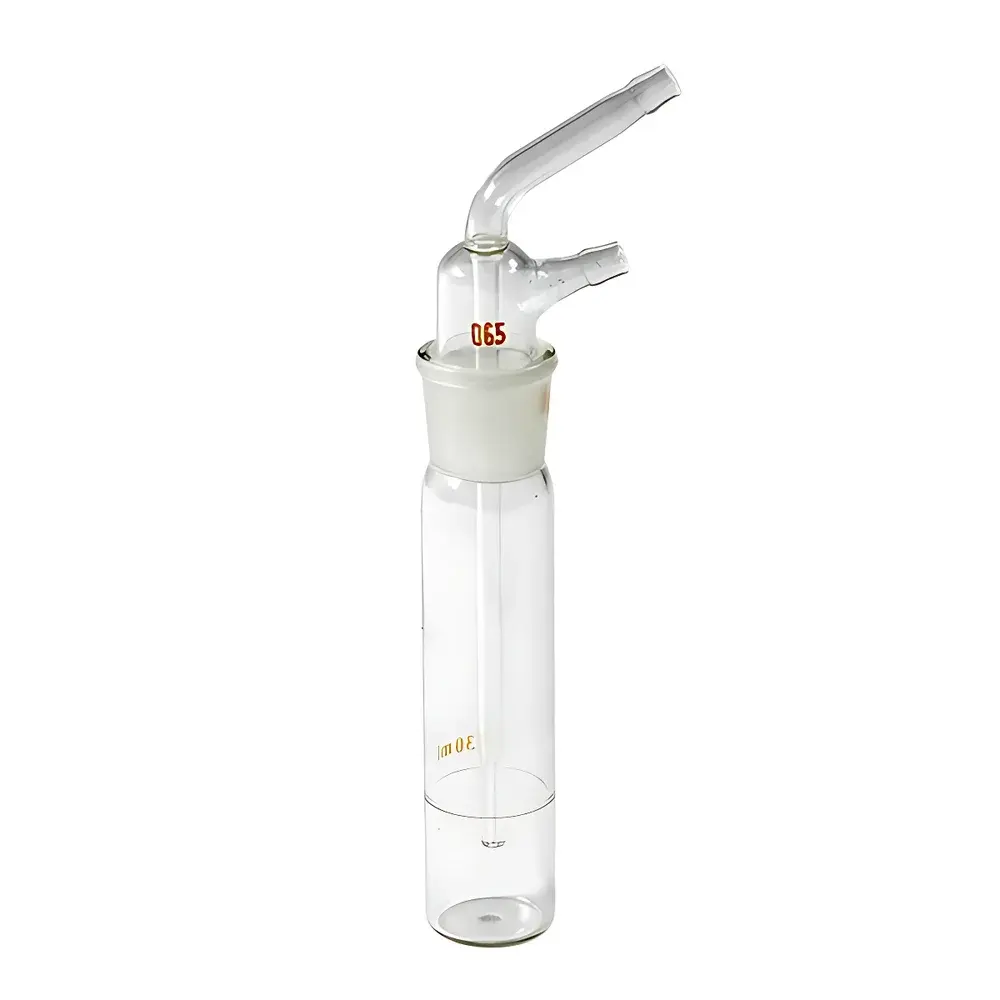
Junray ZR-B01 AGI-30 Air Microbial Sampling Impinger
| Brand | Junray |
|---|---|
| Model | ZR-B01 |
| Type | AGI-30 Impinger |
| Origin | Shandong, China |
| Manufacturer | Junray Instrument Co., Ltd. |
| Compliance | GB/T 18204.1–2013, HJ 93–2013, ISO 14698-1:2003 (principles) |
| Liquid Volume Capacity | 15–30 mL |
| Inlet Flow Rate Range | 5–15 L/min (optimized at 12.5 L/min) |
| Nozzle Orifice Diameter | 0.5 mm |
| Material | Borosilicate Glass (USP Type I), PTFE-sealed cap |
Overview
The Junray ZR-B01 AGI-30 Air Microbial Sampling Impinger is a precision-engineered liquid impaction device designed for quantitative collection of viable and non-viable airborne microorganisms—including bacteria, fungi, yeasts, and viral particles—into a defined volume of sterile collection fluid. It operates on the principle of inertial impaction: ambient air is drawn through a calibrated, narrow-bore stainless steel or glass nozzle (0.5 mm internal diameter) at controlled flow rates (typically 12.5 L/min), generating high-velocity jet streams that force microbial-laden aerosol particles to deviate from the airflow path due to their mass inertia. These particles impact directly onto the surface of a shallow pool of collection medium (e.g., neutralizing broth, saline, or nutrient-rich buffer) contained within the impinger’s lower chamber. The viscous and surface-tension properties of the liquid ensure efficient retention and viability preservation of captured organisms—critical for subsequent culturing, PCR-based identification, or ATP bioluminescence analysis.
Key Features
- Borosilicate glass construction (USP Type I) ensures chemical inertness, thermal stability, and optical clarity for post-sampling visual inspection.
- Optimized AGI-30 geometry with dual-stage spiral inlet and deep liquid reservoir minimizes splash-back and re-aerosolization during extended sampling (up to 8 hours at 12.5 L/min).
- PTFE-lined screw cap provides leak-tight sealing and compatibility with sterilization protocols (autoclave-safe up to 121°C, 20 min).
- Calibrated nozzle design maintains consistent jet velocity and impaction efficiency across the operational flow range (5–15 L/min), validated per ISO 14698-1:2003 Annex B guidelines.
- Low dead-volume configuration (<0.3 mL residual liquid after aspiration) maximizes recovery yield for downstream molecular or culture-based assays.
- No external power or electronics required—designed for seamless integration with standard laboratory vacuum pumps or portable diaphragm samplers.
Sample Compatibility & Compliance
The ZR-B01 impinger supports a broad spectrum of collection media, including tryptic soy broth (TSB), phosphate-buffered saline (PBS), Letheen broth (for neutralizing disinfectants), and RNAlater-compatible buffers for RNA stabilization. Its performance meets the methodological requirements of Chinese national standards GB/T 18204.1–2013 (“Public place hygiene inspection methods – Part 1: Physical and chemical factors”) and HJ 93–2013 (“Technical specification for environmental air particulate matter (PM10 and PM2.5) samplers”), as well as foundational principles outlined in ISO 14698-1:2003 (“Biocontamination control — Part 1: General principles and methods”). While not an electronic instrument, its mechanical design facilitates traceable calibration using primary flow standards (e.g., bubble flow meters traceable to NIM), supporting GLP-compliant environmental monitoring programs in pharmaceutical cleanrooms, hospital HVAC validation, and biosafety level (BSL) facility assessments.
Software & Data Management
As a passive, non-electronic sampling device, the ZR-B01 requires no embedded firmware, drivers, or proprietary software. All operational parameters—including flow rate, sampling duration, collection volume, and ambient temperature/pressure—are recorded manually or via external data loggers compliant with ISO/IEC 17025 documentation requirements. Sample identification, chain-of-custody tracking, and result association are managed within laboratory information management systems (LIMS) such as LabWare, STARLIMS, or Thermo Fisher SampleManager. When used in regulated environments (e.g., FDA-regulated manufacturing), sampling logs must include operator ID, calibration certificate numbers for associated flow meters, and media lot traceability—fully auditable under 21 CFR Part 11 when paired with electronic signature-enabled LIMS modules.
Applications
- Quantitative assessment of airborne bioburden in ISO Class 5–8 cleanrooms per EU GMP Annex 1 and USP <797>/<800>.
- Validation of HEPA filtration efficiency and room air exchange rates in healthcare settings.
- Field-based bioaerosol surveillance in agricultural facilities, wastewater treatment plants, and composting operations.
- Research-grade collection for metagenomic sequencing of atmospheric microbiomes.
- Verification of disinfection efficacy (e.g., hydrogen peroxide vapor, UV-C) by comparing pre- and post-treatment microbial loads.
- Baseline environmental monitoring during clinical trial site qualification (ICH E6 R3).
FAQ
What is the recommended sampling flow rate for optimal microbial recovery?
The ZR-B01 achieves peak impaction efficiency at 12.5 L/min; operation between 5–15 L/min is acceptable but requires flow calibration verification prior to each sampling campaign.
Can the impinger be sterilized in an autoclave?
Yes—the borosilicate glass body and PTFE-sealed cap are rated for autoclaving at 121°C for 20 minutes; avoid thermal shock by allowing gradual cooling post-cycle.
Is the ZR-B01 compatible with real-time particle counters?
No; it is a batch-collection device. Real-time correlation requires parallel deployment with optical particle sizers (e.g., GRIMM, TSI OPCs) and synchronized time-stamped logging.
How should collection fluid be selected for fungal spore sampling?
Use glycerol-supplemented Sabouraud dextrose broth (SDB) or malt extract broth (MEB) to suppress bacterial overgrowth and support hyphal germination during incubation.
Does Junray provide flow calibration certificates?
Junray supplies optional NIST-traceable calibration services for integrated flow metering systems; the impinger itself requires third-party verification per ISO/IEC 17025-accredited laboratories.
Related Products







