
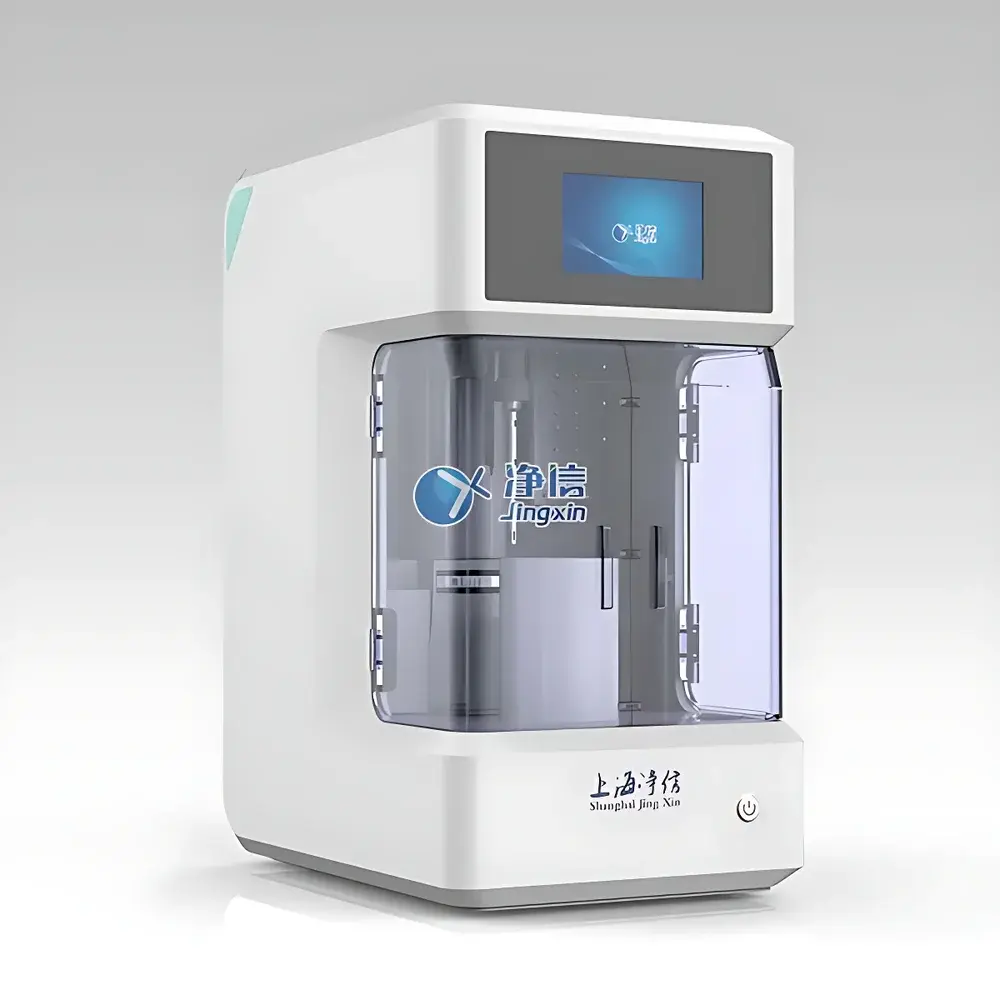
JXAuto-4L Fully Automatic Bead Mill Homogenizer by Shanghai Jingxin
| Brand | Shanghai Jingxin |
|---|---|
| Origin | Shanghai, China |
| Manufacturer Type | Direct Manufacturer |
| Instrument Type | Bead Mill Homogenizer |
| Processing Capacity Range | 5 mL – 4 L (selectable) |
| Speed Range | 3000–36,000 rpm |
| Processing Time | 1–9999 s |
| Noise Level | <60 dB(A) |
| Display | 10-inch Full-Color Touchscreen Interface |
| Automation Level | Fully Automated |
| Sample Positions | 1–3 |
| Cleaning System | Dual Independent Ultrasonic Wash Stations (Deionized Water + Organic Solvent) |
| Blade Material | ASTM F138-Grade 316L Stainless Steel |
| Compliance | Designed for GLP/GMP-aligned workflows |
| Safety Features | Sealed chamber with active exhaust ventilation, drip-proof sample tray, cup presence detection, front-access transparent door with integrated LED illumination |
Overview
The JXAuto-4L Fully Automatic Bead Mill Homogenizer is an engineered solution for high-throughput, reproducible mechanical lysis and homogenization of biological, food, and environmental samples. Operating on the principle of high-shear bead milling—where kinetic energy from rapidly rotating grinding beads disrupts cellular membranes and matrix structures—the system delivers consistent particle size reduction and efficient extraction across heterogeneous matrices. Unlike rotor-stator or ultrasonic homogenizers, this instrument leverages controlled impact and attrition forces within sealed vessels, minimizing thermal degradation and cross-contamination risks. It is purpose-built for laboratories requiring compliance-ready sample preparation in regulated environments, including those supporting ISO/IEC 17025-accredited testing, FDA-regulated food safety screening (e.g., pesticide residue analysis per AOAC 2017.16), and pharmaceutical microbiological assay preparation (USP <61>, <62>). Its architecture supports traceability through automated method execution and electronic record retention.
Key Features
- Fully automated workflow: One-touch initiation covers homogenization, post-run blade rinsing, and dual-chamber cleaning—eliminating operator-dependent variability and reducing hands-on time by up to 70% versus manual protocols.
- Intelligent 10-inch capacitive touchscreen interface: Enables precise control over rotational speed (3000–36,000 rpm), duration (1–9999 s), blade immersion depth, and pulsing modes (intermittent, ramped, or continuous).
- Dual independent cleaning stations: Separate ultrasonic baths for deionized water and organic solvents (e.g., ethanol, acetone) ensure matrix-specific decontamination—critical when transitioning between lipid-rich (e.g., fish tissue) and fibrous (e.g., feedstuffs) samples.
- Drip-proof sample tray design: Prevents residual liquid migration during blade retraction, maintaining inter-sample integrity without manual wiping or disposable gaskets.
- Integrated sample cup detection: Optical sensors confirm vessel placement prior to operation, preventing dry-run damage and enforcing procedural adherence.
- Acoustically optimized enclosure: High-efficiency brushless motor and vibration-damping chassis achieve <60 dB(A) at 1 m distance—meeting ISO 7779 noise emission standards for shared laboratory spaces.
- 316L stainless steel grinding assembly: Fully autoclavable and compatible with sterilization cycles per ISO 17664; chemically resistant to chlorinated and acidic reagents used in pesticide extraction protocols.
Sample Compatibility & Compliance
The JXAuto-4L accommodates diverse physical sample types—including high-moisture fruits/vegetables, adipose-rich animal tissues (fish, meat), fibrous feeds, oily nuts (e.g., walnuts, soybeans), and hydrated microbial pellets—within tube volumes ranging from 5 mL to 4000 mL. All contact surfaces comply with USP Class VI biocompatibility requirements. The system’s closed-vessel processing meets containment criteria for BSL-2 agents under CDC/NIH guidelines. Method storage (up to 20 protocols) includes timestamped execution logs, supporting ALCOA+ data integrity principles. Optional integration with LIMS via RS-232 or Ethernet enables electronic signature capture and 21 CFR Part 11-compliant audit trails when paired with validated middleware.
Software & Data Management
The embedded operating system records all operational parameters (speed, time, temperature if external probe enabled), error flags, and cleaning cycle completion status. Each run generates a CSV-formatted report with unique ID, operator tag, and method version. Stored protocols retain calibration offsets and maintenance history—facilitating IQ/OQ documentation. Firmware updates are performed via USB or network push, with rollback capability and SHA-256 checksum verification. No cloud dependency: all data remains on-device unless explicitly exported.
Applications
- Food safety labs: Homogenization of composite samples for multi-residue pesticide analysis (QuEChERS-compatible prep), mycotoxin extraction, and pathogen enrichment (e.g., Salmonella from ground poultry).
- Pharmaceutical QC: Preparation of suspension-based dosage forms, microbial load testing of raw materials, and dissolution media conditioning.
- Academic & clinical research: Tissue dissociation for single-cell RNA-seq library prep, bacterial cell lysis for plasmid isolation, and plant metabolite extraction.
- Environmental testing: Soil/sludge homogenization for heavy metal leaching studies and microplastic dispersion in aquatic sediment simulants.
FAQ
What sample tube formats are supported?
Standard configurations include conical-bottom polypropylene tubes (15–50 mL), wide-mouth glass jars (100–4000 mL), and custom-fit stainless-steel vessels—all secured via pneumatic clamping with torque feedback.
Can the system be validated for GMP use?
Yes. The JXAuto-4L provides configurable electronic logs, password-protected method editing, and optional third-party IQ/OQ protocol packages aligned with Annex 11 and EU GMP Annex 15 requirements.
Is remote monitoring possible?
Local wireless control (Wi-Fi 5 GHz) allows real-time status viewing and emergency stop via tablet or laptop; full remote operation requires on-site network configuration and firewall exception approval.
How is cross-contamination prevented between runs?
Automated dual-bath cleaning, drip-proof tray geometry, optical cup detection, and programmable air purge intervals collectively reduce carryover to <0.01% (validated using spiked bovine serum albumin recovery tests).



