
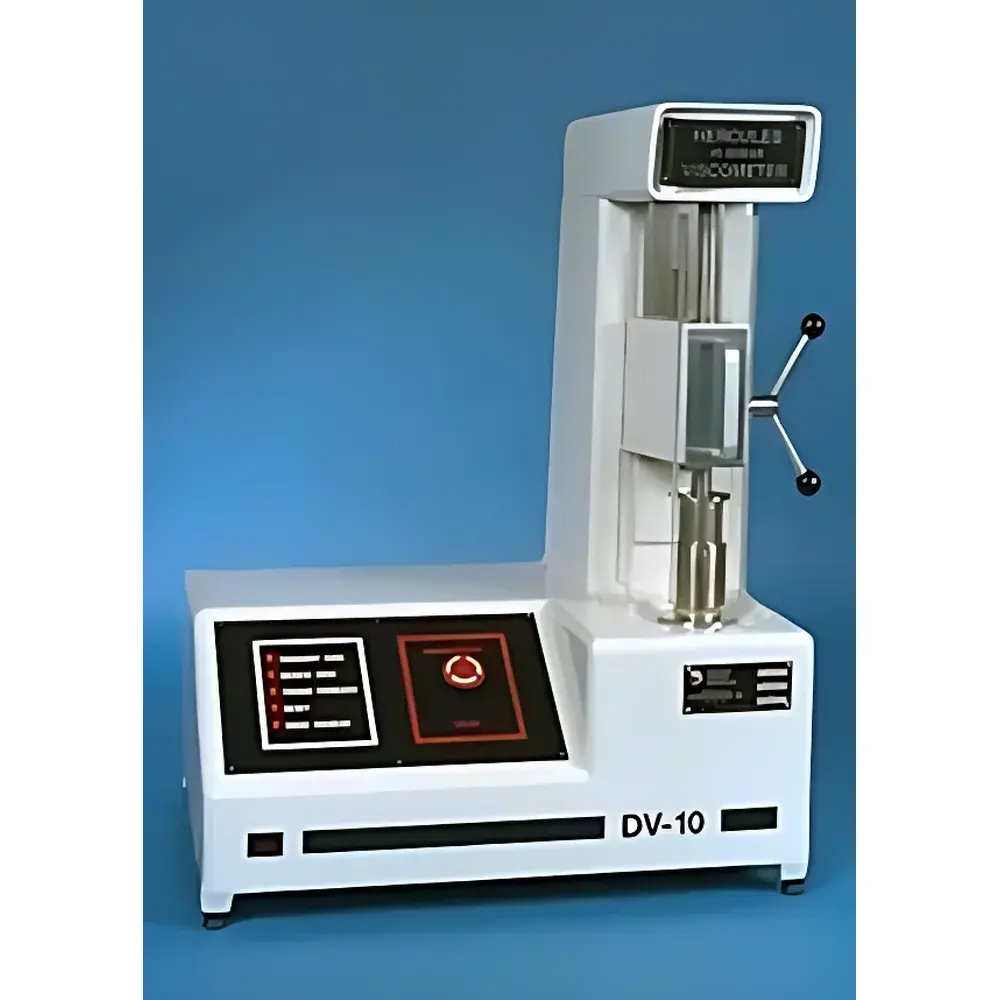
Kaltec HERCULES DV-10 High-Shear Rotational Rheometer
| Origin | USA |
|---|---|
| Manufacturer | Kaltec (USA) |
| Instrument Type | Rotational Rheometer |
| Max Shear Rate | 1–1.38×10⁵ s⁻¹ (standard), up to 1.85×10⁵ s⁻¹ (upgraded) |
| Torque Range | 1.0×10⁴–1.8×10⁷ dyn·cm |
| Shear Stress Range | 80–6.0×10⁵ dyn/cm² |
| Recommended Viscosity Range | 1–4.5×10³ cP (10⁻² P) |
| Weight | 62 kg |
| Dimensions (H×W×D) | 81×64×46 cm |
Overview
The Kaltec HERCULES DV-10 High-Shear Rotational Rheometer is a precision-engineered instrument designed for controlled, high-shear-rate rheological characterization of complex fluids under industrially relevant flow conditions. Based on the Couette principle, it employs a concentric cylinder geometry—typically a rotating outer cylinder and stationary inner bob—to generate well-defined shear fields across a wide dynamic range. This architecture ensures uniform shear rate distribution and minimizes end-effects, enabling reproducible measurement of viscosity, shear stress, and apparent yield behavior in non-Newtonian systems. The DV-10 is specifically optimized for quality control and formulation development in coatings, pigment dispersions, inks, adhesives, and other shear-thinning or thixotropic suspensions where performance at processing-relevant shear rates (e.g., spray application, roller coating, or high-speed mixing) dictates functional behavior.
Key Features
- High-shear capability with programmable shear rate range from 1 to 1.38×10⁵ s⁻¹ (extendable to 1.85×10⁵ s⁻¹ via firmware/hardware upgrade), covering both low-shear equilibrium and high-shear transient regimes.
- Wide torque detection range (1.0×10⁴–1.8×10⁷ dyn·cm) supporting accurate measurement across low-viscosity dilute dispersions and highly concentrated pastes.
- Integrated digital motor control and real-time data acquisition synchronized with PC-based operation via RS-232 or USB interface.
- Predefined test protocols—including steady-state ramp, step-shear, and time-sweep modes—enabling compliance with standardized methods such as ASTM D2196 (viscosity of paints) and ISO 2555 (resin solutions).
- Rugged cast-aluminum frame and thermally stable mechanical design ensure long-term calibration integrity and resistance to vibration-induced noise during extended testing cycles.
- Modular sensor configuration supports interchangeable bob/cup geometries to accommodate sample volume constraints and optimize shear sensitivity for specific material classes.
Sample Compatibility & Compliance
The DV-10 accommodates samples ranging from low-density aqueous dispersions to high-solid organic solvent-based formulations, with typical volumes between 20–60 mL depending on geometry selection. Its sealed cup assembly minimizes solvent evaporation during prolonged high-shear tests—a critical factor for volatile systems. The instrument meets mechanical and electrical safety requirements per UL 61010-1 and CE EN 61010-1. While not intrinsically rated for hazardous environments, optional temperature-controlled jacketing (compatible with external circulators) enables testing within ±0.2 °C stability over 15–60 °C ranges. Data output conforms to CSV and XML formats suitable for import into LIMS platforms and satisfies traceability requirements under GLP and GMP frameworks when paired with validated software workflows.
Software & Data Management
Control and analysis are performed using Kaltec’s proprietary RheoSoft™ v4.x suite, which runs on Windows OS (7/10/11, 64-bit). The software provides full audit trail functionality—including user login tracking, parameter change logging, and timestamped raw data export—supporting compliance with FDA 21 CFR Part 11 when deployed with electronic signature modules and system access controls. Real-time plotting of viscosity vs. shear rate (flow curves), shear stress vs. shear rate (constitutive curves), and time-dependent recovery profiles is supported. Curve fitting options include Power Law, Bingham Plastic, and Herschel-Bulkley models, with statistical reporting of R², confidence intervals, and parameter uncertainty estimates derived from repeated measurements. All datasets are stored with embedded metadata (operator ID, date/time, geometry ID, temperature, calibration certificate reference).
Applications
- Formulation screening of rheology modifiers (e.g., fumed silica, associative thickeners) in architectural and industrial coatings.
- Stability assessment of nanoparticle dispersions via high-shear viscosity hysteresis and recovery kinetics.
- QC release testing of inkjet inks to verify jetting consistency at shear rates >10⁴ s⁻¹.
- Correlation of laboratory-scale high-shear data with pilot-plant extrusion or homogenization parameters.
- Evaluation of thixotropic breakdown and structural recovery times in sealants and caulks using controlled shear start-stop sequences.
- Supporting regulatory submissions requiring shear-dependent viscosity data per USP (Rheology of Semisolid Dosage Forms) or ICH Q5C (stability of biotech products).
FAQ
What sample volume is required for standard DV-10 testing?
Typical volume ranges from 20 mL (for small-diameter bobs) to 60 mL (full-cup configuration); exact volume depends on selected geometry and desired shear gap.
Can the DV-10 perform oscillatory measurements?
No—the DV-10 is a steady-shear rotational rheometer; it does not support dynamic oscillatory modes. For viscoelastic characterization, Kaltec offers complementary modular systems such as the HERCULES DM series.
Is calibration traceable to NIST standards?
Yes—each instrument ships with a factory calibration certificate traceable to NIST-traceable torque and rotational speed standards, with optional annual recalibration services available through Kaltec-certified labs.
Does the system support temperature control?
The base DV-10 operates at ambient temperature; however, it is fully compatible with external temperature jackets and circulating baths for isothermal testing between 15–60 °C.
How is data security managed in regulated environments?
RheoSoft™ supports role-based user permissions, encrypted database storage, electronic signatures, and automated backup—enabling full 21 CFR Part 11 compliance when validated per site-specific SOPs.



