
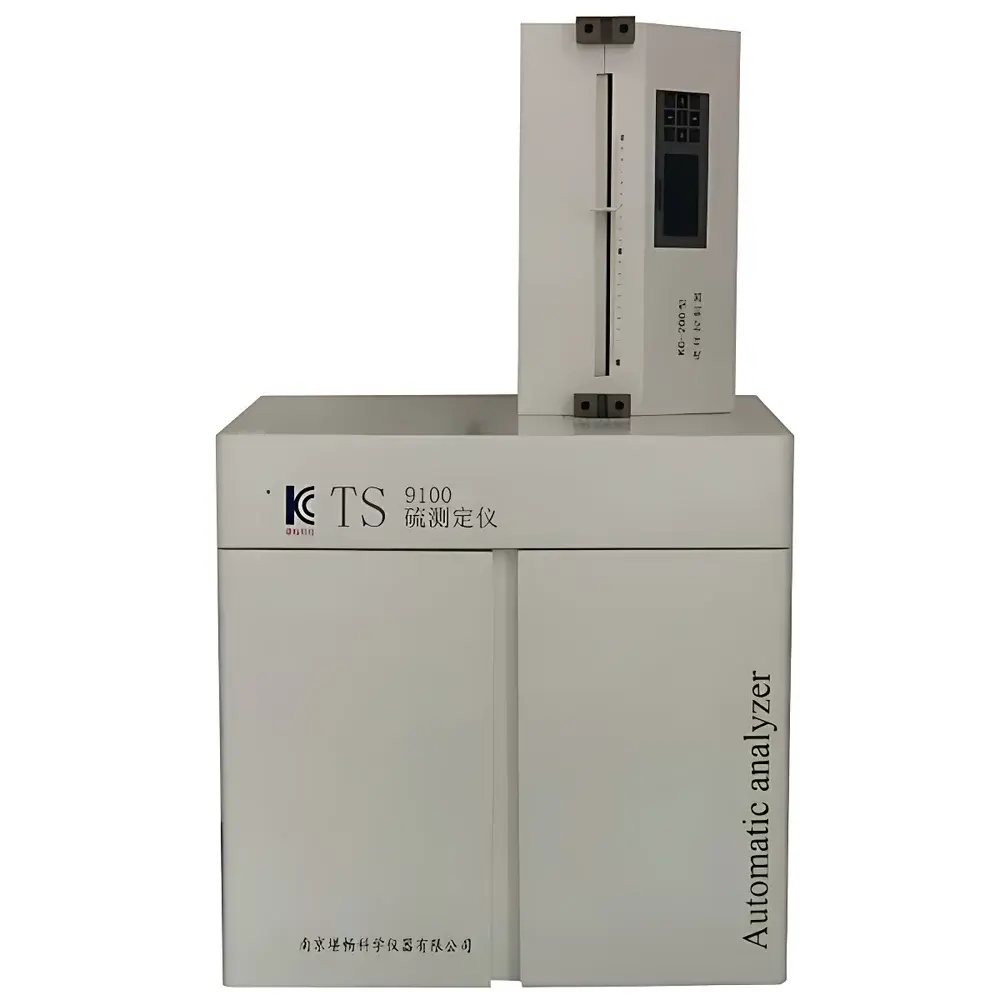
Kanchang TS-9100 Mobile UV Fluorescence Sulfur Analyzer
| Brand | Kanchang |
|---|---|
| Model | TS-9100 |
| Measurement Principle | UV Fluorescence |
| Detection Element | Sulfur |
| Detection Range | 0.2–10,000 mg/L |
| LOD | 0.1 mg/L |
| Repeatability | RSD < 3% |
| Linearity (R²) | > 0.999 |
| Cracking Furnace Temp | Ambient to 1300 °C (±2 °C) |
| Gas Flow Control | 0–600 mL/min (accuracy ≤1%) |
| Power Supply | AC 220 V, 50 Hz |
| Sample Introduction | Automated Vertical Liquid Autosampler |
| Reaction Gas | Compressed Air (no Ar/O₂ required) |
| Compliance | ASTM D5453, GB/T 34100, GB/T 11060, SH/T 0689, SH/T 1820 |
| Data Export | LIMS-compatible formats |
Overview
The Kanchang TS-9100 Mobile UV Fluorescence Sulfur Analyzer is a field-deployable elemental analyzer engineered for rapid, accurate, and interference-free determination of total sulfur in liquid and gaseous hydrocarbon samples. It operates on the principle of ultraviolet fluorescence detection following high-temperature catalytic combustion—where sample molecules are quantitatively converted to SO₂ in a quartz cracking tube packed with proprietary catalyst under controlled air flow. The resulting SO₂ is excited by pulsed xenon UV light (214 nm), and the intensity of emitted fluorescence at 394 nm is measured via a cooled photomultiplier tube (PMT). This method delivers high specificity for sulfur, minimal matrix interference, and excellent signal-to-noise ratio across a wide dynamic range. Designed specifically for mobile laboratory applications—including fuel quality inspection vans, refinery gate labs, and roadside compliance units—the TS-9100 eliminates dependency on bottled argon or oxygen by using an integrated air generator as both carrier and combustion gas, significantly reducing operational complexity and logistical constraints.
Key Features
- Integrated mobile architecture: All core modules—including sulfur detection unit, catalytic cracking furnace (ambient to 1300 °C, ±2 °C stability), and vertical liquid autosampler—are housed in a single ruggedized chassis optimized for vibration resistance and thermal management during transit.
- Air-only reaction system: Eliminates need for external Ar/O₂ cylinders; built-in air generator delivers purified, moisture- and oil-free compressed air at precisely regulated flow (0–600 mL/min, ≤1% control accuracy) with real-time digital feedback.
- Long-life UV excitation source: High-intensity, flash-type xenon lamp with stable output and extended service life (>5,000 hours), ensuring consistent photon flux and detector response over extended operation cycles.
- Intelligent calibration management: Supports editable multi-point calibration curves; users may add, delete, or re-fit concentration points without full recalibration. Curve longevity is enhanced by PMT gain stabilization and sulfur-specific optical filtering.
- Comprehensive hardware protection: Real-time monitoring of cracking furnace temperature, PMT high-voltage deviation, airflow error, and quartz tube backpressure triggers audible/visual alarms and automatic shutdown to prevent damage from carbon deposition or thermal runaway.
- Energy-efficient operational modes: Post-analysis auto-sleep function allows independent configuration of furnace temperature setpoint, gas flow rate, and UV lamp status—reducing power consumption and thermal stress during idle periods.
Sample Compatibility & Compliance
The TS-9100 accommodates a broad spectrum of petroleum-derived matrices including gasoline, diesel, jet fuel, naphtha, kerosene, benzene, toluene, and liquefied petroleum gas (LPG) after appropriate phase conditioning. Its performance meets or exceeds the precision, linearity, and detection requirements specified in ASTM D5453 (Standard Test Method for Determination of Total Sulfur in Light Hydrocarbons, Motor Fuels and Oils by Ultraviolet Fluorescence), GB/T 34100–2017 (Petroleum Products — Determination of Total Sulfur Content in Gasoline and Diesel Fuel — UV Fluorescence Method), GB/T 11060.8 (Natural Gas — Determination of Total Sulfur Content), SH/T 0689 (Determination of Total Sulfur in Light Hydrocarbons and Motor Fuels by UV Fluorescence), and SH/T 1820 (Determination of Total Sulfur in Ethylene and Propylene). Instrument design supports GLP-compliant workflows, including audit-trail enabled data logging, user-access controls, and electronic signature readiness per FDA 21 CFR Part 11 when paired with validated software configurations.
Software & Data Management
The TS-9100 is operated via a Windows-based analytical workstation featuring intuitive instrument control, real-time chromatogram visualization, and automated peak integration. Raw fluorescence signals are digitized at ≥10 kHz sampling rate to preserve transient response fidelity. All measurement metadata—including sample ID, injection time, furnace temperature profile, gas flow history, and PMT voltage—is embedded into each result file. Data export supports CSV, TXT, and XML formats compatible with enterprise LIMS platforms (e.g., Thermo Fisher SampleManager, LabVantage, STARLIMS). Optional software modules provide trend analysis, QC charting (X-bar/R charts), and batch reporting aligned with ISO/IEC 17025 documentation requirements.
Applications
This analyzer serves critical quality assurance and regulatory enforcement functions across multiple sectors: refiners use it for real-time sulfur monitoring in blending operations; fuel terminals deploy it for incoming/outgoing cargo verification; customs and environmental agencies rely on its portability for on-site screening at border checkpoints and storage facilities; third-party testing laboratories apply it for contract analysis under CNAS-accredited scopes. Its robustness enables reliable operation in ambient temperatures ranging from 5 °C to 40 °C and relative humidity up to 85% non-condensing—making it suitable for uncontrolled field environments where traditional benchtop analyzers would fail.
FAQ
Does the TS-9100 require external gas cylinders?
No. It uses an integrated air generator as both carrier gas and combustion oxidant, eliminating dependency on argon or oxygen tanks.
Can the instrument measure chlorine simultaneously?
Yes—via optional TSX-9100 upgrade kit, which adds a dedicated chlorine detection module while retaining full sulfur functionality.
What is the typical analysis time per sample?
Approximately 2–4 minutes, depending on sample matrix and sulfur concentration; includes injection, cracking, detection, and baseline recovery.
Is method validation support available?
Yes—Kanchang provides IQ/OQ documentation templates, system suitability test protocols, and application notes aligned with ASTM and GB standards.
How is data integrity ensured during mobile deployment?
All measurements are timestamped, digitally signed, and stored with immutable audit trails; local database encryption and backup synchronization ensure continuity during intermittent network connectivity.




