
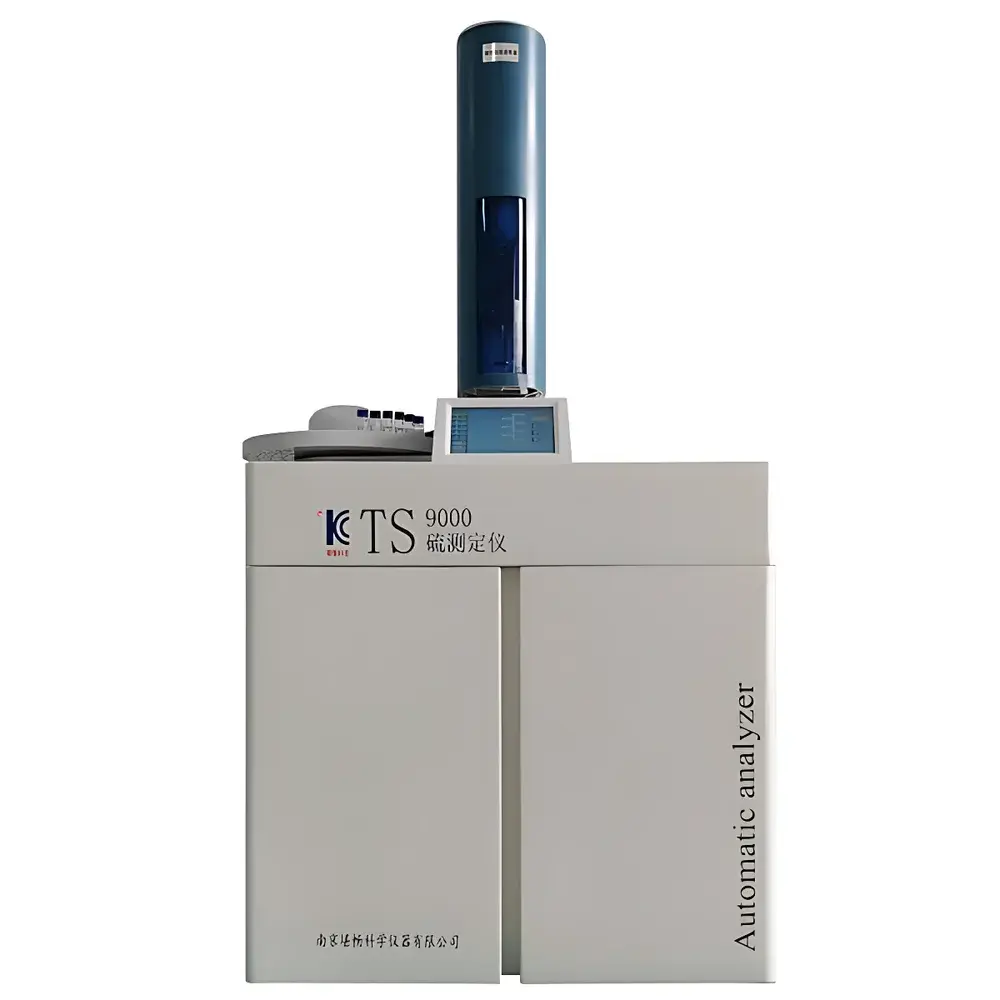
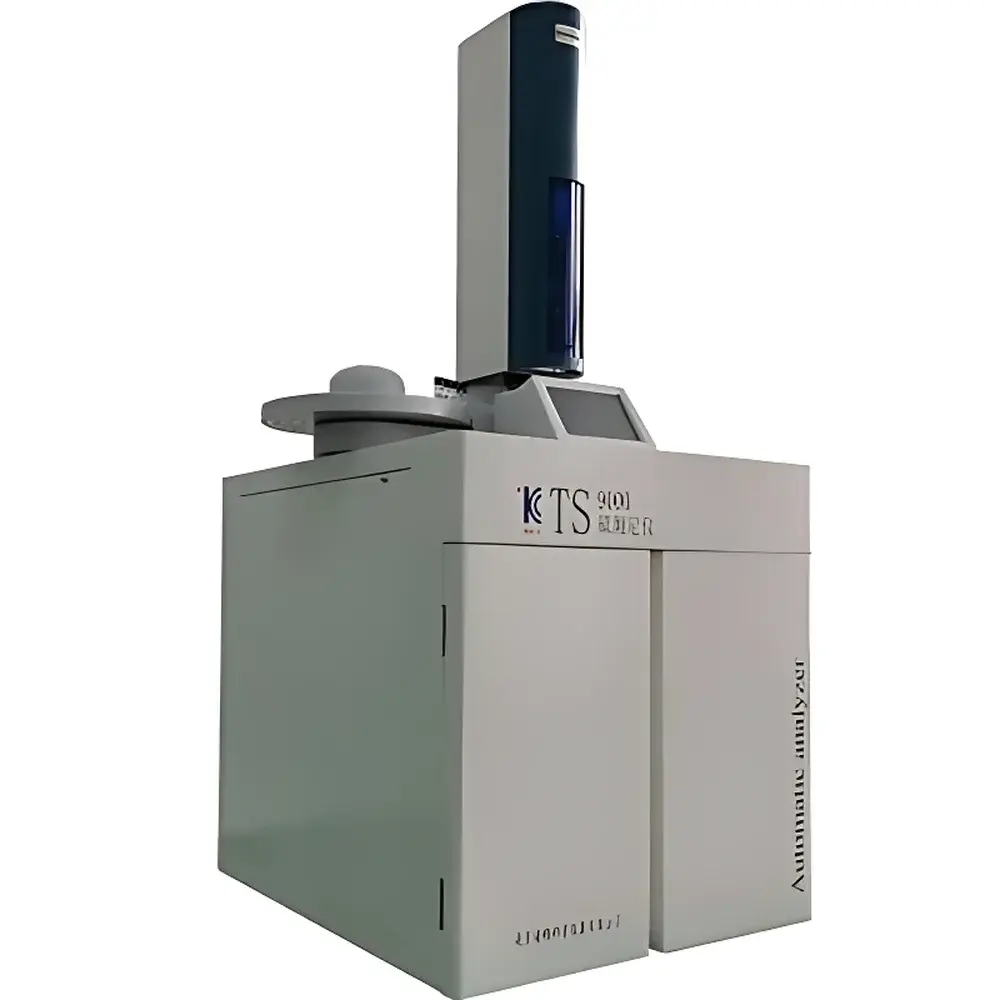
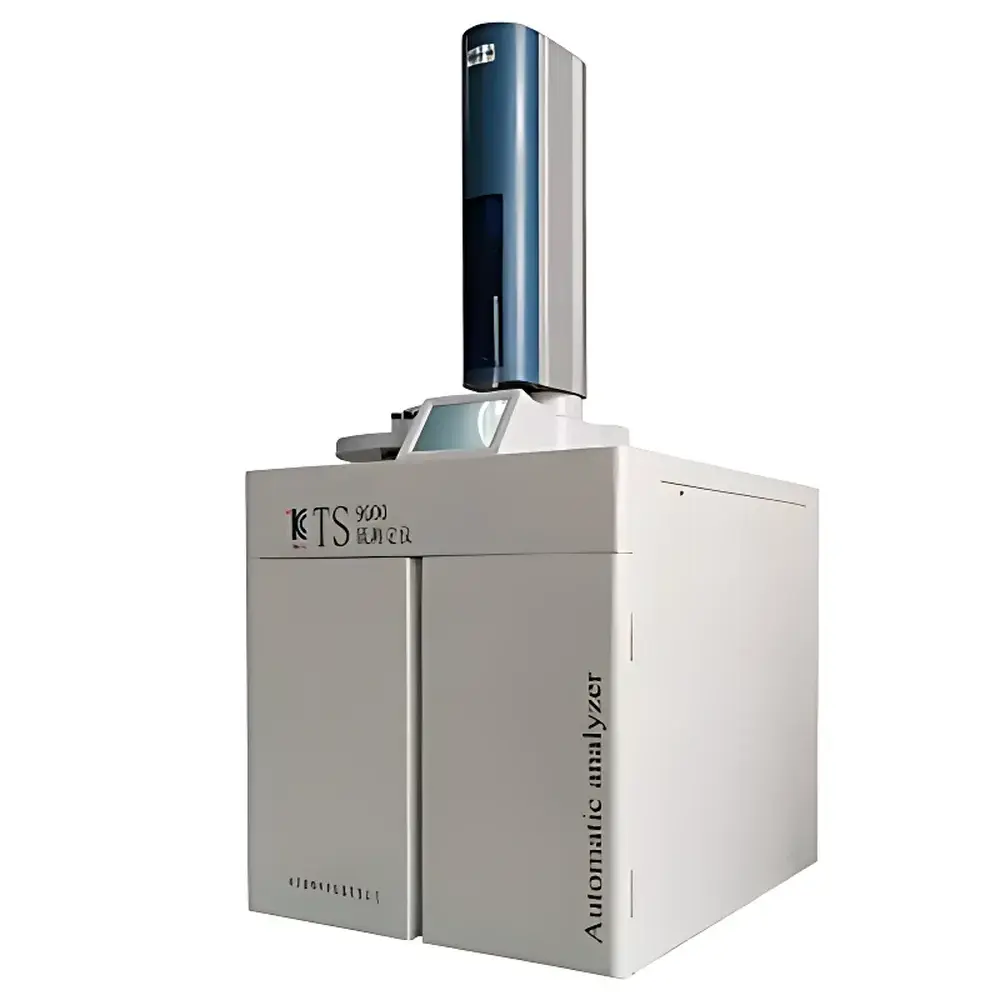
Kanchang TS9000 UV Fluorescence Sulfur Analyzer
| Brand | Kanchang |
|---|---|
| Origin | Jiangsu, China |
| Model | TS9000 |
| Detection Principle | UV Fluorescence |
| Detection Range | 0.01–10,000 mg/L |
| LOD | 0.01 mg/L |
| Repeatability | RSD < 3% (0.2–1.0 mg/L), RSD < 2% (1.0–10,000 mg/L) |
| Linearity | Correlation coefficient > 0.999 (linear fit) |
| Furnace Temp Range | Ambient to 1300 °C |
| Temp Control Accuracy | ±2 °C |
| Autosampler Capacity | 156-position liquid autosampler |
| Power Supply | AC 220 V, 50 Hz |
Overview
The Kanchang TS9000 UV Fluorescence Sulfur Analyzer is a dedicated elemental analyzer engineered for precise, trace-level quantification of total sulfur in liquid, gaseous, and volatile organic samples. It operates on the well-established ultraviolet fluorescence detection principle: sample matrices are fully oxidized in a high-temperature quartz combustion furnace (up to 1300 °C), converting all sulfur species—regardless of chemical form (e.g., thiophenes, sulfides, mercaptans, SO₂)—into excited-state SO₂* molecules. Upon relaxation, these emit characteristic UV photons (λ ≈ 320–390 nm), which are isolated by optical filters and detected by a thermoelectrically cooled photomultiplier tube (PMT). Signal intensity is directly proportional to sulfur mass flow rate, enabling absolute quantification without matrix-specific calibration. The instrument’s architecture integrates the sulfur detection module, high-stability combustion furnace, and 156-position liquid autosampler into a single, compact host unit—minimizing dead volume, thermal lag, and cross-contamination risk. Designed for compliance-driven laboratories, the TS9000 delivers robust performance across petroleum refining, petrochemical QA/QC, environmental monitoring, customs inspection, and third-party testing facilities.
Key Features
- High-temperature vertical/horizontal dual-mode furnace: Switchable between vertical configuration (optimized for liquid autosampling) and horizontal mode (compatible with solid/viscous sample boats), supporting diverse sample physical states.
- Stable UV excitation source: Imported pulsed xenon lamp (Japan) ensures consistent photon flux, eliminates spectral drift from filament aging, and extends operational lifetime beyond 2,000 hours.
- Optimized optical path: Reflective mirror system and imported quartz optical components maintain signal fidelity; PMT housed in a precision temperature-controlled chamber (±0.1 °C) minimizes dark current drift.
- Real-time system diagnostics: Continuous monitoring of furnace temperature, carrier gas pressure/flow (O₂, zero air, O₃), PMT high voltage, and UV lamp intensity—with automated alerts and fault logging for remote troubleshooting.
- Corrosion-resistant electronics: Main control board coated with industrial-grade conformal coating to withstand sulfuric acid vapor exposure and ambient humidity fluctuations.
- Flexible data reprocessing: Raw chromatographic integrals retained indefinitely; users may reapply alternative calibration curves or adjust baseline parameters post-analysis without re-injection.
- Modular expandability: Optional nitrogen detection module enables seamless upgrade to TSN9000 configuration for simultaneous S/N analysis within identical hardware footprint and software interface.
Sample Compatibility & Compliance
The TS9000 accommodates a broad spectrum of sample types—including gasoline, diesel, jet fuel, naphtha, benzene, xylene, LPG, natural gas condensates, and aqueous hydrocarbon emulsions—without derivatization. Solid and semi-solid matrices (e.g., catalysts, polymer pellets, asphaltene residues) are introduced via boat-loading into the horizontal furnace mode. All operational protocols align with internationally recognized standard methods: ASTM D5453 (determination of total sulfur in light hydrocarbons), ASTM D7183 (ultraviolet fluorescence method for total sulfur in aromatic hydrocarbons), ASTM D6667 (gasoline and distillate fuels), ISO 17198 (petroleum products), UOP 987, EN 20846, and multiple Chinese national standards (GB/T 11141, GB/T 11060.8, SH/T 0689). Instrument design supports GLP-compliant workflows, including full audit trail capability, electronic signature readiness, and data integrity features compatible with FDA 21 CFR Part 11–aligned LIMS integration.
Software & Data Management
The TS9000 is controlled via Windows-based analytical software featuring intuitive workflow navigation, real-time chromatogram visualization, and multi-user permission management. Calibration routines support single-point, multi-point, and bracketing strategies; curve editing allows dynamic addition or removal of concentration points without invalidating historical validation. All raw spectral data, peak integrals, and system logs are stored in vendor-neutral binary format with embedded metadata (operator ID, timestamp, method version, instrument serial number). Export options include CSV, Excel (.xlsx), and plain-text (.txt) formats—structured for direct ingestion into laboratory information management systems (LIMS) or statistical process control (SPC) platforms. Long-term archival preserves full spectral fidelity: archived runs retain full deconvolution capability, enabling retrospective reintegration or baseline correction years after acquisition.
Applications
- Petroleum refining: Monitoring sulfur content in feedstocks, intermediates, and finished fuels to meet Tier 3, Euro 6, and China VI specifications.
- Chemical manufacturing: Quantifying residual sulfur in specialty solvents, monomers (e.g., styrene, butadiene), and pharmaceutical intermediates where ppm-level contamination affects catalyst life or product stability.
- Environmental compliance: Analysis of sulfur compounds in stack emissions, wastewater extracts, and soil leachates per EPA Method 1664 and ISO 8245.
- Regulatory testing: Customs clearance verification of fuel sulfur limits under IMO MARPOL Annex VI and national import regulations.
- Research & development: Reaction pathway studies involving desulfurization kinetics, catalyst screening, and speciation modeling via coupling with GC or HPLC front-end separation.
FAQ
What sample introduction methods does the TS9000 support?
Liquid samples are introduced via the 156-position autosampler using standard 2-mL vials; solid, viscous, or diluted samples are loaded manually into quartz boats and processed in horizontal-furnace mode.
Can the TS9000 measure sulfur in gaseous samples directly?
Yes—when equipped with optional gas sampling valve and calibrated mass flow controller, it quantifies total sulfur in permanent gases (e.g., natural gas, refinery off-gas) per ASTM D7551 and ISO 17198 protocols.
How is system performance verified daily?
Built-in system suitability checks include lamp intensity verification, PMT gain stabilization, furnace temperature ramp validation, and reference standard (e.g., DBT in toluene) recovery assessment—all documented automatically in the audit trail.
Is method transfer possible between TS9000 units?
Yes—method files contain complete instrument parameter sets, calibration coefficients, and processing algorithms; validated methods can be deployed across instruments with identical firmware revision and hardware configuration.
What maintenance intervals are recommended for critical components?
Xenon lamp replacement every 2,000 hours; quartz combustion tube cleaning every 500 injections; membrane dryer cartridge exchange every 6 months or after 1,000 analyses—schedule tracked and prompted by onboard maintenance log.



