
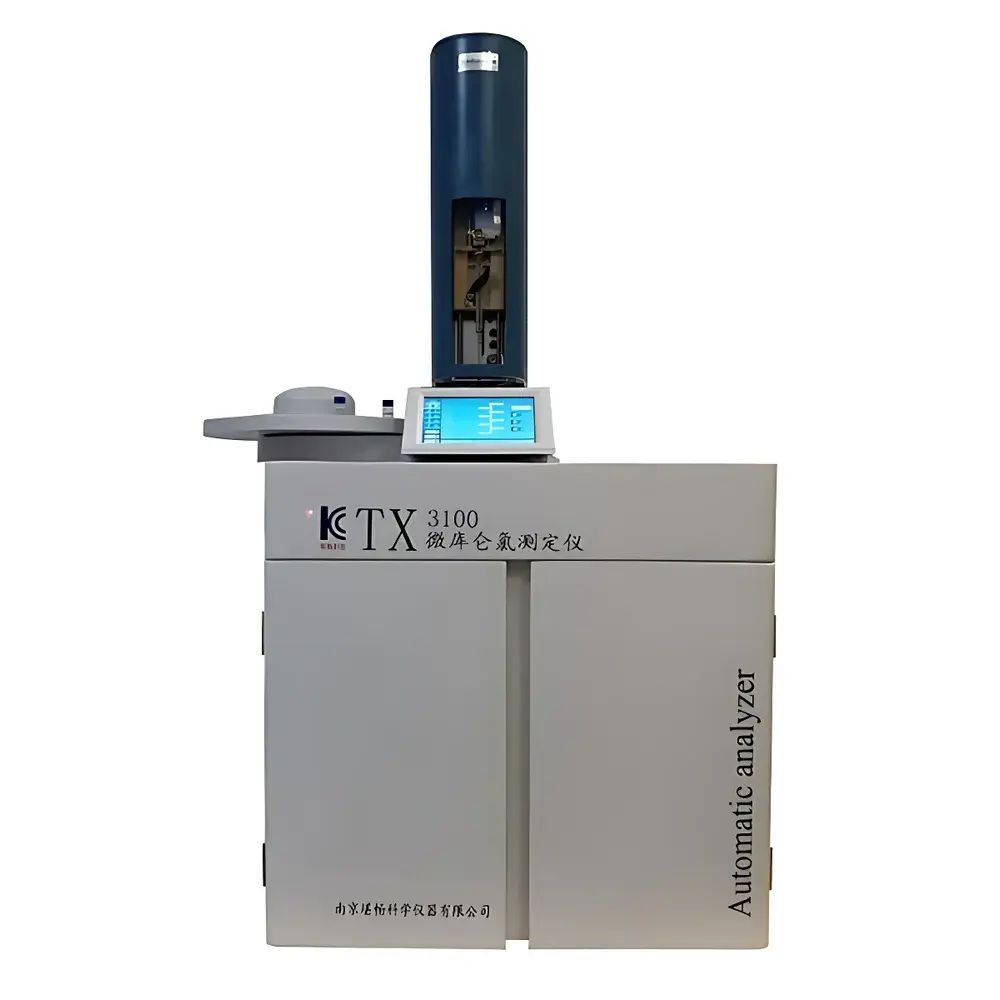
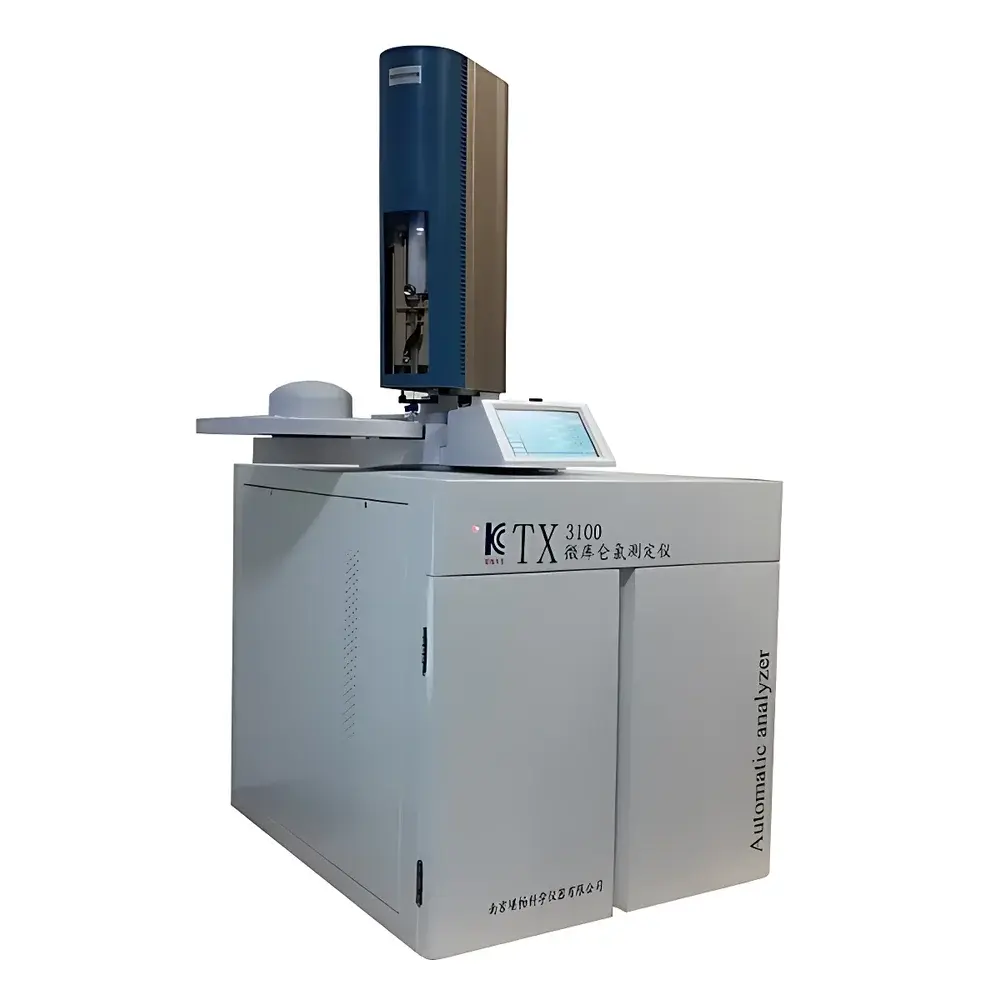
Kanchang TX3100 Automated Microcoulometric Chlorine Analyzer
| Brand | Kanchang |
|---|---|
| Model | TX3100 |
| Measurement Principle | Microcoulometric (Coulometric Titration) |
| Elements Analyzed | Chlorine, Sulfur |
| Sample Types | Liquid and Gaseous |
| Injection Volume | 1–100 µL |
| Detection Range | 0.05 mg/L to 5000 mg/L (dilutable beyond) |
| Repeatability | RSD < 3% |
| Combustion Furnace Temp | Ambient to 1300 °C (±1 °C control) |
| Furnace Power | 1000 W |
| Autosampler Capacity | 156-position liquid autosampler |
| Carrier Gas | High-purity N₂ or Ar |
| Reactant Gas | High-purity O₂ |
| Dimensions | 450 × 550 × 450 mm |
| Operating System | Windows 7/10 |
| Compliance | ASTM D5808, D4929, D5194, D3120, D3246 |
Overview
The Kanchang TX3100 Automated Microcoulometric Chlorine Analyzer is a high-precision elemental analyzer engineered for quantitative determination of total chlorine and sulfur in liquid and gaseous samples using the microcoulometric (coulometric titration) principle. In this method, analyte-containing samples are combusted in a high-temperature quartz furnace under controlled oxidative conditions, converting organically bound chlorine or sulfur into reactive halide or SO₂ species. These species are swept into a proprietary dual-electrode microcoulometric cell, where electrochemical titration occurs via generation of Ag⁺ (for Cl) or I₂ (for S) at the generator electrode. The charge consumed during titration—measured in coulombs—is directly proportional to the mass of analyte, enabling trace-level quantification without reliance on external calibration standards for each run. Designed for laboratories requiring regulatory-grade data integrity, the TX3100 delivers robust performance across ppb-to-percent level concentration ranges while maintaining full compliance with internationally recognized test methods.
Key Features
- 156-position fully automated liquid autosampler ensures representative sampling, minimizes operator intervention, and supports unattended overnight analysis.
- Patented microcoulometric detection cell architecture eliminates air bubble formation during electrolyte filling, enables continuous operation for >8 hours, and reduces electrolyte consumption by up to 90% versus conventional cells.
- Modular electrode design allows independent removal, cleaning, or replacement of reference, measuring, anode, and cathode electrodes—significantly reducing downtime and maintenance complexity.
- Real-time monitoring of carrier gas flow rate, quartz reactor pressure, and furnace temperature ensures complete sample oxidation and optimal combustion efficiency.
- Integrated automatic bias voltage reduction function shortens analysis cycle time without compromising endpoint resolution.
- Corrosion-resistant PCB coating enhances long-term stability and extends instrument service life in chemically aggressive laboratory environments.
- Flexible detection capability: interchangeable chlorine- and sulfur-specific electrolytic cells enable seamless method switching between halogen and sulfur analysis protocols.
- Single-point (conversion factor) and multi-point (calibration curve) calibration modes supported; all calibration parameters are stored with timestamped metadata.
Sample Compatibility & Compliance
The TX3100 accommodates a broad spectrum of sample matrices—including hydrocarbon fuels (gasoline, diesel, jet fuel), lubricating oils, solvents, petrochemical intermediates, and process gases—without matrix-specific hardware modification. Its combustion system operates reliably across volatile and viscous liquids as well as pressurized gas streams when paired with optional gas introduction modules. Regulatory alignment includes full method equivalence to ASTM D5808 (chlorine in aromatic hydrocarbons), ASTM D4929 (organic chloride in crude oil), ASTM D5194 (chlorine in middle distillates), SH/T 1757 (chlorine in gasoline), GB/T 18612 (chlorine in petroleum products), and parallel sulfur methods including ASTM D3120 and D3246. Instrument firmware and software architecture support audit-ready data handling per GLP/GMP requirements, with optional 21 CFR Part 11 compliance packages available for electronic signature and audit trail configuration.
Software & Data Management
The TX3100 runs on a dedicated Windows-based acquisition and analysis platform featuring intuitive workflow navigation, real-time chromatogram visualization, and dynamic peak integration algorithms optimized for coulometric current transients. All analytical sequences—including sample ID, injection volume, calibration status, furnace parameters, and raw coulombic response—are logged automatically with ISO/IEC 17025-compliant metadata tagging. Data export options include native .txt and Microsoft Excel (.xlsx) formats compatible with LIMS integration via standard ODBC drivers. Software supports user-defined report templates, customizable pass/fail criteria, and batch-level statistical summaries (mean, SD, RSD, % recovery). Audit trails record every parameter change, calibration event, and result modification—including operator ID and timestamp—with immutable storage.
Applications
Primary application domains include quality control in refining and petrochemical production, environmental monitoring of chlorinated contaminants in wastewater effluents, specification testing of aviation turbine fuels per DEF STAN 91-91 and ASTM D1319, catalyst poisoning assessment in hydrotreating units, and regulatory screening for organochlorine pesticides in agrochemical formulations. The analyzer is routinely deployed in contract testing laboratories serving API, ASTM, and ISO-certified accreditation scopes, particularly where trace-level chlorine quantification below 0.1 mg/L must be demonstrated with documented measurement uncertainty.
FAQ
What sample types can the TX3100 analyze?
Liquid hydrocarbons, solvents, crude oil fractions, and compressed gases—provided appropriate inlet modules and dilution protocols are applied.
Is the instrument compliant with FDA 21 CFR Part 11?
Yes, when configured with the optional electronic signature and audit trail module, supporting role-based access control and tamper-evident recordkeeping.
Can the same electrolytic cell be used for both chlorine and sulfur analysis?
No—dedicated chlorine and sulfur cells are required due to fundamental differences in electrochemical reaction chemistry and electrode materials.
How is calibration verified over time?
Through routine analysis of certified reference materials (CRMs) traceable to NIST or equivalent national metrology institutes; calibration verification reports are auto-generated and archived.
What maintenance intervals are recommended for the combustion furnace and detection cell?
Furnace quartz tube inspection every 500 analyses; electrolyte replacement every 8–12 hours of continuous use; electrode cleaning after every 200 injections or upon signal drift detection.




