
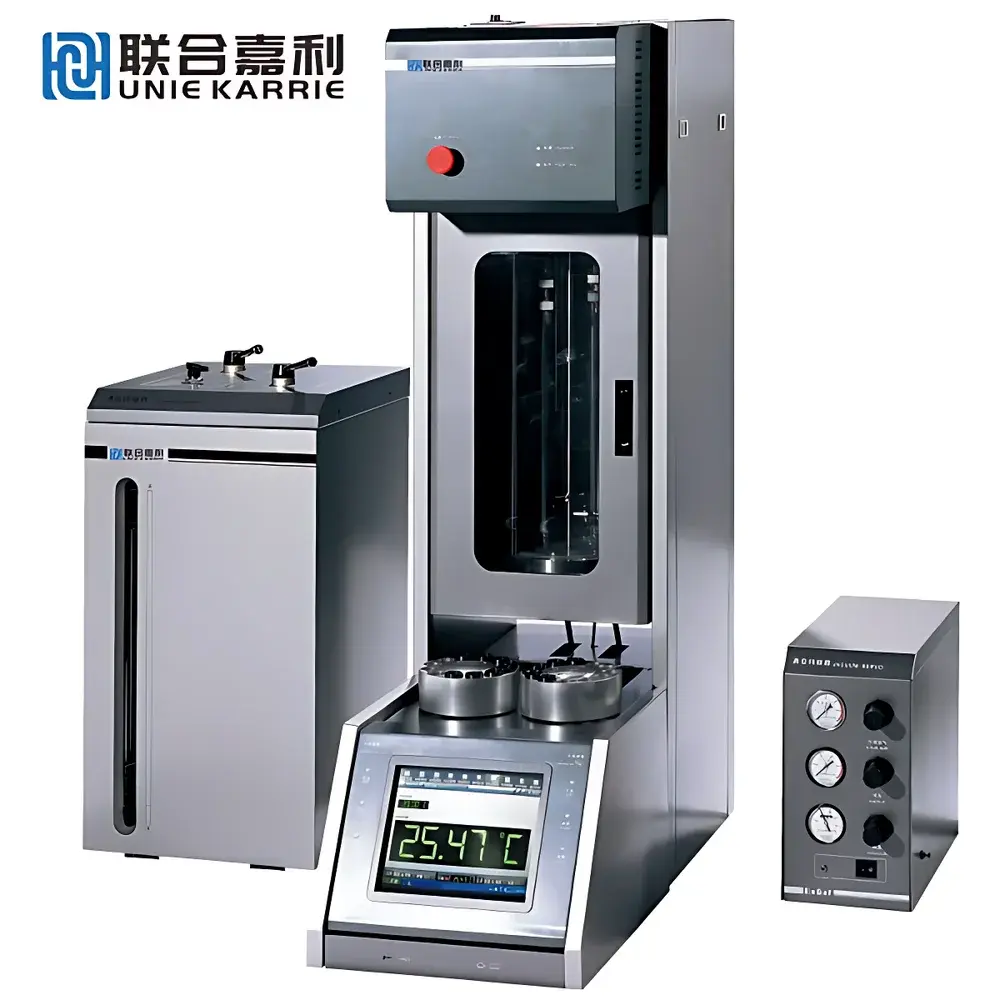
Karrie EKV-110 Fully Automated Kinematic Viscosity Tester
| Brand | Karrie |
|---|---|
| Model | EKV-110 |
| Compliance | ASTM D445, ISO 3104, GB/T 265 |
| Sample Capacity | 2 × 12 positions |
| Temperature Range | 20–100 °C (bath stability ±0.01 °C, resolution 0.01 °C) |
| Viscosity Range | 0.5–500 cSt, 10–1000 cSt, or 100–2000 cSt (dual-capillary configuration with triple-bulb design per viscometer) |
| Detection Method | Dual-mode — optical sensor & platinum RTD (PT100), timing resolution 0.01 s |
| Bath Medium | Silicone oil (long-life, non-replacement required) |
| Cooling Medium | Anhydrous ethanol |
| Power Supply | AC 220 V, 50 Hz |
| Total Power | 2000 W |
| Dimensions (W×D×H) | 1300 × 400 × 900 mm |
| Weight | 120 kg |
| Display | 10.4″ color TFT LCD (800 × 600), touch-enabled |
| Input | Waterproof metal keyboard, trackball, stylus |
| Data Interface | RS-232, USB 2.0, RJ-45 Ethernet |
| Operating System | Windows XP Embedded (English/Chinese bilingual UI) |
| Onboard Storage | 4 GB SSD, 1 GB RAM |
| Preheating Capability | Dual sample trays, up to 70 °C |
| Cleaning System | Dual-solvent (A/B), programmable cycles & duration |
| Drying | Compressed-air assisted, user-defined blow time & repetitions |
| Ambient Storage | –20 to 50 °C |
Overview
The Karrie EKV-110 Fully Automated Kinematic Viscosity Tester is an engineered solution for precise, high-throughput kinematic viscosity measurement of petroleum-based liquids—including crude oil, distillates, lubricants, fuel oils, and additives—under strict adherence to ASTM D445, ISO 3104, and GB/T 265 standards. It operates on the capillary efflux principle: a fixed volume of sample flows under gravity through a calibrated glass capillary tube immersed in a thermostatically controlled bath; kinematic viscosity (ν, in mm²/s or cSt) is calculated as ν = C × t, where C is the capillary constant (determined via certified reference oils) and t is the efflux time. The instrument integrates dual independent Ubbelohde-type viscometers—each featuring a triple-bulb design—to span three overlapping viscosity ranges (0.5–500 cSt, 10–1000 cSt, and 100–2000 cSt), enabling seamless analysis across light naphthas to heavy residual fuels without manual capillary swaps. Its single-bath, dual-viscometer architecture eliminates inter-bath thermal drift while maintaining ±0.01 °C temperature stability over the full 20–100 °C operating range—critical for reproducible results in regulatory-compliant testing environments.
Key Features
- Fully automated workflow: sample loading → auto-positioning → vacuum-assisted aspiration → bath immersion → timed efflux → solvent cleaning → compressed-air drying → repeat cycle—all unattended.
- Dual 12-position sample trays with independent preheating (up to 70 °C), supporting 24 samples per batch with programmable cup identification and priority sequencing.
- Dual detection methodology: high-precision optical sensors for transparent fluids and PT100-resolved thermal detection for opaque or dark samples (e.g., asphaltene-rich residuals), ensuring universal applicability.
- Robust hardware architecture: industrial-grade PC (1 GB RAM, 4 GB SSD, Windows XP Embedded) paired with real-time microcontroller for temperature regulation and timing-critical viscometry functions.
- Calibration traceability: each viscometer pre-calibrated using NIST-traceable Cannon-Ubbelohde standard oils; onboard software supports user-performed recalibration with certified reference materials.
- Integrated safety systems: overtemperature cutoff, power-fail recovery, vacuum pressure monitoring, and real-time diagnostic logging with audible/visual fault alerts.
Sample Compatibility & Compliance
The EKV-110 accommodates both transparent and opaque liquid petroleum products—including gasoline, diesel, jet fuel, base oils, hydraulic fluids, transformer oils, marine fuels, and refinery intermediates—without modification. Its dual-detection capability ensures reliable efflux timing even for highly pigmented or suspended-particle-laden samples that obscure optical paths. All mechanical, thermal, and timing performance parameters meet or exceed the repeatability (≤0.35% RSD) and reproducibility (≤0.7% RSD) requirements defined in ASTM D445 Annex A1 and ISO 3104 Clause 9. The system supports GLP/GMP-aligned operation: audit trails record operator ID, test parameters, calibration events, maintenance logs, and raw timing data with immutable timestamps. Optional 21 CFR Part 11 compliance modules are available for electronic signature enforcement and secure user-role management.
Software & Data Management
The embedded Windows-based control software provides intuitive bilingual (English/Chinese) navigation via 10.4″ resistive touchscreen, metal keyboard, and precision trackball. Test methods are stored as editable templates—including temperature setpoint, soak duration, replicate count (2–4), cleaning protocol (solvent A/B selection, cycle count, dwell time), and drying parameters. Raw efflux times, calculated kinematic viscosity values, statistical summaries (mean, SD, CV%), and pass/fail flags against method-defined limits are exported in CSV, PDF, or XML formats. Native RS-232, USB, and Ethernet interfaces enable direct integration with LIMS platforms or enterprise networks; HTTP server mode allows remote status monitoring via standard web browsers. All data files include embedded metadata (instrument ID, firmware version, calibration date, ambient conditions) to satisfy ISO/IEC 17025 documentation requirements.
Applications
The EKV-110 serves core quality control and research functions across upstream, midstream, and downstream petroleum operations. Refineries deploy it for feedstock characterization, distillation cut verification, and finished product release testing (e.g., ASTM D975 diesel, D1655 jet fuel). Lubricant manufacturers use it to monitor base stock consistency and additive package stability during blending. Independent testing labs rely on its dual-detection reliability for third-party certification of bunker fuels (ISO 8217) and marine distillates. In R&D settings, its programmable soak times and multi-replicate averaging support studies on temperature-dependent flow behavior, shear-thinning effects in multigrade oils, and oxidation-induced viscosity drift. The system also supports method development for non-standard matrices—such as biofuel blends or synthetic esters—via customizable timing thresholds and viscosity range mapping.
FAQ
Does the EKV-110 require periodic recalibration with certified reference oils?
Yes—per ASTM D445 Section 7.2 and ISO 3104 Clause 8.3, capillary viscometers must be verified at least daily using traceable standard oils covering the intended measurement range. The EKV-110 includes built-in calibration routines and stores calibration coefficients with date/time stamps.
Can the instrument operate unattended overnight?
Yes—its fault-tolerant architecture, automatic solvent recovery logic, and power-loss resume functionality support extended 24/7 operation. All 24 samples can be loaded prior to initiation, with completion alerts sent via system log or optional email gateway.
Is silicone oil bath medium compatible with long-term operation at 100 °C?
Yes—the specified high-stability methylphenyl silicone fluid maintains viscosity and thermal conductivity over >5,000 hours at 100 °C without degradation or replacement, as validated per ASTM D2879 thermal stability testing.
How is data integrity ensured for regulatory submissions?
Raw timing data, calculation parameters, and environmental logs are written directly to non-volatile memory with write-once-read-many (WORM) attributes. Optional 21 CFR Part 11 add-ons provide electronic signatures, role-based access control, and immutable audit trails compliant with FDA and EU Annex 11 requirements.
What maintenance intervals are recommended for the vacuum and air-drying subsystems?
Vacuum pump oil should be replaced every 6 months or 2,000 operating hours; air filters require quarterly inspection and replacement if clogged. The system’s self-diagnostic routine monitors pump vacuum level and airflow pressure to flag deviations before performance impact occurs.
Related Products




