
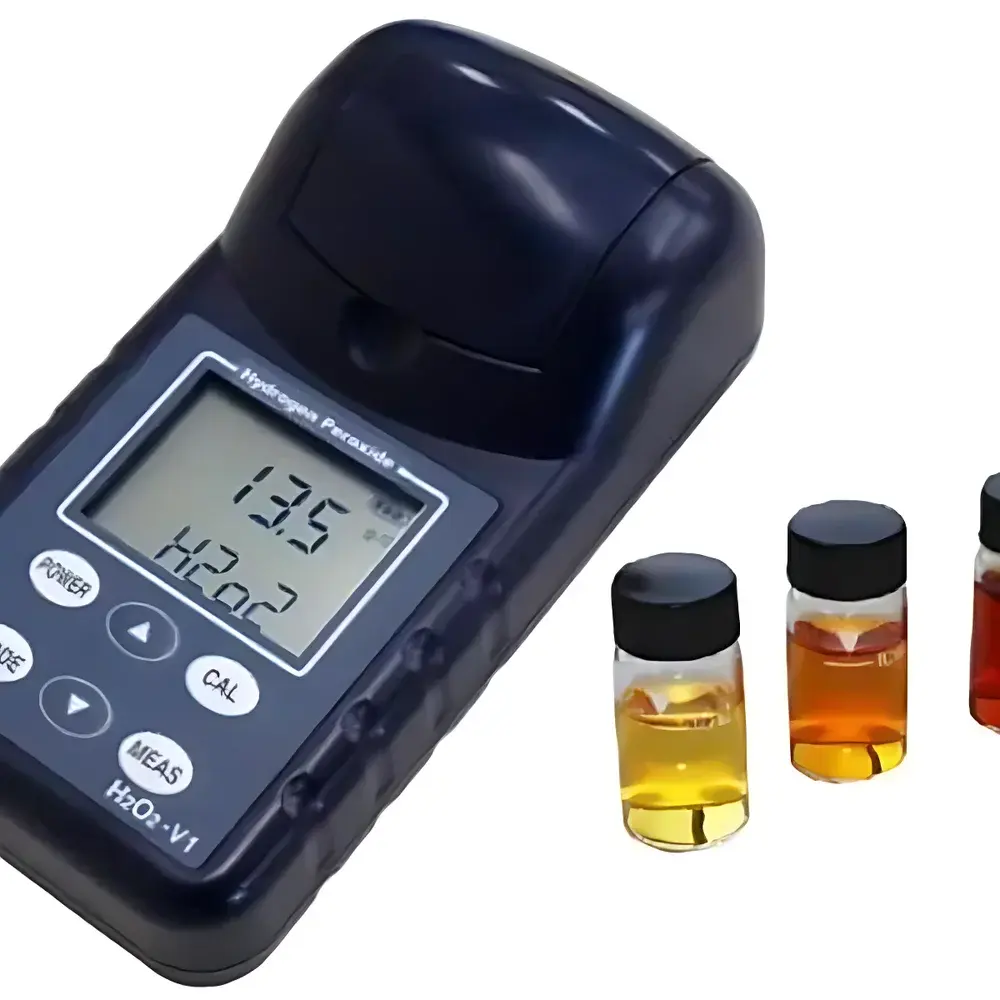
Kasuri H2O2-V2L Portable Photometric Hydrogen Peroxide Analyzer for Copper Plating Baths (Medium-Range)
| Brand | Kasuri |
|---|---|
| Origin | Japan |
| Model | H2O2-V2L |
| Measurement Range | 0–1200 mg/L |
| Resolution | 1 mg/L |
| Accuracy | ±5% FS |
| Repeatability | ±5% FS |
| Response Time | <5 s after power-on |
| Auto-off | After 5 s hold of measurement button |
| Dimensions | 88 × 174 × 65 mm |
| Weight | ~310 g |
| Power | 4× AAA alkaline batteries (DC 6 V) |
| Measurement Method | LED-based photometry with dual-wavelength compensation |
| Calibration | Zero-point calibration standard |
| Sample Compatibility | Aqueous copper plating electrolytes containing Cu²⁺, Fe²⁺/Fe³⁺, Ni²⁺, Cr⁶⁺/Cr³⁺ |
| Compliance | Designed per JIS K 0121 and ISO 15705 for photometric water analysis in industrial process control |
Overview
The Kasuri H2O2-V2L is a dedicated, portable photometric analyzer engineered for rapid, interference-resistant quantification of hydrogen peroxide (H₂O₂) in acidic copper electroplating baths. Unlike conventional titrimetric or enzymatic methods, the H2O2-V2L employs a stabilized dual-wavelength LED photometric system operating at optimized absorbance bands (typically 405 nm and reference wavelength >600 nm) to selectively detect the iodide-catalyzed oxidation product formed in the presence of H₂O₂—eliminating reliance on operator skill, reagent stoichiometry, or endpoint interpretation. Its optical architecture incorporates temperature-compensated photodiode detection and factory-aligned optical path geometry, ensuring consistent performance across varying bath temperatures (15–40 °C) and ionic strengths typical of acid sulfate copper plating solutions (e.g., 180–220 g/L CuSO₄·5H₂O, 50–70 g/L H₂SO₄). The instrument delivers traceable results within the medium-range specification of 0–1200 mg/L H₂O₂, with 1 mg/L digital resolution and ≤±5% full-scale repeatability under GLP-aligned field conditions.
Key Features
- Interference-immune photometry: Engineered to suppress spectral overlap from Cu²⁺ (blue-green absorption), Fe³⁺ (yellow-brown), Ni²⁺ (green), and Cr⁶⁺ (orange), enabling direct measurement without sample dilution or matrix masking agents.
- Zero-maintenance optical core: Solid-state LED light source with ≥10,000-hour lifetime; no lamp replacement or warm-up delay required.
- Field-optimized ergonomics: Compact housing (88 × 174 × 65 mm), 310 g mass, and integrated carry case support routine in-line monitoring at plating line stations or QC labs.
- Self-diagnostic firmware: Real-time monitoring of battery voltage, photodiode signal drift, LED output degradation, and calibration validity—alerts displayed via LED status indicators.
- Minimal consumables workflow: Requires only one proprietary reagent (H2O2-V2-RA) and standardized 10-mm pathlength cuvettes; no glassware cleaning or volumetric pipetting.
- Regulatory-ready operation: Supports audit-trail-capable calibration logging when paired with Kasuri’s optional PC interface software (sold separately).
Sample Compatibility & Compliance
The H2O2-V2L is validated for use in operational copper plating electrolytes conforming to IPC-4552A and ASTM B841 specifications. It maintains accuracy in solutions containing up to 250 g/L total dissolved solids, pH 0.5–2.0, and redox potentials between +300 mV and +650 mV (vs. Ag/AgCl). Interference testing per ISO 15705 Annex D confirms ≤±3% bias in presence of 10–500 mg/L Fe²⁺/Fe³⁺, 5–200 mg/L Ni²⁺, and 1–50 mg/L Cr⁶⁺. While not CE-marked for EU environmental monitoring, the device meets JIS K 0121:2020 requirements for industrial water quality analyzers and supports compliance with internal QA/QC protocols aligned with ISO/IEC 17025 and IATF 16949 manufacturing standards.
Software & Data Management
The H2O2-V2L operates as a standalone instrument with embedded firmware (v2.3+). Raw absorbance values and calculated concentrations are stored in non-volatile memory (up to 256 records) with timestamp and operator ID fields. Optional Kasuri DataLink v3.1 software (Windows 10/11) enables USB-C export of CSV-formatted datasets, trend charting, calibration certificate generation, and electronic signature capture per FDA 21 CFR Part 11 requirements. All calibration events—including zero adjustment and span verification using NIST-traceable H₂O₂ standard solutions—are time-stamped and archived with checksum validation.
Applications
- Real-time H₂O₂ dosing control in acid copper electroplating lines to maintain optimal micro-throwing power and reduce void formation in through-hole vias.
- Preventive maintenance monitoring of peroxide decomposition rates in recirculated bath systems, supporting predictive replenishment scheduling.
- Validation of H₂O₂ scavenger efficacy during bath purification cycles (e.g., activated carbon treatment).
- Technical support documentation for IPC-A-600 and IPC-6012 qualification reports requiring documented oxidant concentration stability.
- Teaching laboratories demonstrating redox chemistry principles in electrochemical process engineering curricula.
FAQ
Does the H2O2-V2L require daily recalibration?
No—zero-point calibration is recommended before first use each day or after ambient temperature shifts >5 °C; span calibration is only necessary if long-term drift exceeds ±3% FS or after reagent lot changes.
Can it measure H₂O₂ in alkaline plating baths?
No—the assay chemistry is optimized for acidic media (pH <2.5); alkaline or cyanide-based copper baths require alternative analytical methods such as ion chromatography or amperometric sensors.
Is the H2O2-V2-RA reagent stable after opening?
Yes—when stored refrigerated (2–8 °C) in its original amber bottle with intact septum seal, the reagent retains full activity for ≥12 months; discard if discoloration or precipitate forms.
What is the shelf life of the factory-calibrated cuvettes?
The supplied quartz-equivalent polymer cuvettes exhibit no measurable optical aging over 5 years when protected from UV exposure and mechanical scratching.
How does the instrument handle turbid or particulate-laden samples?
The dual-wavelength algorithm corrects for nonspecific scattering up to NTU 30; for samples exceeding this, centrifugation or filtration through 0.45-µm PVDF membrane is advised prior to analysis.
Related Products







