
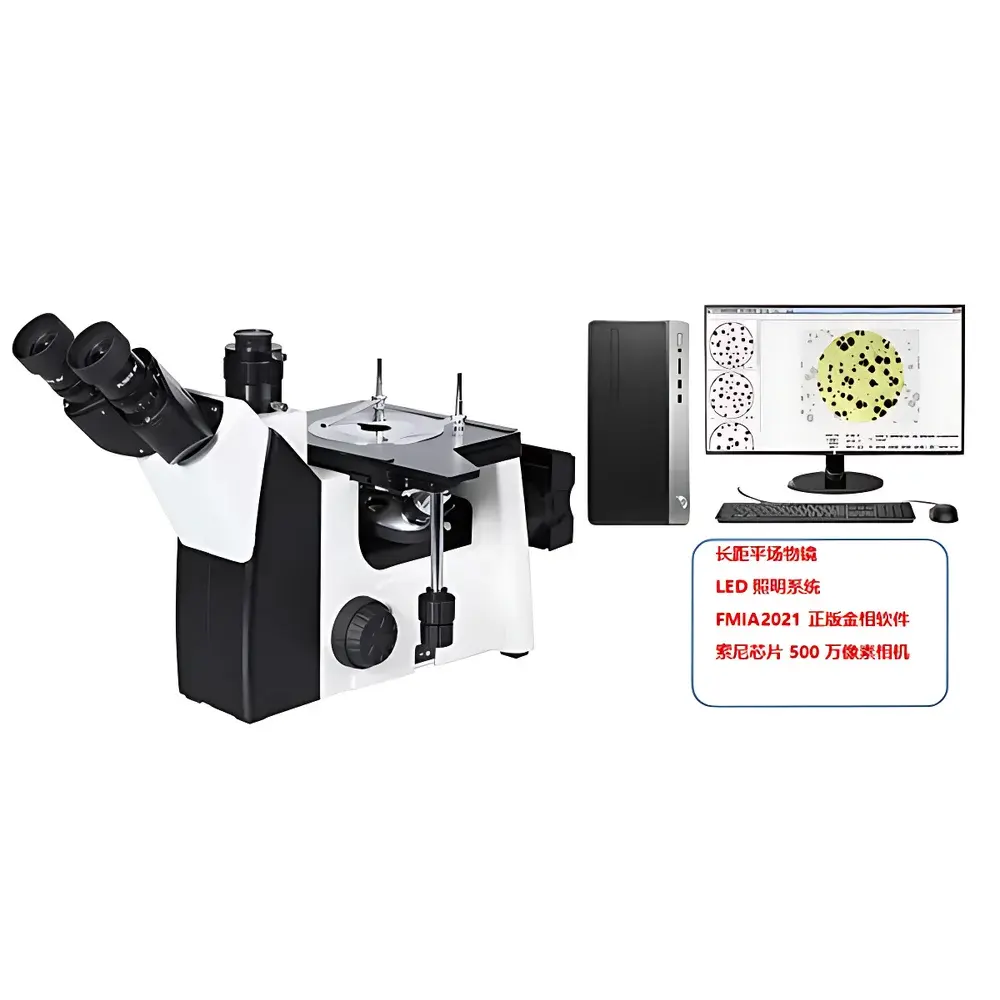
KB KCM-2000W Inverted Metallurgical Microscope
| Brand | KB |
|---|---|
| Origin | Zhejiang, China |
| Manufacturer Type | OEM/ODM Manufacturer |
| Regional Classification | Domestic (China) |
| Model | KCM-2000W |
| Price Range | USD 1,400–2,800 |
| Configuration | Inverted |
| Integrated Image Analysis System | Yes |
| Total Magnification Range | 50×–500× |
| Eyepieces | 10× wide-field plan eyepieces (18 mm field number) |
| Objectives | 5×, 10×, 20×, 50× long-working-distance achromat objectives (LMPL series) |
| Focusing Mechanism | Coaxial coarse/fine focus with 38 mm coarse travel and 2 µm fine adjustment increment |
| Stage | 180 × 155 mm mechanical three-layer stage, right-hand control, 75 × 40 mm travel range |
| Illumination | Reflected Köhler LED illumination (5 W warm-white LED, 100–240 V AC auto-ranging) with adjustable aperture and field diaphragms |
| Optional Light Source | 6 V / 30 W halogen lamp |
| Standard Software | FMIA2021 metallurgical image analysis suite with 700+ standardized modules compliant with ASTM E112, E3, E1245, ISO 643, ISO 6892-1, GB/T 6394, GB/T 13298, and other metallurgical standard protocols |
Overview
The KB KCM-2000W Inverted Metallurgical Microscope is engineered for high-fidelity microstructural characterization of opaque, polished metallic and alloy specimens. Its inverted optical configuration positions the objective lenses beneath the specimen stage—enabling unobstructed access to large, heavy, or irregularly shaped samples such as castings, forgings, weldments, and coated substrates. This architecture eliminates the need for specimen mounting in vertical orientation, significantly improving workflow efficiency in quality control laboratories and metallurgical R&D environments. The system employs a finite-conjugate achromatic optical path optimized for reflected-light contrast techniques—including brightfield, darkfield, and polarized light imaging—ensuring consistent resolution, minimal chromatic aberration, and high depth-of-field across the full magnification range (50× to 500×). Designed for compliance with international metallurgical testing standards, the KCM-2000W supports routine evaluation of grain size (ASTM E112), inclusion rating (ASTM E45), phase distribution, porosity, coating thickness, and heat-affected zone morphology.
Key Features
- Inverted trinocular head with 45° inclination, interpupillary adjustment range of 54–75 mm, and 80:20 beam-splitting ratio for simultaneous visual observation and digital imaging
- Long-working-distance LMPL series objectives (5×/0.13, 10×/0.25, 20×/0.40, 50×/0.60) providing ≥5.1 mm working distance at highest magnification—ideal for thick specimens and stage-mounted accessories
- Coaxial coarse/fine focusing mechanism with ergonomic low-position controls on both left and right sides; coarse travel: 38 mm per revolution; fine adjustment resolution: 2 µm per division
- 180 × 155 mm three-layer mechanical stage with right-hand drive, offering 75 × 40 mm linear travel and precision positioning for repeatable field-of-view registration
- Reflected Köhler illumination system featuring a 5 W warm-white LED source (100–240 V AC universal input), continuously variable intensity control, and independently adjustable aperture and field diaphragms for optimal contrast and uniformity
- Standard filter set includes yellow, green, blue, and ground-glass filters for spectral contrast enhancement and glare reduction
Sample Compatibility & Compliance
The KCM-2000W accommodates specimens up to 30 mm in height and 150 mm in diameter without interference from objective lenses or condenser assemblies. Its inverted design supports direct examination of mounted cross-sections, bulk components, electroplated surfaces, thermal spray coatings, and sintered ceramics—without requiring secondary embedding or thin-sectioning. The system meets mechanical and optical requirements specified in ASTM E883 (Guide for Reflected Light Photomicrography), ISO 643 (Metallographic Determination of Ferrite Grain Size), and GB/T 13298 (Metallographic Examination of Metals). When equipped with optional polarizing accessories (fixed analyzer and rotatable polarizer), it enables birefringence-based phase identification in duplex stainless steels, titanium alloys, and intermetallic compounds—supporting ISO 80000-7 and ASTM E112 Annex A2 methodologies.
Software & Data Management
The microscope integrates with FMIA2021—a CE-certified, Windows-based metallurgical image analysis platform developed in accordance with ISO/IEC 17025 and FDA 21 CFR Part 11 principles. The software includes over 700 standardized analysis modules aligned with ASTM, ISO, GB/T, and JIS metallurgical standards—including grain sizing (linear intercept, planimetric), inclusion classification (ASTM E45 Type A–D), second-phase quantification, and coating thickness measurement via edge-detection algorithms. All modules are accessible for lifetime use with no subscription fees; updates are provided free of charge to maintain alignment with evolving national and international standards. Audit trails, user-level permissions, electronic signatures, and raw-data export (TIFF, BMP, CSV) ensure traceability and regulatory readiness in GLP/GMP environments. The system interfaces natively with Sony ICX274AQ 5-megapixel progressive-scan cameras via USB 3.0 and supports calibration using NIST-traceable stage micrometers (100 × 0.01 mm and 100 × 0.01 cm scales).
Applications
- Quality assurance of cast iron, aluminum alloys, and superalloys in foundry and aerospace manufacturing
- Evaluation of carburized, nitrided, and induction-hardened case depths per ASTM E1077
- Failure analysis of fatigue cracks, stress corrosion cracking, and hydrogen embrittlement in pipeline and pressure vessel steels
- Characterization of thermal barrier coatings (TBCs), PVD/CVD layers, and anodized aluminum surfaces
- Microstructural assessment of additive-manufactured (AM) metal parts—including porosity mapping, melt pool geometry, and residual stress-induced dislocation patterns
- Geological petrographic analysis of ore minerals and synthetic refractories under reflected light
FAQ
Is the KCM-2000W compatible with third-party image analysis software?
Yes—the microscope outputs standard USB video streams and supports TWAIN-compliant acquisition. Users may integrate alternative platforms such as ImageJ (with MetalJ plugin), Olympus Stream, or Thermo Scientific CellSens via SDK or generic camera drivers.
What is the maximum specimen weight supported by the mechanical stage?
The reinforced stage assembly supports specimens weighing up to 5 kg without compromising positional stability or focus repeatability.
Does the system include calibration documentation for ISO/IEC 17025 accreditation?
A factory-issued calibration certificate (including stage scale verification, magnification accuracy test report, and illumination uniformity map) is supplied with each unit. On-site metrological validation services are available upon request.
Can the LED illumination be replaced with a halogen source without hardware modification?
Yes—the base module accepts either the standard 5 W LED board or the optional 6 V / 30 W halogen lamp assembly using the same power interface and heat-sink mount.
Is remote operation supported for multi-user lab environments?
FMIA2021 supports network deployment via shared folder or SQL Server backend, enabling concurrent access, centralized database management, and role-based reporting—fully compatible with institutional IT infrastructure.



