
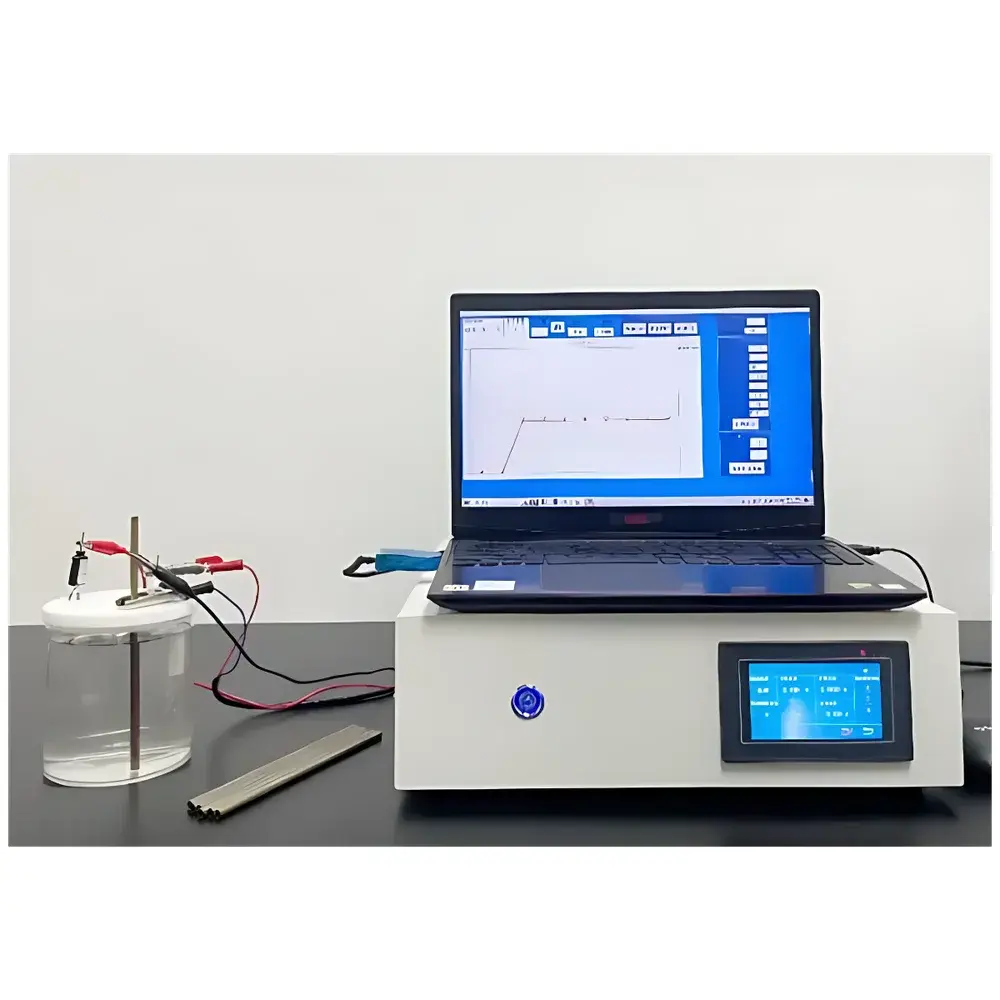
KB KYH-1000 Electrolytic Thickness Gauge for Copper Oxide Films
| Brand | KB |
|---|---|
| Model | KYH-1000 |
| Type | Coulometric Electrolytic Thickness Gauge |
| Measurement Principle | Controlled-potential anodic dissolution (ASTM B504, ISO 2177) |
| Measurable Layers | Cu₂O and CuO on copper substrates |
| Thickness Range | 0.00001–6 µm |
| Resolution | 0.00001 µm |
| Voltage Output | 0–5 V DC, digitally adjustable |
| Current Output | 0–100 mA DC |
| Voltage Resolution | 1 mV |
| Current Resolution | 0.1 mA |
| Sample Diameter Range | 1–25 mm |
| Power Supply | AC 220 V, 50 Hz |
| Dimensions (W×D×H) | 440 × 410 × 135 mm |
| Compliance | NB/T 10194–2019 (Chinese National Standard for Electrolytic Measurement of Copper Oxide Films) |
| Software | KB-ThickControl v3.x with audit trail, data export (CSV, PDF), statistical analysis (mean, SD, CPK), and GLP-compliant user access control |
Overview
The KB KYH-1000 Electrolytic Thickness Gauge for Copper Oxide Films is a precision coulometric instrument engineered for the quantitative determination of oxide layer thickness—specifically cuprous oxide (Cu₂O) and cupric oxide (CuO)—on copper conductors, rods, and wire surfaces. It operates on the principle of controlled-potential anodic dissolution: a precisely regulated direct current is applied between a platinum counter electrode and the copper substrate (serving as the working electrode), while a reference electrode monitors interfacial potential. Under optimized electrolyte conditions (typically dilute phosphoric or sulfuric acid), the oxide film dissolves stoichiometrically according to Faraday’s law. The integrated charge (Q = ∫I·dt) consumed during complete removal of the oxide layer is directly proportional to its mass and, by known density and molar volume, to its geometric thickness. This method eliminates dependence on optical contrast, surface roughness, or substrate conductivity—making it uniquely suited for quality assurance in copper rod manufacturing, electrical conductor processing, and high-reliability cable production where nanoscale oxide uniformity directly impacts solderability, bonding integrity, and long-term corrosion resistance.
Key Features
- Integrated 7-inch capacitive touchscreen interface with intuitive workflow navigation and real-time parameter monitoring.
- Dual-mode electrochemical control: selectable constant-current (CC) or constant-voltage (CV) operation, each with programmable ramping and hold profiles.
- High-fidelity analog front-end: low-noise, low-ripple DC power supply with voltage resolution of 1 mV and current resolution of 0.1 mA—ensuring reproducible dissolution kinetics across repeated measurements.
- Automated endpoint detection via real-time current-voltage curve analysis, minimizing operator subjectivity and enabling unattended batch measurement.
- Onboard statistical engine: automatic calculation of mean thickness, standard deviation, coefficient of variation (CV%), process capability indices (Cp/Cpk), and outlier flagging per ASTM E29 and ISO 5725.
- Comprehensive hardware protection: overvoltage, overtemperature, and AC input undervoltage/overvoltage safeguards compliant with IEC 61000-4-5 surge immunity requirements.
- Modular electrode assembly: standardized Pt counter electrode, Ag/AgCl reference electrode with Luggin capillary, and custom-fit sample holder accommodating 1–25 mm diameter copper rods without reconfiguration.
Sample Compatibility & Compliance
The KYH-1000 is validated for use on oxygen-free copper (OFC), electrolytic-tough-pitch (ETP) copper, and phosphorus-deoxidized copper substrates. It conforms to NB/T 10194–2019, the Chinese national standard governing electrolytic measurement of copper oxide films in industrial wire and rod production. While not certified to ISO/IEC 17025, the instrument’s architecture supports GLP and GMP-aligned workflows: all measurements are timestamped, user-logged, and stored with full metadata (electrolyte lot, temperature, electrode calibration date). Its dissolution protocol aligns with the fundamental principles of ASTM B504 (standard test method for measuring coating thickness by coulometric methods) and ISO 2177 (metallic coatings—measurement of coating thickness—coulometric method), ensuring technical interoperability with international QA/QC laboratories.
Software & Data Management
KB-ThickControl v3.x is a Windows-based application designed for traceable, auditable thickness analysis. It features role-based user authentication (admin/operator), electronic signature support, and 21 CFR Part 11–compatible audit trails—including immutable records of parameter changes, measurement start/stop events, and manual overrides. Data exports include CSV (for SPC integration), PDF reports with embedded calibration certificates, and XML for LIMS ingestion. All raw current-time and voltage-time curves are retained with 100 Hz sampling resolution. The software includes built-in calibration verification routines using certified Cu₂O reference standards (traceable to NIM, China) and supports periodic system suitability testing per internal SOPs.
Applications
- Quality control of oxide thickness on copper rods prior to drawing or stranding—ensuring optimal lubricity and die life.
- Validation of annealing atmosphere control (O₂ partial pressure, dew point) in continuous rod lines by correlating oxide stoichiometry (Cu₂O vs. CuO ratio) with thickness profiles.
- R&D studies on oxidation kinetics under varying temperature, humidity, and storage duration—supporting shelf-life modeling for bare copper conductors.
- Failure analysis of solder joint voiding or wire bond lift-off linked to non-uniform oxide growth.
- Supplier qualification audits requiring objective, non-destructive verification of surface oxide specifications per IPC-STD-004 or JIS H 3100.
FAQ
What electrolyte is required for Cu₂O/CuO measurement?
Aqueous 0.1 M phosphoric acid (H₃PO₄) is recommended per NB/T 10194–2019; alternative formulations (e.g., 0.05 M H₂SO₄) may be used with method validation.
Is the instrument suitable for measuring oxide on copper-clad laminates?
No—the KYH-1000 is calibrated exclusively for bulk copper substrates (diameter ≥1 mm); thin-film or composite substrates require cross-validation and are outside its scope of accreditation.
How often must the reference electrode be recalibrated?
Calibration against a fresh Ag/AgCl reference is recommended before each 8-hour shift or after 20 measurements, whichever occurs first; drift exceeding ±2 mV invalidates prior results.
Can the software generate SPC charts directly?
Yes—X̄-R and individual/moving-range charts are auto-generated with control limits calculated per AIAG SPC manual; Cp/Cpk values update dynamically with new data.
Does the system support networked deployment in a shared lab environment?
KB-ThickControl supports concurrent multi-user access via Windows domain authentication; database storage is configurable to local SQL Server Express or enterprise SQL Server instances.



