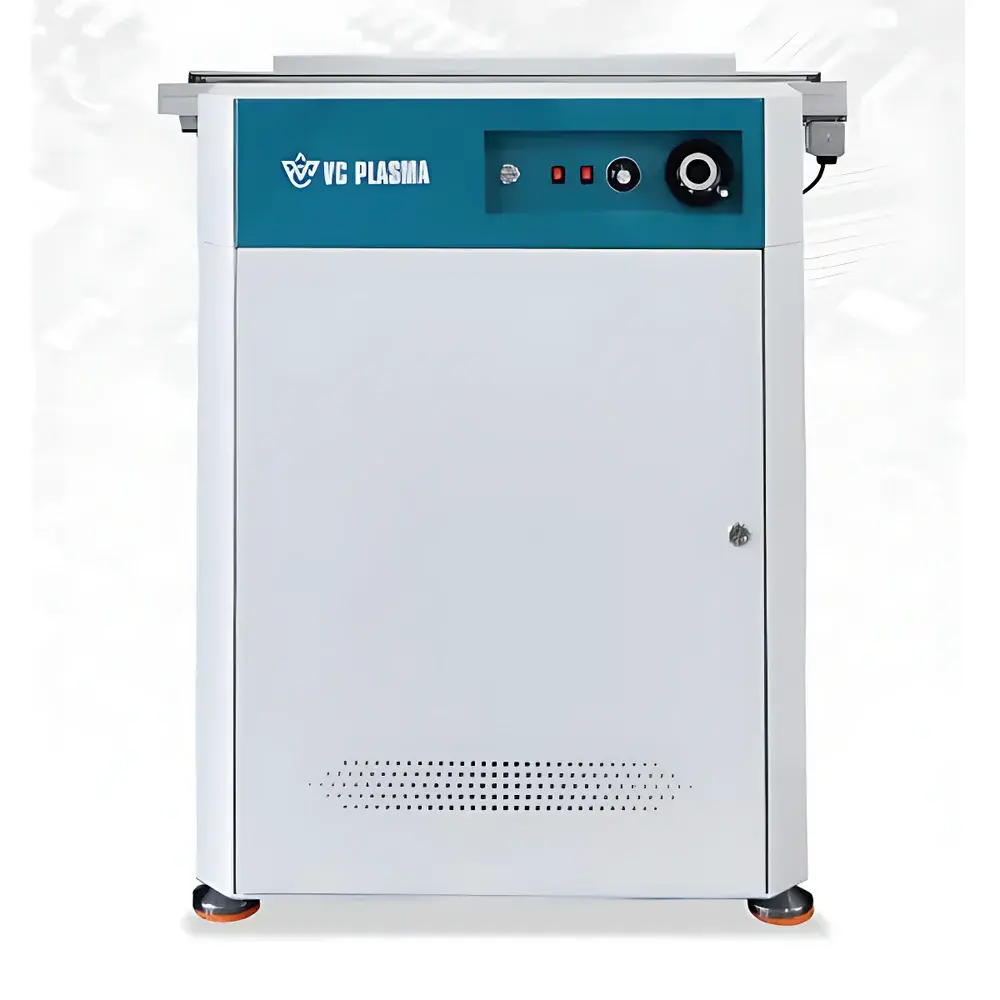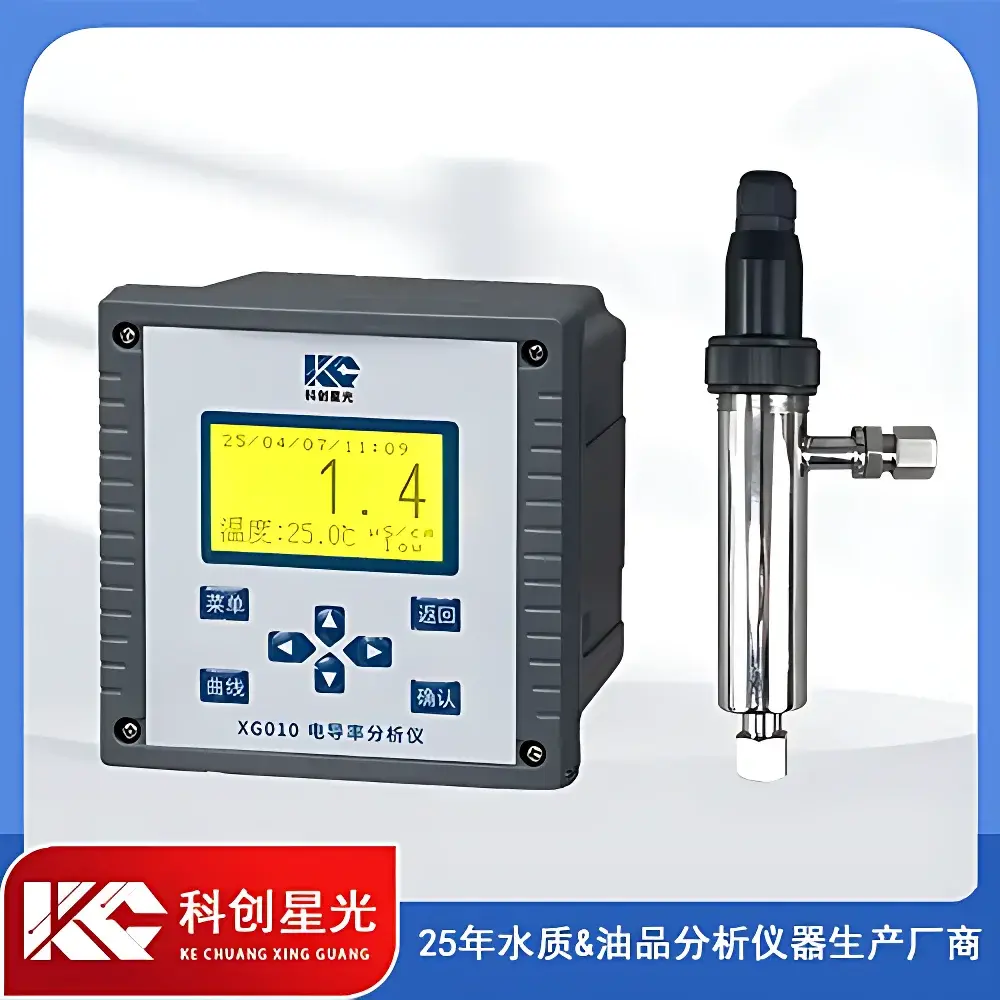
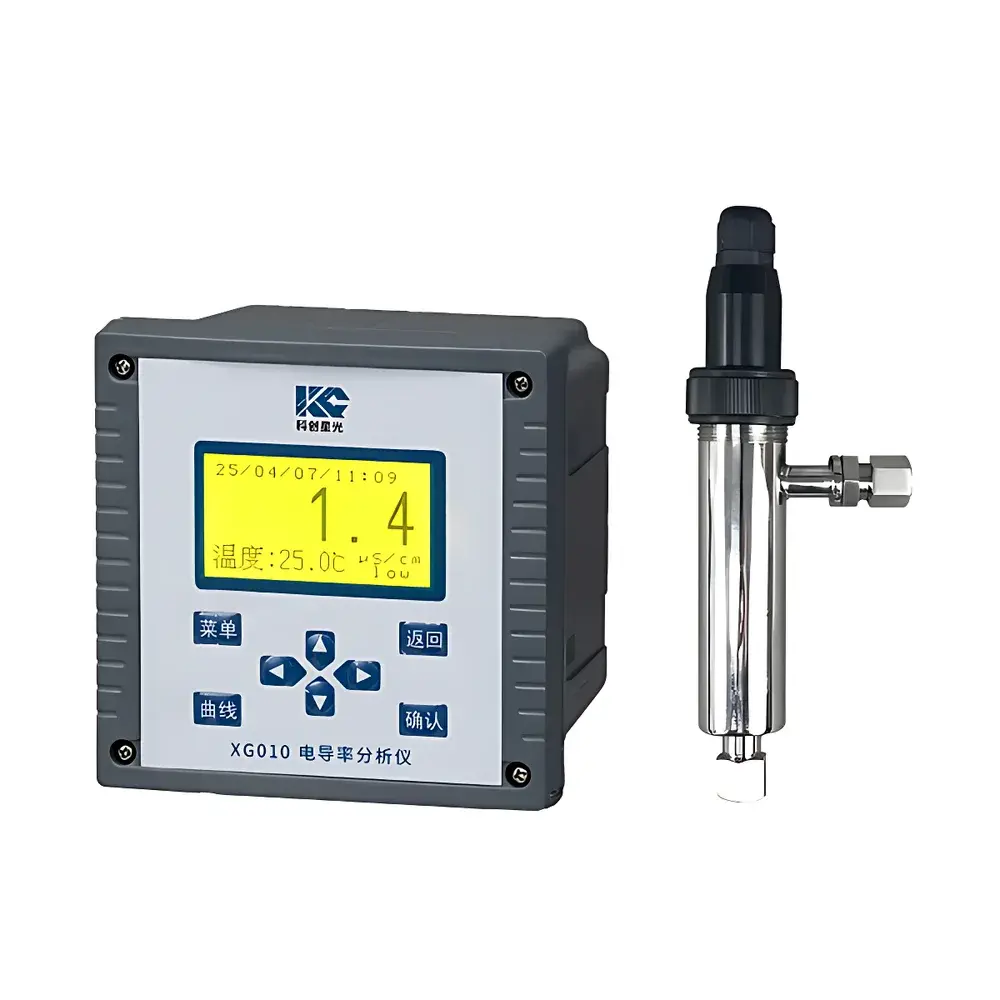
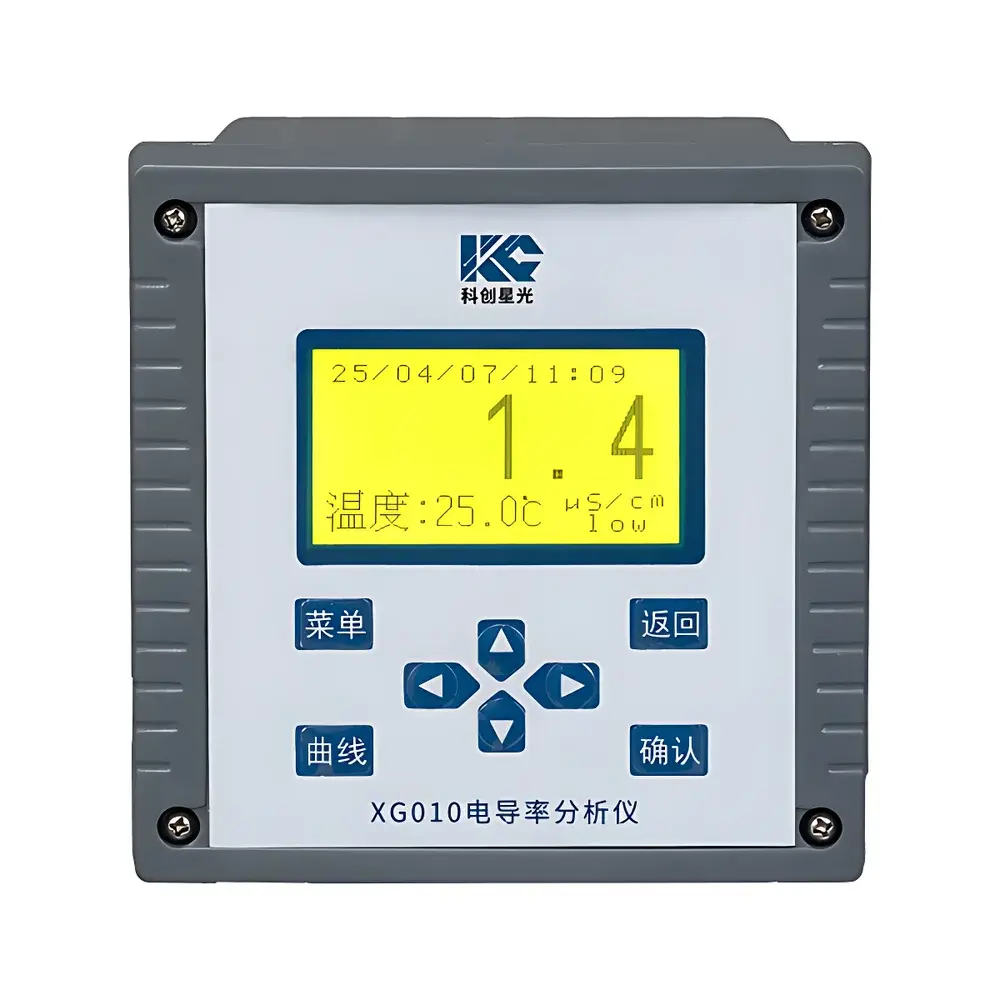
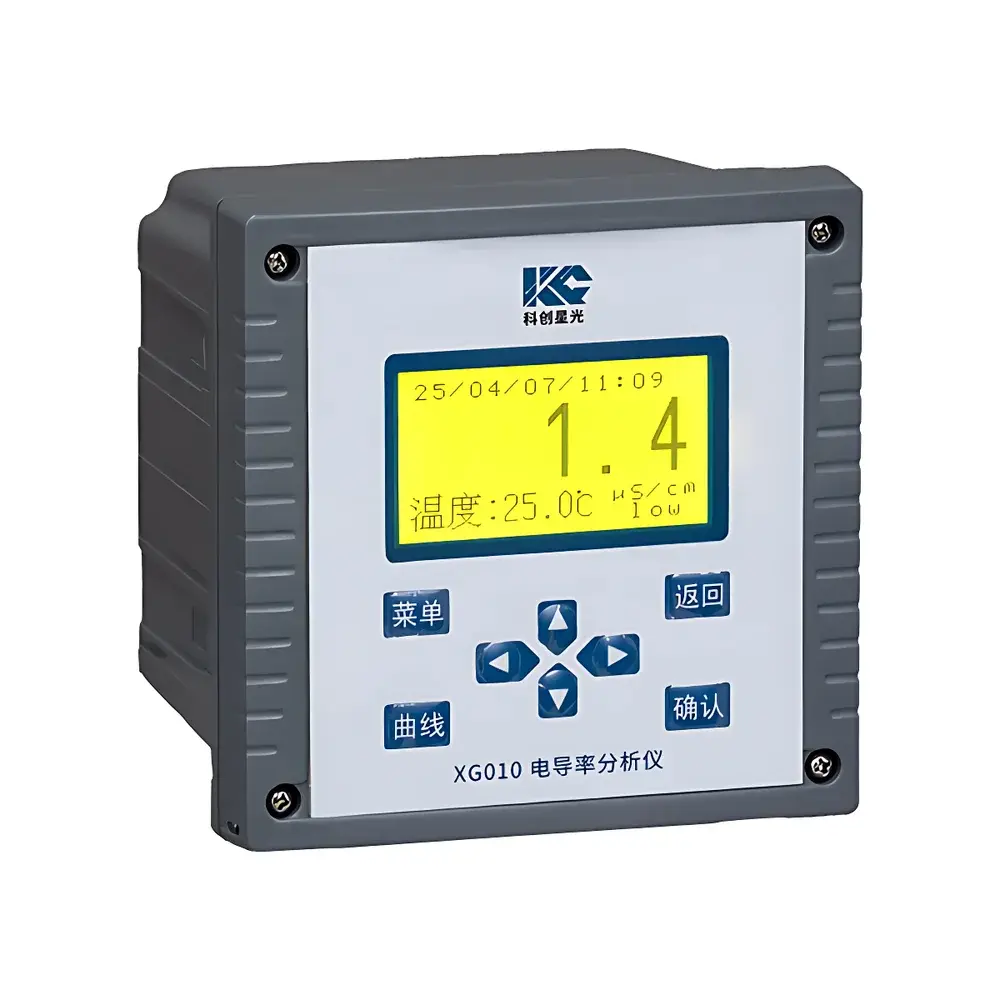
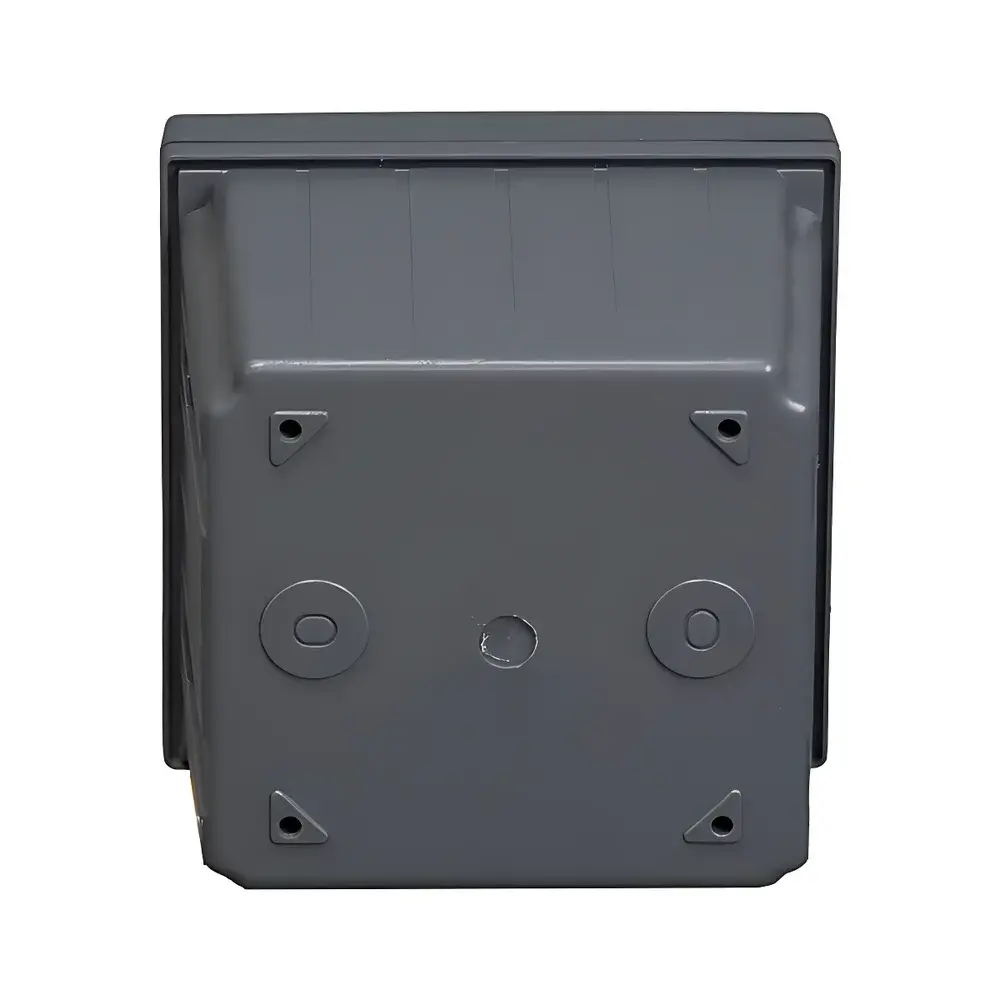
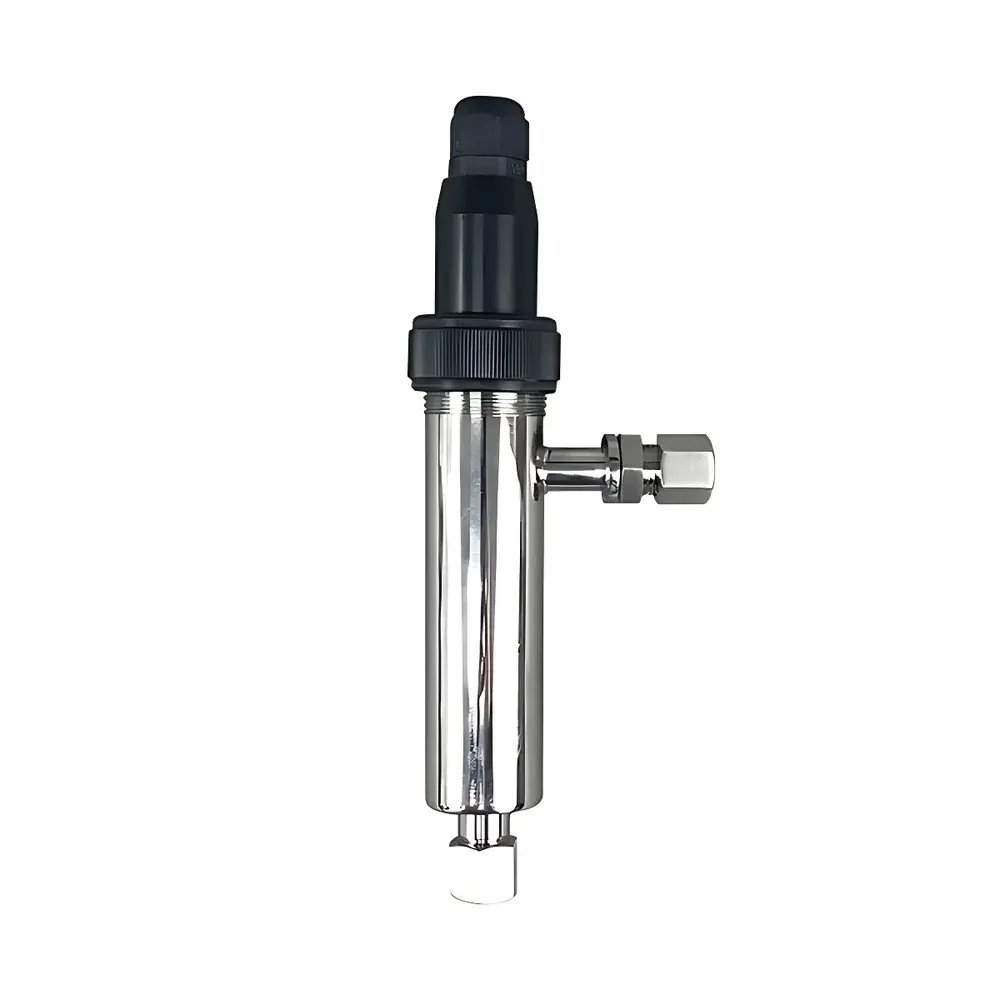
KC Starlight XG-010 Online Conductivity Analyzer
| Brand | KC Starlight |
|---|---|
| Origin | Beijing, China |
| Manufacturer Type | Direct Manufacturer |
| Model | XG-010 |
| Conductivity Range (� | S/cm): K=0.01 cm⁻¹: 0.000–2.000 & 0.00–20.00 μS/cm |
| K=0.10 cm⁻¹ | 0.00–20.00 & 0.0–200.0 μS/cm |
| K=1.00 cm⁻¹ | 0.0–200.0 & 0–2000 μS/cm |
| K=10.0 cm⁻¹ | 0–2000 & 0–20000 μS/cm |
| Temperature Range | 5–60 °C |
| Basic Accuracy | ±2.5% F.S. |
| Resolution | 0.001 μS/cm |
| Dimensions | 145 mm × 120 mm × 145 mm (L×D×H) |
| Weight | 0.63 kg |
Overview
The KC Starlight XG-010 Online Conductivity Analyzer is a robust, microprocessor-based industrial process instrument engineered for continuous, real-time measurement of aqueous solution conductivity in demanding production and utility environments. Operating on the principle of two-electrode or four-electrode conductometric sensing—depending on cell constant selection—the analyzer delivers stable, temperature-compensated readings across a wide dynamic range (0.000 μS/cm to 20,000 μS/cm), configurable via interchangeable conductivity cells with standardized cell constants (K = 0.01, 0.10, 1.00, and 10.0 cm⁻¹). Its design adheres to fundamental electrochemical measurement standards, ensuring compliance with routine calibration traceability protocols required in water treatment, boiler feedwater monitoring, pharmaceutical utilities (PW/WFI), and chemical dosing control loops. The integrated Pt1000 temperature sensor enables automatic linear or non-linear (configurable) temperature compensation per ASTM D1125 and ISO 7888 guidelines, minimizing thermal drift under varying process conditions.
Key Features
- High-stability composite conductivity sensor with precision-matched electrode geometry and low-noise signal conditioning circuitry
- Automatic temperature compensation (ATC) using embedded Pt1000 RTD; compensation range: 0–60.0 °C, with ±0.5 °C sensor accuracy
- Dual independent relay outputs (AC220V/3A or DC30V/3A), fully programmable for high/low limit alarms or system interlocks
- Three selectable analog current outputs: 0–10 mA, 0–20 mA, or 4–20 mA (load ≤750 Ω), optically isolated for EMI resilience in electrically noisy plant environments
- Non-volatile flash memory supporting >10-year data retention without power; circular buffer stores timestamped conductivity and temperature values with automatic overwrite
- 128×64 dot-matrix LCD with native Chinese character support—designed for intuitive local operation in multilingual industrial settings without reliance on external PCs
- IP65-rated front panel enclosure; operating ambient temperature: 5–45 °C; relative humidity ≤85% RH (non-condensing); maximum sample pressure: 0.6 MPa
Sample Compatibility & Compliance
The XG-010 is validated for use with low-to-medium conductivity aqueous streams—including deionized water, cooling tower makeup, reverse osmosis permeate, condensate polishing loops, and clean-in-place (CIP) rinse solutions. It is not intended for highly viscous, suspended-solid-laden, or strongly oxidizing media without appropriate pre-filtration or flow-cell adaptation. While not certified to IEC 61508 or SIL levels out-of-the-box, its hardware architecture supports integration into safety-related systems when deployed with external logic solvers. The device conforms to EMC Directive 2014/30/EU (EN 61326-1) and Low Voltage Directive 2014/35/EU (EN 61010-1). Calibration procedures align with ISO/IEC 17025-recommended practices, and documentation supports audit readiness for GMP (21 CFR Part 211), GLP, and ISO 9001 quality management systems.
Software & Data Management
No proprietary PC software is required for basic operation; all configuration, calibration, and alarm setup are performed locally via the front-panel keypad and LCD interface. However, optional Modbus RTU (RS-485) communication is available upon request, enabling integration into SCADA, DCS, or MES platforms for centralized data logging and trending. Audit trail functionality is implemented at firmware level: every parameter change, calibration event, or relay activation is timestamped and stored in non-volatile memory. While native FDA 21 CFR Part 11 electronic signature compliance is not embedded, the device’s deterministic behavior, immutable log structure, and secure access control (via password-protected configuration mode) provide foundational elements for regulated environment validation.
Applications
- Real-time monitoring of ultrapure water (UPW) resistivity in semiconductor fab utilities
- Boiler feedwater purity verification to prevent scaling and corrosion in power generation
- Continuous conductivity surveillance in pharmaceutical purified water (PW) and water-for-injection (WFI) distribution loops
- Concentration control of acid/base solutions in chemical dosing skids
- Leak detection in double-containment piping systems via conductivity spike analysis
- Effluent discharge compliance tracking against local environmental regulatory thresholds (e.g., EPA 40 CFR Part 136)
FAQ
What cell constants are supported, and how do they affect measurement range?
The XG-010 supports four standardized cell constants: K = 0.01, 0.10, 1.00, and 10.0 cm⁻¹. Lower K-values optimize sensitivity for ultralow-conductivity applications (e.g., UPW), while higher K-values extend upper-range capability for brines or concentrated electrolytes.
Is temperature compensation mandatory, and what algorithms are used?
Yes—temperature compensation is enabled by default using a user-selectable linear or nonlinear (NaCl-based) algorithm per ISO 7888 Annex B. Compensation parameters are field-adjustable to match specific solution chemistries.
Can the device be calibrated in-situ without removing the sensor?
Yes—two-point calibration (zero and span) is supported using standard KCl reference solutions directly in the process line, provided flow velocity and temperature are stabilized during procedure.
Does the unit meet hazardous area classification requirements?
No—the XG-010 is rated for general-purpose use only (non-explosion-proof). For Zone 1/2 or Class I Div 1 installations, it must be housed in an approved barrier enclosure or paired with an intrinsically safe transmitter module.
How is data integrity ensured during power interruption?
All critical configuration parameters, calibration coefficients, and the last 1,000 logged measurements are retained in EEPROM with no battery backup required; retention life exceeds 10 years at 25 °C.
Related Products