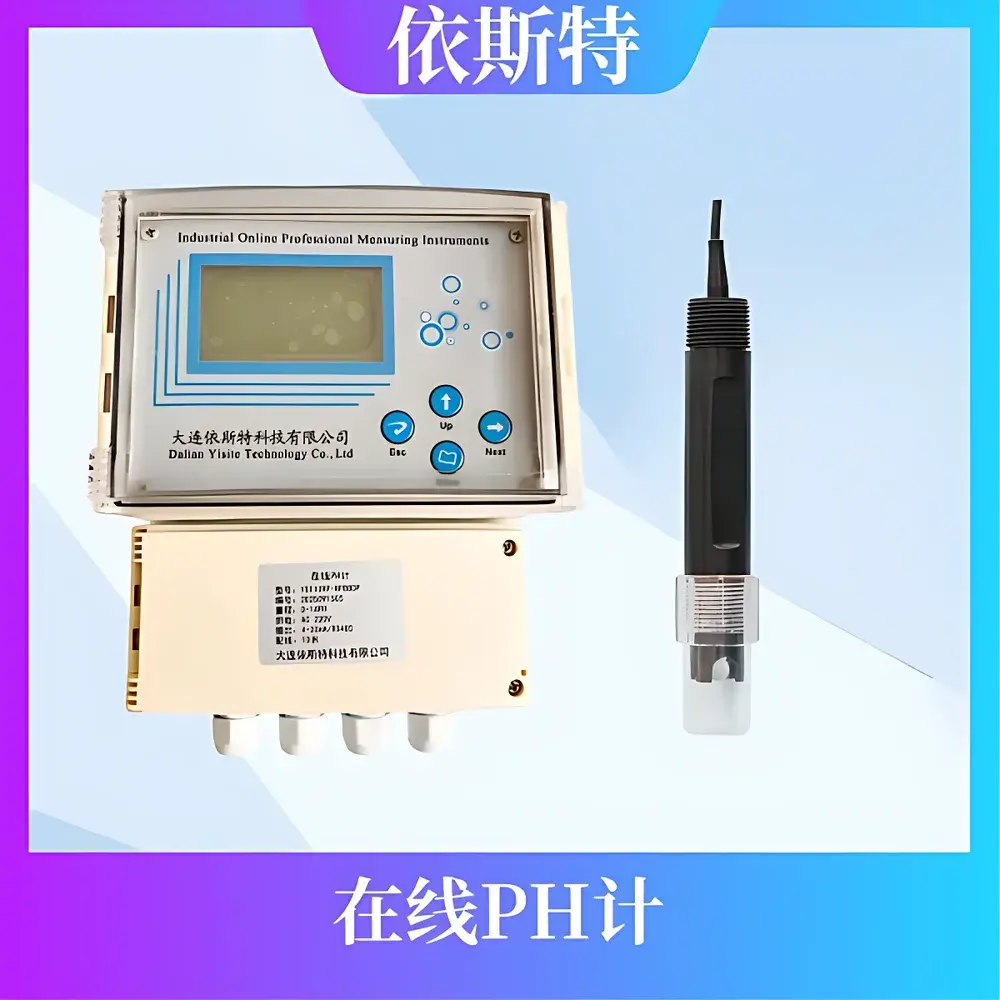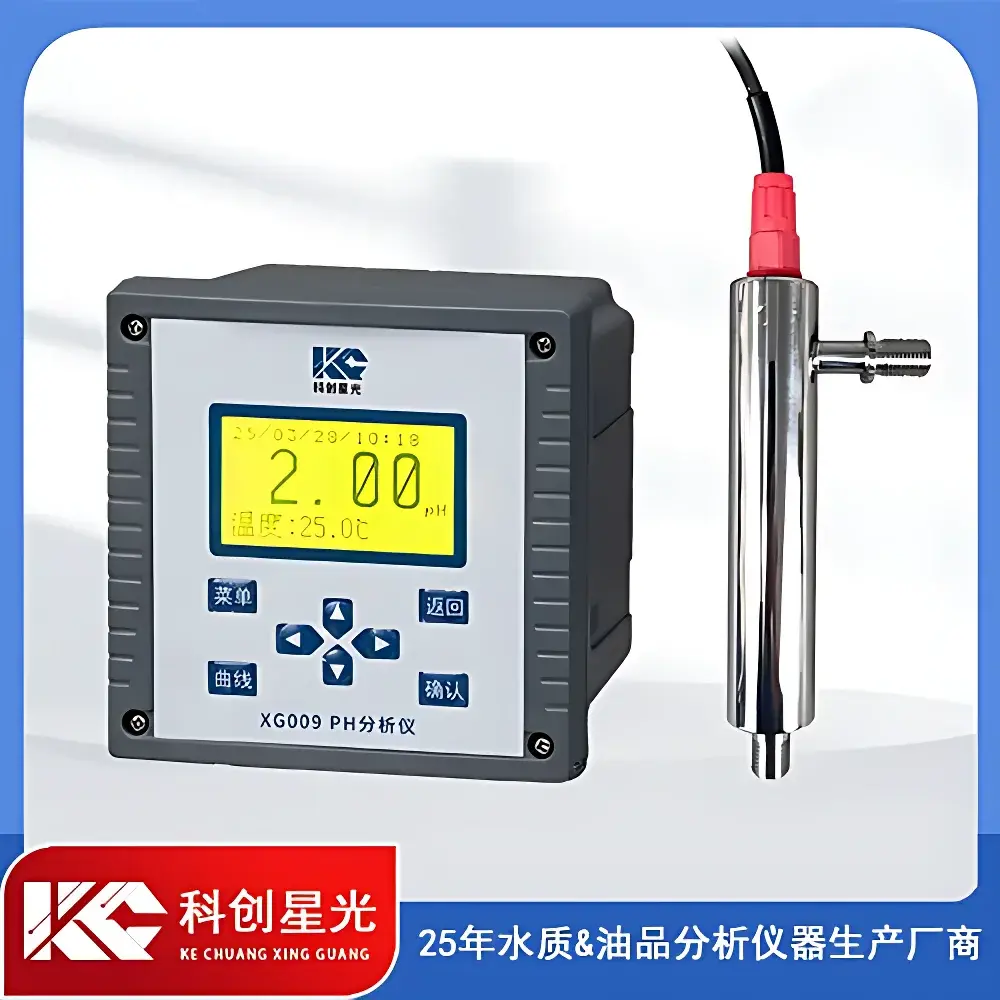
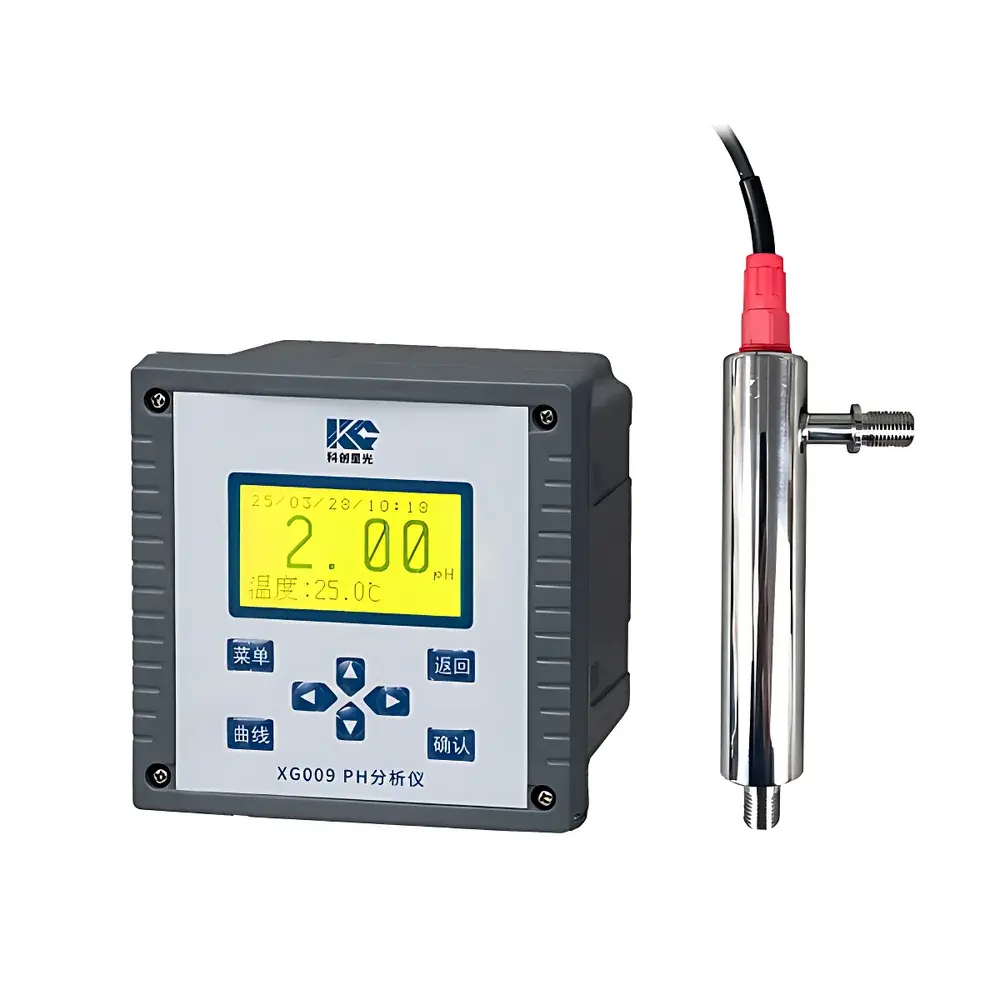
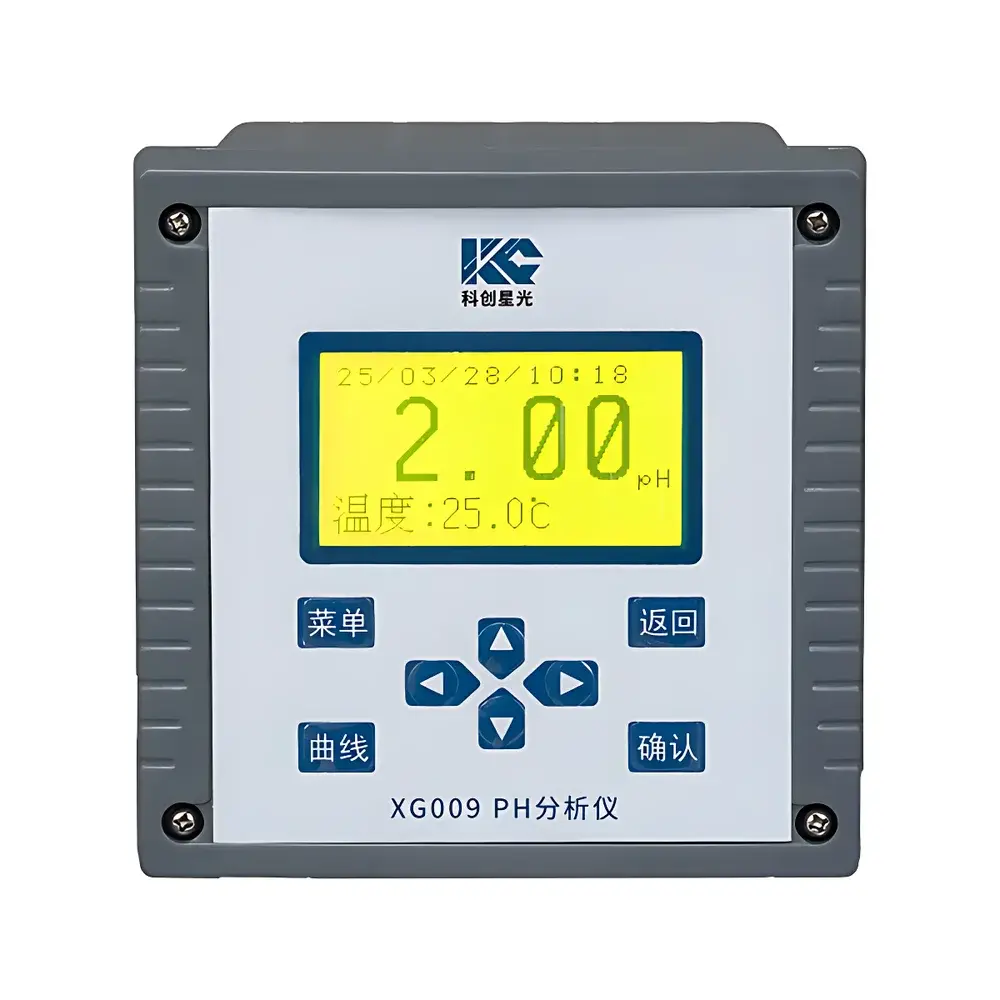
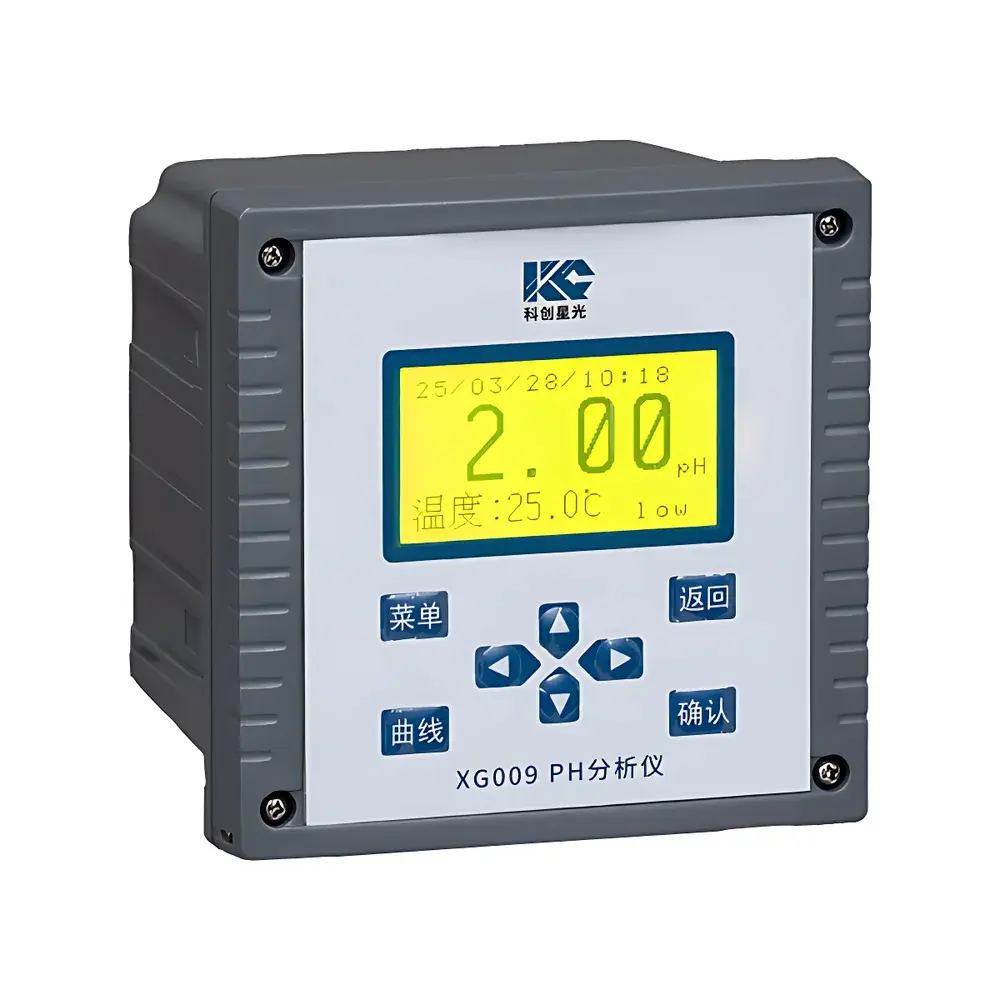
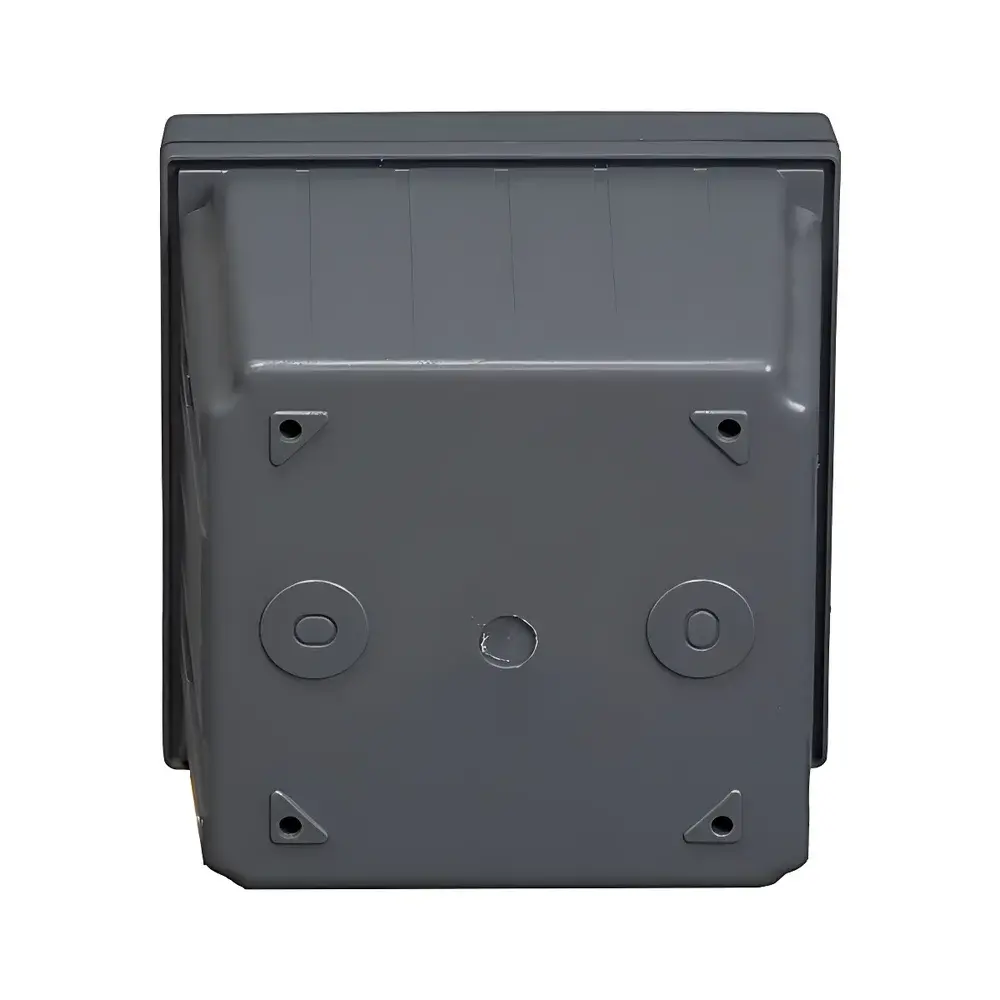
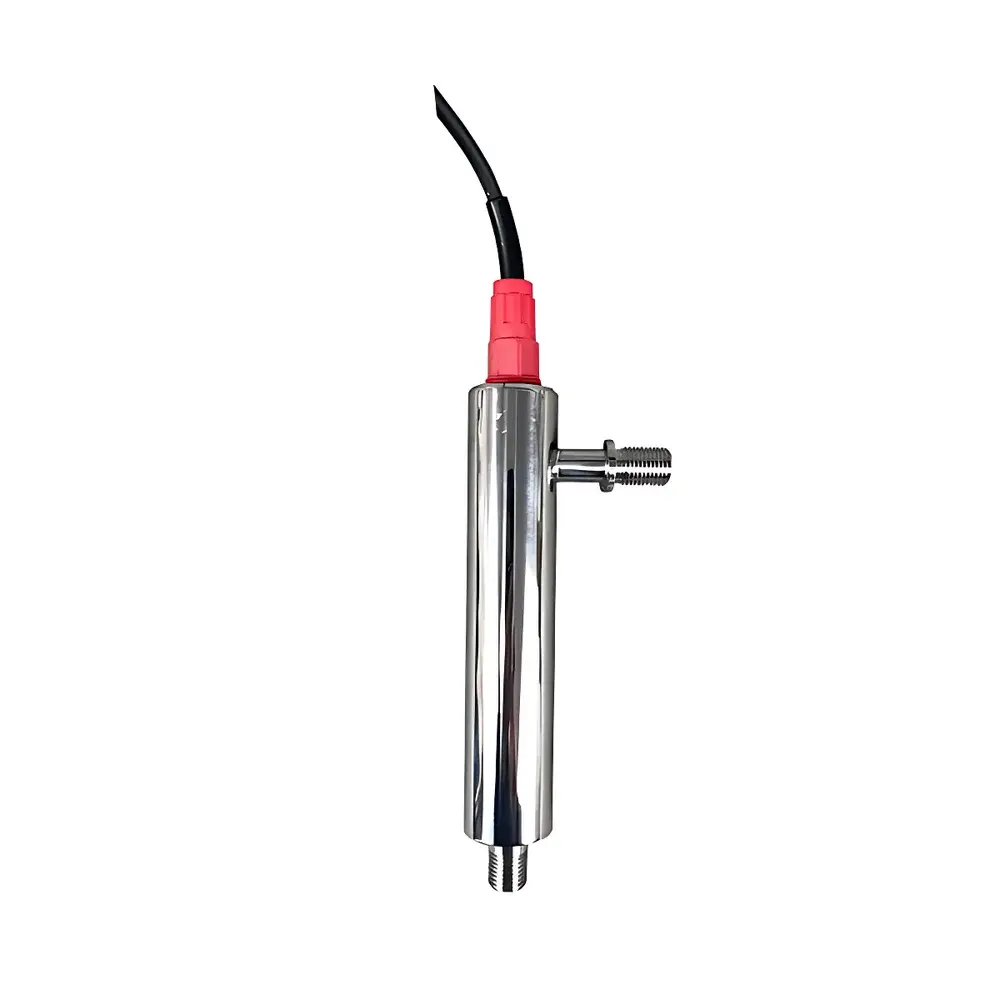
KC Starlight XG09 Online pH Meter and Acidity Analyzer
| Brand | KC Starlight |
|---|---|
| Origin | Beijing, China |
| Manufacturer Type | Direct Manufacturer |
| Model | XG09 |
| Measurement Range | 0.00–14.00 pH |
| Resolution | 0.01 pH |
| Accuracy | ±0.02 pH |
| Temperature Compensation Range | 0.0–60.0 °C |
| Dimensions | 145 mm × 120 mm × 145 mm (L×D×H) |
| Weight | 0.63 kg |
| Display | 128×64 dot-matrix LCD with Chinese interface |
| Input Impedance | ≥10¹² Ω |
| Temperature Sensor | Pt1000 |
| Output Signals | 0–10 mA / 0–20 mA / 4–20 mA (selectable, load <750 Ω) |
| Relay Outputs | 2 SPST (AC220 V/3 A or DC30 V/3 A) |
| Protection Rating | IP65 |
| Power Supply | AC 220 V ±10%, 50 Hz ±10% |
| Data Retention Time | >10 years after power loss |
| Operating Ambient | 5–45 °C, ≤85% RH (non-condensing) |
| Storage Temperature | −25–55 °C (electrode storage >0 °C) |
| Sample Temp. Range | 5–60 °C |
Overview
The KC Starlight XG09 Online pH Meter and Acidity Analyzer is an industrial-grade continuous monitoring instrument engineered for precision, stability, and long-term reliability in demanding process environments. Based on potentiometric measurement principles, the XG09 measures hydrogen ion activity in aqueous solutions using a high-impedance, three-in-one composite pH electrode — integrating pH sensing, reference junction, and integrated Pt1000 temperature sensor in a single robust probe. The system employs automatic temperature compensation (ATC) across 0.0–60.0 °C to correct for thermal drift in electrode potential, ensuring traceable accuracy per ISO 17025-compliant calibration practices. Designed for fixed-mount installation in water treatment plants, chemical dosing loops, bioreactors, food & beverage processing lines, and pharmaceutical clean utilities, the XG09 delivers real-time pH data with ±0.02 pH accuracy and 0.01 pH resolution — meeting routine QC requirements under ASTM D1293 and USP <791> for aqueous solution acidity assessment.
Key Features
- Triple-composite pH electrode with built-in Pt1000 thermistor for simultaneous pH and temperature measurement, minimizing inter-probe variability and installation complexity
- High-input-impedance (>1012 Ω) analog front-end and 24-bit ADC architecture, optimized to preserve signal integrity from high-resistance glass electrodes
- Microcontroller-based firmware with adaptive digital filtering, enabling stable readings even under fluctuating flow conditions or electrical noise
- Dual programmable relay outputs (SPST, AC220 V/3 A or DC30 V/3 A), configurable for high/low alarms, pump control, or valve actuation without external logic controllers
- Optically isolated current output (0–10 mA / 0–20 mA / 4–20 mA selectable), compliant with IEC 61000-4 immunity standards for industrial electromagnetic environments
- IP65-rated NEMA 4X enclosure with corrosion-resistant ABS housing, suitable for wall- or panel-mounted deployment in humid or splash-prone areas
- Non-volatile memory with >10-year data retention post-power-loss; supports cyclic logging of time-stamped pH and temperature values for trend analysis and audit readiness
Sample Compatibility & Compliance
The XG09 is validated for continuous measurement in conductive aqueous streams with conductivity ≥50 µS/cm. It is compatible with standard 12 mm diameter industrial pH electrodes (e.g., KC-PE100 series) and supports both refillable and gel-filled reference systems. While not certified for explosive atmospheres (ATEX/IECEx), its design adheres to CE marking directives (EMC 2014/30/EU, LVD 2014/35/EU). For regulated industries, the device supports manual calibration logging and meets foundational data integrity expectations under FDA 21 CFR Part 11 when paired with validated procedural controls (e.g., operator authentication, audit trail documentation). It complies with ISO 5725 (accuracy/trueness) and ISO 8655-4 (volumetric apparatus) for comparative method validation in laboratory-to-process transfer workflows.
Software & Data Management
The XG09 operates as a standalone transmitter with no embedded PC software dependency. All configuration — including calibration parameters (single- or two-point), alarm thresholds, output scaling, and data logging intervals — is performed via intuitive on-device menu navigation using the 128×64 Chinese-language LCD. Logged data can be reviewed directly on-screen with chronological scroll and search-by-date functionality. For integration into centralized SCADA or DCS platforms, the 4–20 mA analog output provides seamless compatibility with standard PLC analog input modules. Optional RS485 Modbus RTU communication (firmware upgrade required) enables remote parameter readout and basic diagnostics via HART-compatible host systems — supporting GLP/GMP-aligned operational qualification (OQ) protocols where electronic records must be attributable and retrievable.
Applications
- Real-time pH monitoring in municipal wastewater influent/effluent channels and activated sludge basins
- Neutralization control in chemical manufacturing batch reactors and continuous stirred-tank reactors (CSTRs)
- Acid/base dosing feedback in boiler feedwater treatment and cooling tower chemistry management
- In-line acidity verification during dairy pasteurization, juice blending, and brewery wort conditioning
- Environmental compliance monitoring for industrial discharge permits (e.g., EPA NPDES reporting thresholds)
- Validation support for cleaning-in-place (CIP) cycle endpoint detection in pharmaceutical equipment
FAQ
What calibration standards are recommended for routine verification?
NIST-traceable pH 4.01, 7.00, and 10.01 buffer solutions at 25 °C, following ISO 8655-4 procedures. Two-point calibration (pH 4.01 + 7.00 or 7.00 + 10.01) is advised for process applications with known operating range.
Can the XG09 operate in high-purity water applications (e.g., UPW)?
No — due to low ionic strength and high resistivity (<1 MΩ·cm), ultra-pure water causes unstable junction potentials and slow response. Use only in streams with conductivity ≥50 µS/cm.
Is the unit compatible with third-party pH electrodes?
Yes, provided they feature BNC or DIN connectors, standard mV output, and a compatible temperature element (Pt1000 or Pt100).
How is data security handled for stored measurements?
Stored data lacks encryption or user-level access control. For regulatory environments, export logs manually and archive externally under controlled document management systems.
Does the device support automatic calibration?
No — calibration requires manual intervention with buffer solutions. Automatic calibration is not implemented to maintain regulatory acceptability in GxP settings where human oversight is mandated.
Related Products