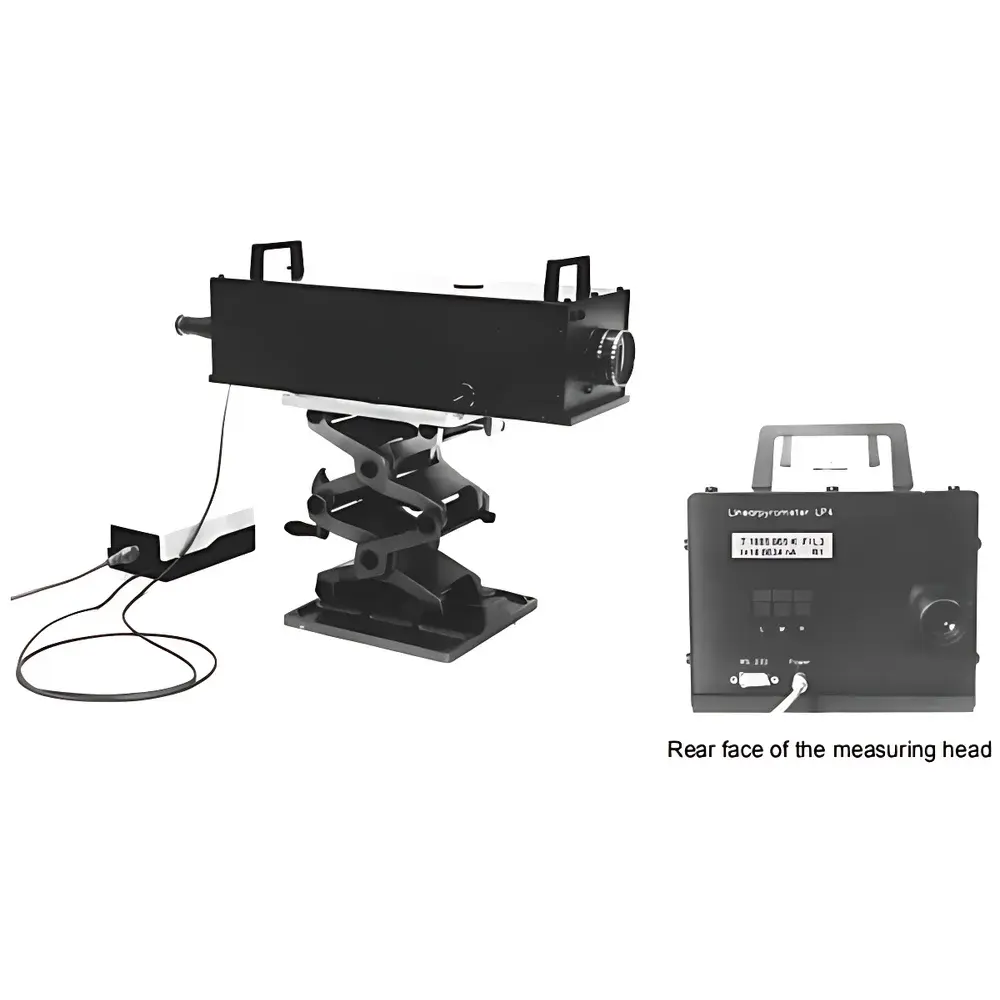
KE-Technologe LP4/LP5 Precision Optical Pyrometer
| Brand | KE-Technologe GmbH |
|---|---|
| Origin | Germany |
| Model | LP4 / LP5 |
| Temperature Range (LP4) | 650–3000 °C (Si detector) |
| Temperature Range (LP5) | up to 3400 °C (Si), up to 2500 °C (InGaAs) |
| Photocurrent Range | 1 pA – 8 nA |
| Accuracy Class | ±0.1% of reading |
| Spectral Bandpass | Interchangeable interference filters from 500 nm to 1600 nm (standard: 650 nm ±10 nm HBW) |
| Field of View | Target diameter 0.22 mm (LP5) / 0.25 mm (LP4) |
| Objective Lens | f = 143 mm, achromatic |
| Working Distance | 600 mm or 2000 mm (target-to-lens) |
| Expanded Uncertainty (k=2) | 0.8 K @ 1200 K, 1.2 K @ 1600 K, 2.1 K @ 2000 K, 3.4 K @ 2400 K, 4.8 K @ 2800 K |
| Long-Term Stability (6 months, 22 °C ±3 °C, k=1) | 0.25–2.4 K depending on temperature point |
| Power Supply | 115 V or 230 V, 50/60 Hz |
| Dimensions (H×W×D) | Host unit: 600×178×140 mm (LP4), 500×138×120 mm (LP5) |
| Power supply | 215×110×78 mm (LP4), 220×120×75 mm (LP5) |
| Weight | Host ~12 kg (LP4), ~9 kg (LP5) |
Overview
The KE-Technologe LP4/LP5 Precision Optical Pyrometer is a primary-standard-grade radiometric temperature measurement instrument engineered for metrological traceability in national metrology institutes, calibration laboratories, and high-temperature R&D facilities. Based on the principle of spectral brightness temperature measurement using narrow-band filtered photoelectric detection, the LP4/LP5 series operates in accordance with the fundamental Planck radiation law and is designed to serve as a reference standard for the calibration and verification of radiation thermometers across the high-temperature range. Its core architecture integrates a stabilized Si or InGaAs photodetector with thermally compensated optical path, precision interference filtering, and calibrated achromatic focusing optics—enabling direct realization of thermodynamic temperature via comparison with fixed-point blackbody sources or high-stability cavity-type blackbodies.
Key Features
- Primary-standard capability: Validated for use as a transfer standard in accredited temperature calibration laboratories compliant with ISO/IEC 17025 and traceable to national standards (e.g., PTB, NIST, NPL).
- Dual-detector configuration: Selectable Si (650–3000 °C / up to 3400 °C) or InGaAs (232–1200 °C / up to 2500 °C) detectors, each optimized for spectral responsivity and linearity over defined ranges.
- High spectral purity: Interchangeable interference filters (500–1600 nm), including standard 650 nm ±10 nm half-bandwidth (HBW), enabling flexibility for specific emissivity correction protocols and multi-wavelength validation.
- Sub-millimeter spatial resolution: Achromatic f = 143 mm objective lens with selectable aperture diaphragms (0.15–0.45 mm) ensures precise targeting of small-area blackbody apertures or furnace ports under stringent geometric constraints.
- Stable thermal design: Passive thermal stabilization and low-drift electronics guarantee long-term repeatability—verified at ≤0.25 K (k=1) drift over six months at ambient 22 °C ±3 °C.
- Traceable uncertainty budget: Expanded uncertainties (k=2) rigorously evaluated per ISO/IEC Guide 98-3 (GUM), covering contributions from detector nonlinearity, filter transmission drift, lens focal shift, and environmental thermal gradients.
Sample Compatibility & Compliance
The LP4/LP5 is intended for use exclusively with high-emissivity (>0.9995), temperature-stabilized blackbody radiation sources—including fixed-point cells (e.g., Cu, Ag, Au), graphite cavity furnaces, and high-temperature heat-pipe blackbodies—operating within the specified working distance (600 mm or 2000 mm). It complies with international standards governing radiation thermometry, including ASTM E2758 (Standard Practice for Calibration of Radiation Thermometers), ISO 21948 (Radiation thermometers — Calibration by comparison methods), and IEC 61232 (Industrial radiation thermometers). Its design supports full auditability under GLP and GMP environments, with documented calibration history, software version control, and hardware serial traceability required for FDA 21 CFR Part 11–compliant workflows when integrated into regulated quality systems.
Software & Data Management
KE-Technologe provides free, Windows-compatible calibration control software supporting manual and automated measurement sequences. The software enables real-time photocurrent acquisition, digital filtering, linearization correction based on factory-provided calibration coefficients, and automatic uncertainty propagation per measurement point. All raw data (photocurrent, ambient sensor readings, filter ID, lens position) are logged with timestamps and user-defined metadata. Export formats include CSV and XML for integration with LIMS platforms. The system supports external trigger synchronization for pulsed-source measurements and includes built-in diagnostics for detector saturation, lens contamination alerts, and thermal drift compensation flags. Software validation documentation (IQ/OQ protocols) is available upon request for regulated laboratory deployment.
Applications
- Primary calibration of industrial radiation thermometers (single- and two-color) used in metallurgy, glass manufacturing, and semiconductor processing.
- Validation of high-temperature furnace uniformity and stability during ISO/IEC 17025 accreditation audits.
- Intercomparison campaigns between national metrology institutes (NMIs) under CIPM MRA frameworks.
- Research on emissivity modeling of refractory materials using multi-spectral pyrometry setups.
- Traceable temperature assignment in thermophysical property measurements (e.g., specific heat, thermal diffusivity) requiring <1 K uncertainty at >2000 K.
- Supporting development and verification of next-generation high-temperature sensors for aerospace propulsion testing and fusion energy diagnostics.
FAQ
What is the difference between LP4 and LP5 models?
The LP5 features a more compact mechanical design (smaller host dimensions and weight), enhanced thermal shielding for improved long-term stability at ultra-high temperatures, and an optimized optical path for larger target spot sizes (3.4 mm vs. 0.8 mm) at extended working distances—making it preferred for large-aperture blackbody installations.
Can the LP4/LP5 be used without a blackbody source?
No. As a primary reference pyrometer, it requires comparison against a traceable blackbody radiator to establish brightness temperature; it does not provide absolute temperature output without such a reference.
Is the instrument supplied with calibration certificates?
Yes. Each unit ships with a UKAS-accredited or DAkkS-traceable calibration certificate (valid for 12 months), covering photocurrent linearity, spectral responsivity, and geometric field-of-view characterization at multiple temperature points.
How often should recalibration be performed?
Annual recalibration is recommended for routine metrological use; however, in critical applications involving continuous operation above 2000 °C, biannual verification against a fixed-point blackbody is advised per ISO/IEC 17025 clause 7.7.
Does the system support remote operation in hazardous environments?
The host unit is rated IP20 and intended for laboratory use only; fiber-optic extension kits (with vacuum feedthrough options) are available for integration into controlled-atmosphere or vacuum chambers, maintaining full signal integrity and thermal isolation.