
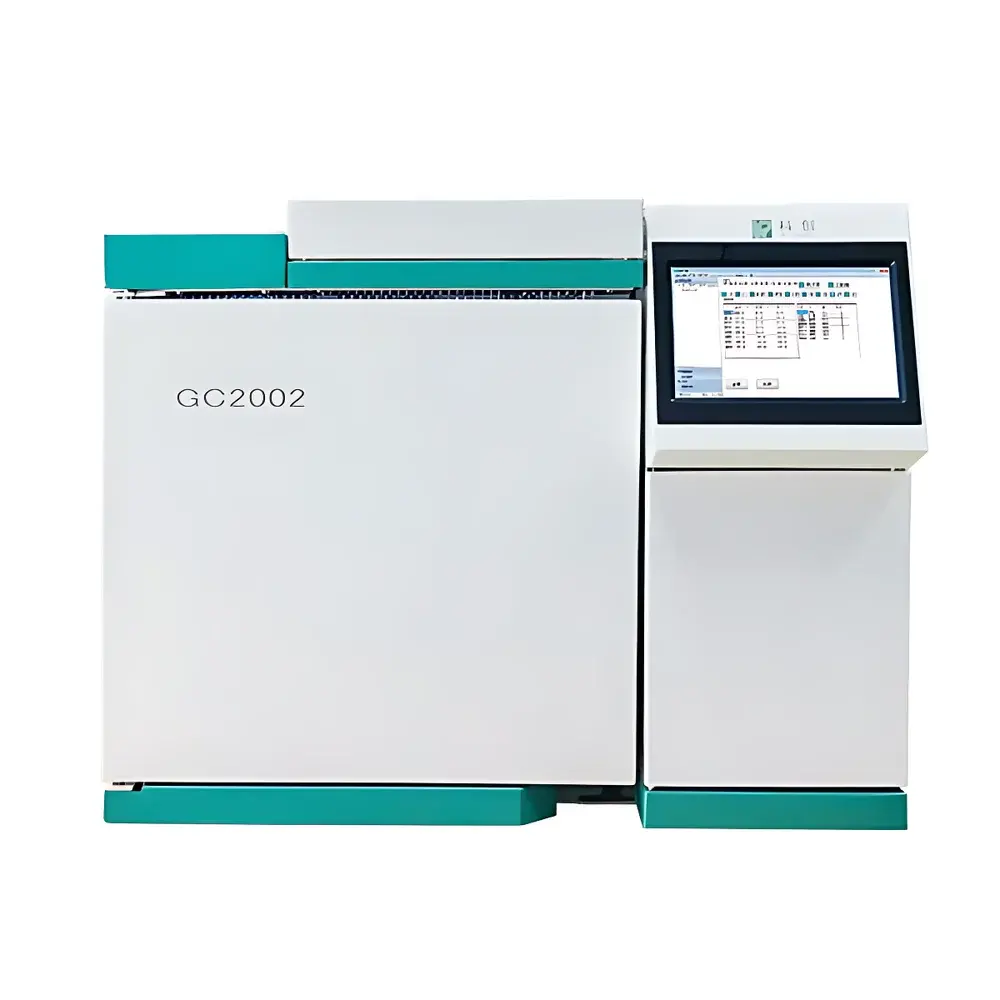
Kechuang GC2002 Series Laboratory Gas Chromatograph for Pesticide Residue Analysis in Food and Agricultural Products
| Brand | Kechuang |
|---|---|
| Origin | Shanghai, China |
| Manufacturer Type | Direct Manufacturer |
| Instrument Type | Benchtop Laboratory Gas Chromatograph |
| Application Domain | Food Safety & Agricultural Residue Testing |
| Oven Temperature Range | +5 °C to 400 °C |
| Maximum Ramp Rate | 40 °C/min |
| Cooling Time (from 400 °C to 50 °C) | ≤4 min |
| Carrier Gas Flow Range | 0–1000 mL/min |
| Carrier Gas Pressure Control Range | 0–100 psi |
| Injector Temperature Range | +5 °C to 400 °C |
| Injector Pressure Setting Range | 0–0.04 MPa |
| Total Injector Flow Setting Range | 0–1000 mL/min |
| Column Oven Dimensions | 280 × 280 × 180 mm |
| Weight | 56 kg |
| Power Consumption | 2000 W |
Overview
The Kechuang GC2002 Series is a dedicated laboratory gas chromatograph engineered for high-reliability pesticide residue analysis in food, feed, dairy products, and agricultural commodities. Based on the fundamental principle of gas-phase separation—where volatile and semi-volatile analytes are partitioned between a mobile carrier gas phase and a stationary liquid or polymer phase coated inside a capillary or packed column—the system delivers reproducible retention time alignment, robust peak resolution, and quantitative accuracy essential for regulatory compliance testing. Designed specifically for food safety laboratories, the GC2002 supports multi-residue methods aligned with internationally recognized protocols including AOAC Official Methods®, ISO 17025-accredited workflows, and national standards such as GB 23200 series (China National Standard for Pesticide Residues in Foods). Its architecture integrates thermal stability, precise pneumatic control, and modular detector compatibility to meet routine QC demands and method validation requirements under GLP and GMP environments.
Key Features
- Microprocessor-controlled oven with 8-stage programmable temperature ramping; minimum operating temperature at +5 °C above ambient, enabling near-ambient separations for thermally labile pesticides.
- Six independent temperature zones—including column oven, up to three injectors, and up to two detectors—with ±0.5 °C thermal accuracy and 0.1 °C display resolution.
- Integrated Ethernet (10/100 M) interface supporting remote instrument control, real-time data streaming, and centralized fleet management across up to 253 units via single workstation software.
- Digital signal output directly embedded in the hardware; chromatographic data transmitted via standard TCP/IP without external analog-to-digital converters.
- Modular detector bay accommodating simultaneous installation of up to three detectors: FID, TCD, ECD, and FPD—enabling compound-class-selective detection (e.g., organophosphates via FPD-P mode, organochlorines via ECD).
- Auto-backflush-capable oven with motorized rear door for rapid cooldown; optimized thermal mass design achieves <4-minute cooling from 400 °C to 50 °C.
- Comprehensive self-diagnostic system with real-time fault logging, thermal runaway protection (automatic heater cutoff if any zone exceeds setpoint), and pressure/flow anomaly alerts.
Sample Compatibility & Compliance
The GC2002 accommodates diverse sample introduction techniques—including split/splitless capillary injection, packed-column injection, headspace analysis (with optional HS unit), thermal desorption (TDS), and pyrolysis—ensuring adaptability across extraction formats (QuEChERS, SPE, LLE). It is validated for multiresidue analysis of over 120 pesticide compounds, including but not limited to: parathion-methyl, fenitrothion, malathion, dichlorvos, carbaryl, chlorpyrifos, cypermethrin, acetamiprid, and glyphosate (after derivatization). The system complies with instrumental performance criteria defined in ISO 8573-1 (gas purity), ASTM D3612 (carrier gas specification), and supports audit-ready electronic records per FDA 21 CFR Part 11 when paired with compliant chromatography data systems (CDS).
Software & Data Management
The GC2002 operates with Kechuang’s native GC Workstation v3.x—a Windows-based CDS supporting method development, sequence scheduling, calibration curve generation (linear, quadratic, weighted), and integrated reporting templates aligned with CNAS and CMA accreditation requirements. Raw data files adhere to ANDI/NetCDF format for cross-platform compatibility. Audit trail functionality logs all user actions—including method edits, integration parameter changes, and result reprocessing—with timestamps and operator IDs. Data export options include CSV, PDF, and XML for LIMS integration. Remote monitoring dashboards allow supervisors to review instrument status, run progress, and alarm history without local access.
Applications
This system is routinely deployed in food safety testing laboratories for quantification of pesticide residues in cereals, edible oils, fruits, vegetables, infant formula, animal feed, and herbal products. Specific validated applications include: determination of organophosphate residues (e.g., diazinon, phorate) in rice and wheat flour; screening of synthetic pyrethroids (e.g., deltamethrin, cyhalothrin) in leafy greens; confirmation of carbamate residues (e.g., carbofuran, carbendazim) in tea and coffee; and multi-analyte profiling of chlorinated hydrocarbons (e.g., DDT, HCH isomers) in milk powder and butter oil. Method transfer capability ensures seamless adoption of official methods such as GB/T 20770–2006, GB/T 23200.113–2018, and EU SANTE/11312/2021.
FAQ
Is the GC2002 compatible with third-party chromatography data systems (CDS)?
Yes—via standard ANDI/NetCDF file export and optional OPC UA interface for enterprise-level LIMS or ELN integration.
What is the minimum detectable concentration for chlorpyrifos using the ECD configuration?
Under optimized conditions (capillary column, nitrogen make-up gas, 1 µL injection), typical MDL is ≤0.005 mg/kg in matrix-matched calibration standards.
Can the instrument perform unattended overnight analysis?
Yes—supported by full sequence scheduling, automatic shutdown after completion, and thermal stabilization algorithms that maintain baseline integrity over >12-hour runs.
Does the system support method validation per ICH Q2(R2) guidelines?
Yes—the platform provides documented linearity ranges, precision (intra-day/inter-day RSD), LOD/LOQ, recovery studies, and robustness testing parameters required for analytical procedure validation.
What maintenance intervals are recommended for routine operation?
Injector liner replacement every 100 injections; column trimming every 200–300 runs; detector cleaning every 6 months; annual preventive maintenance including leak checking, flow calibration, and firmware update verification.



