
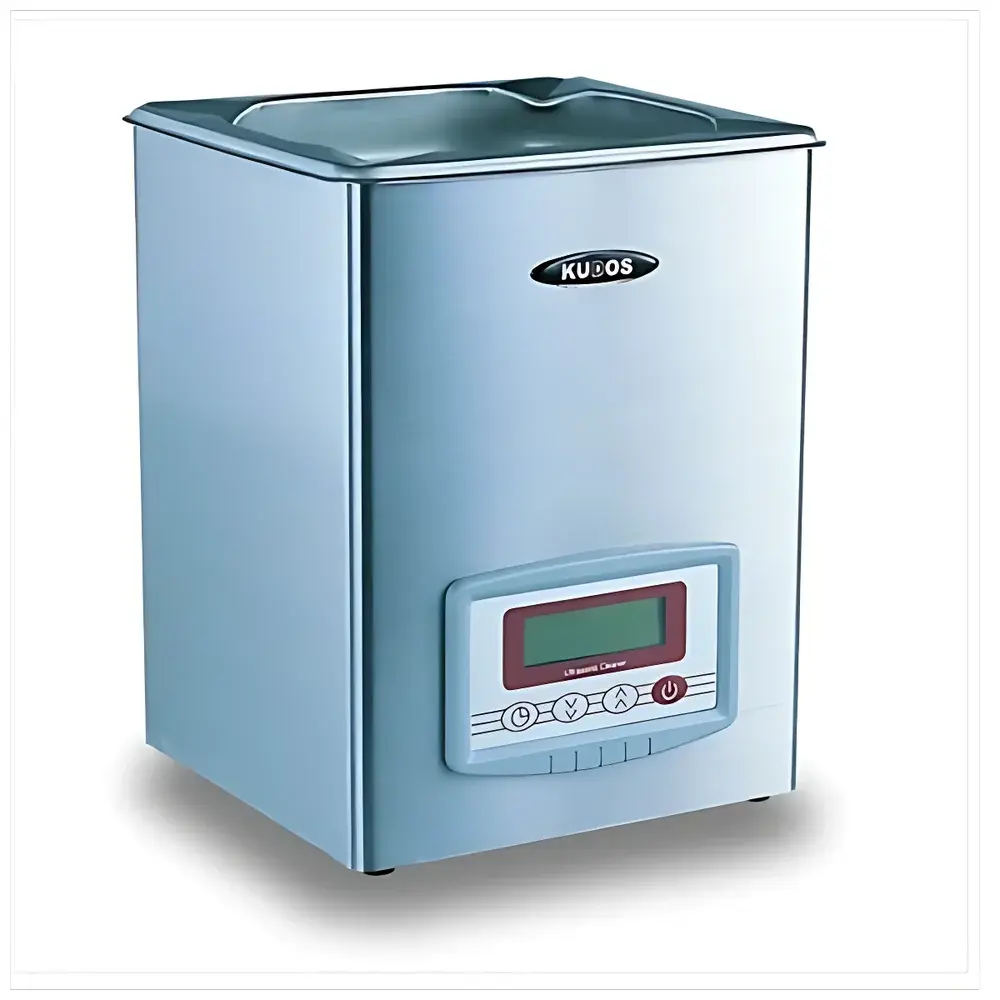
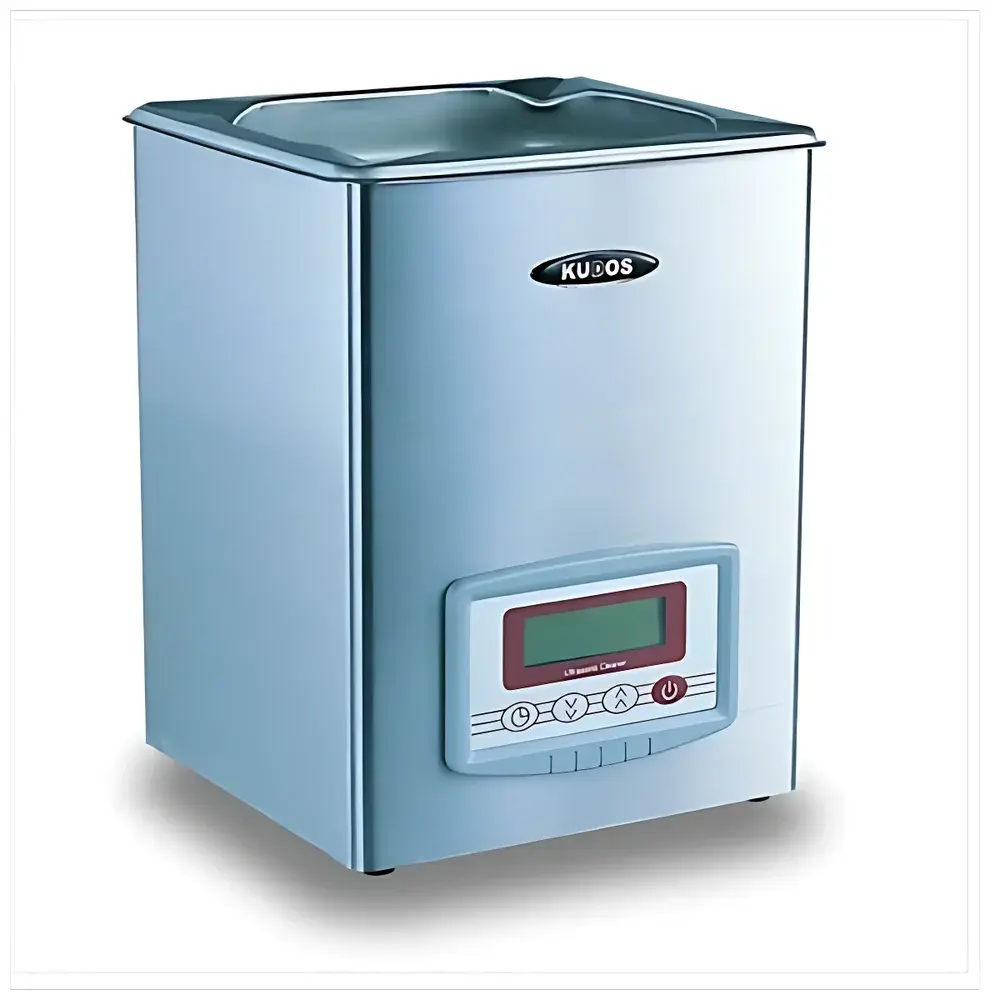
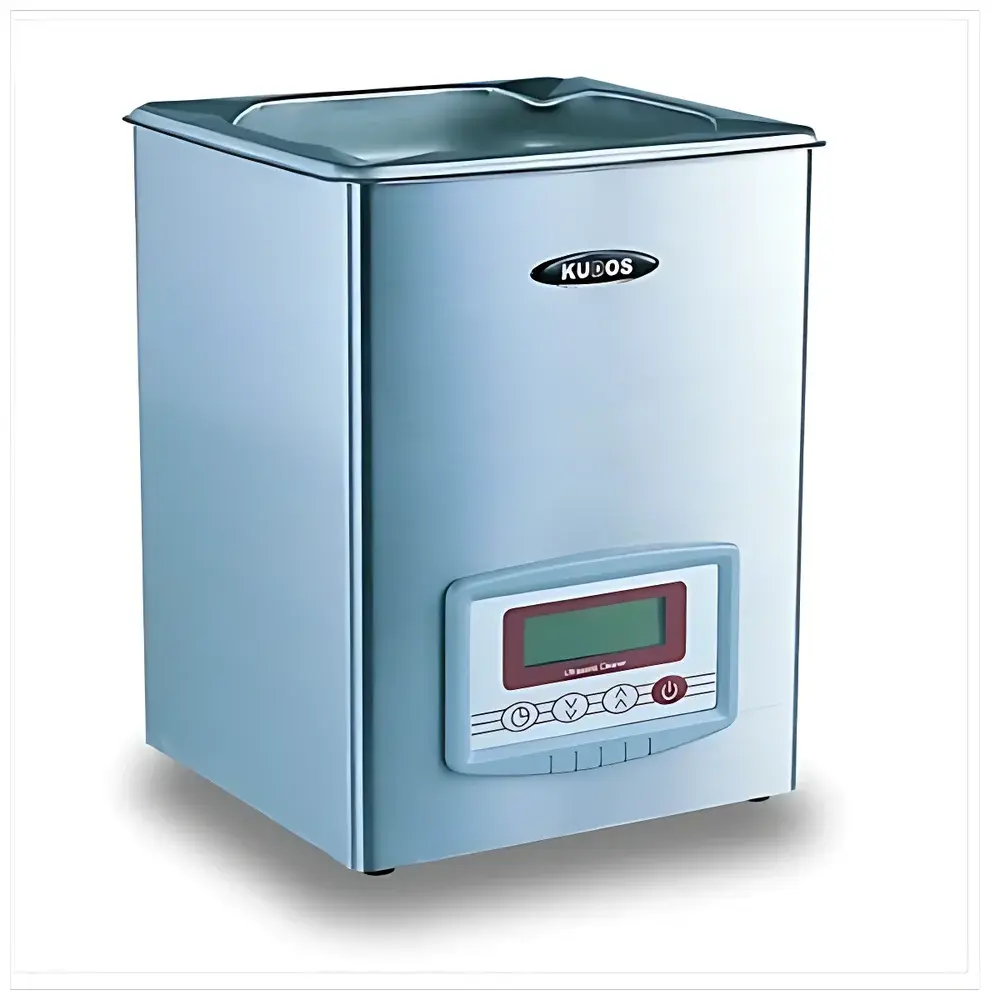
Kedao SK1200H Benchtop Ultrasonic Cleaner
| Brand | Kedao |
|---|---|
| Origin | Shanghai, China |
| Model | SK1200H |
| Capacity | 2 L |
| Ultrasonic Frequency | 50 kHz |
| Ultrasonic Power | 50 W |
| Power Adjustment | Fixed |
| Temperature Control | Not Available |
| Timer Range | Digital, 1–99 min |
| Drain/Inlet | Manual fill and drain only |
| Type | General-purpose benchtop ultrasonic cleaner |
Overview
The Kedao SK1200H is a compact, general-purpose benchtop ultrasonic cleaner engineered for precision cleaning of small to medium-sized laboratory components, optical parts, electronic assemblies, and precision mechanical components. It operates on the principle of acoustic cavitation: high-frequency (50 kHz) ultrasonic energy is transmitted into the cleaning solvent via piezoelectric transducers bonded to the tank bottom. This generates rapid formation and implosive collapse of microscopic vapor cavities—each implosion releasing localized shockwaves (~1,000 atm) and microjets (>400 m/s) that dislodge particulate contamination, organic residues, and thin oxide layers from surfaces and complex geometries—including blind holes, crevices, and microstructures. At 50 kHz, the unit balances moderate cavitation intensity with improved penetration into intricate features and reduced surface erosion risk compared to lower-frequency systems (e.g., 20–40 kHz), making it suitable for delicate substrates such as glassware, stainless steel tools, ceramic substrates, and soldered PCBs.
Key Features
- Benchtop design with compact 2 L stainless-steel tank (304 grade), optimized for space-constrained lab environments and individual workstation use.
- Stable 50 kHz fixed-frequency generator delivering consistent acoustic output; frequency selected to maximize cleaning efficacy for fine contaminants while minimizing substrate pitting on polished metals and optical surfaces.
- Fixed 50 W nominal ultrasonic power—engineered for reproducible energy density per unit volume, avoiding over-saturation or inefficient coupling common in underpowered or excessively high-power units.
- Digital timer with precise 1–99 minute range; enables repeatable process validation and supports standard operating procedures (SOPs) for routine cleaning cycles.
- No integrated heating or temperature control—designed for ambient-temperature operation with compatible solvents (e.g., aqueous detergents, isopropanol, acetone); eliminates thermal drift and simplifies regulatory documentation for non-thermal processes.
- Manual fill-and-drain configuration—reduces complexity, lowers maintenance requirements, and avoids potential leakage or valve failure points associated with automated plumbing.
Sample Compatibility & Compliance
The SK1200H is compatible with a broad range of laboratory and industrial samples, including but not limited to: borosilicate glass vials and cuvettes, stainless steel forceps and tweezers, quartz crystal microbalance (QCM) sensors, silicon wafers (pre-etch), aluminum alloy calibration standards, and polymeric microfluidic chips. Its 50 kHz output exhibits favorable acoustic reflectivity with rigid, high-impedance materials (e.g., metals, glass, ceramics), while exhibiting diminished efficiency with highly absorptive substrates such as rubber gaskets or thick fabric filters—consistent with fundamental acoustics principles governing energy transfer at solid–liquid interfaces. The device complies with IEC 61000-6-3 (EMC emission limits) and IEC 61000-6-1 (immunity). While not certified to ISO 13485 or FDA 21 CFR Part 11, its operational simplicity and deterministic timer functionality support GLP-aligned documentation when integrated into validated lab workflows.
Software & Data Management
The SK1200H operates without embedded software or connectivity interfaces. All controls are hardware-based: a single rotary encoder adjusts timer duration, and an LED display provides real-time countdown. This architecture ensures electromagnetic compatibility in sensitive instrumentation environments (e.g., adjacent to SEMs, NMR spectrometers, or mass spectrometers) and eliminates cybersecurity risks associated with networked devices. Process parameters (time, solvent type, load configuration) must be recorded manually in lab notebooks or electronic lab notebooks (ELNs) to meet audit requirements under ISO/IEC 17025 or GxP frameworks. No firmware updates, calibration logs, or audit trails are generated internally—consistent with Class I non-medical electrical equipment classification per MDR Annex VIII.
Applications
- Routine decontamination of HPLC vials, pipette tips, and syringe filters prior to trace analysis.
- Removal of flux residues and particulates from printed circuit boards during R&D prototyping.
- Cleaning of optical lenses, mirrors, and laser diode housings without surface scratching.
- Preparation of metal coupons for corrosion testing or surface energy characterization (e.g., contact angle measurement).
- De-greasing of watchmaking components, dental instruments, and surgical tool sets in teaching labs.
- Supporting ASTM D2621 (cleaning verification for automotive parts) and ISO 14644-1 (cleanroom component preparation) when paired with appropriate solvents and rinsing protocols.
FAQ
Is the SK1200H suitable for cleaning delicate MEMS devices or semiconductor wafers?
It may be used for pre- and post-processing cleaning of silicon wafers or MEMS packages when operated with low-surface-tension solvents (e.g., terpenes or fluorinated alcohols) and short cycle times (<5 min), but is not recommended for final rinse steps requiring sub-micron particle removal—where megasonic (≥800 kHz) or two-stage ultrasonic/megasonic systems are preferred.
Can I use flammable solvents such as acetone or ethanol?
Yes—provided the unit is operated in a well-ventilated fume hood and all ignition sources are excluded. The SK1200H lacks explosion-proof certification; therefore, solvent selection must comply with local safety regulations (e.g., NFPA 30, ATEX Directive 2014/34/EU) and institutional chemical hygiene plans.
Does the unit include a degassing function?
No. For optimal cavitation onset, users should allow the cleaning solution to stand for 5–10 minutes after filling before initiating the timer, or briefly operate at low duty cycle (e.g., 30 sec ON / 30 sec OFF) to facilitate dissolved gas release.
What is the expected service life of the transducers?
Under normal usage (≤4 hrs/day, distilled/deionized water or mild detergent solutions), piezoelectric transducers typically maintain >90% nominal output for ≥5 years. Performance degradation accelerates with hard-water scaling, abrasive slurries, or prolonged dry operation.



