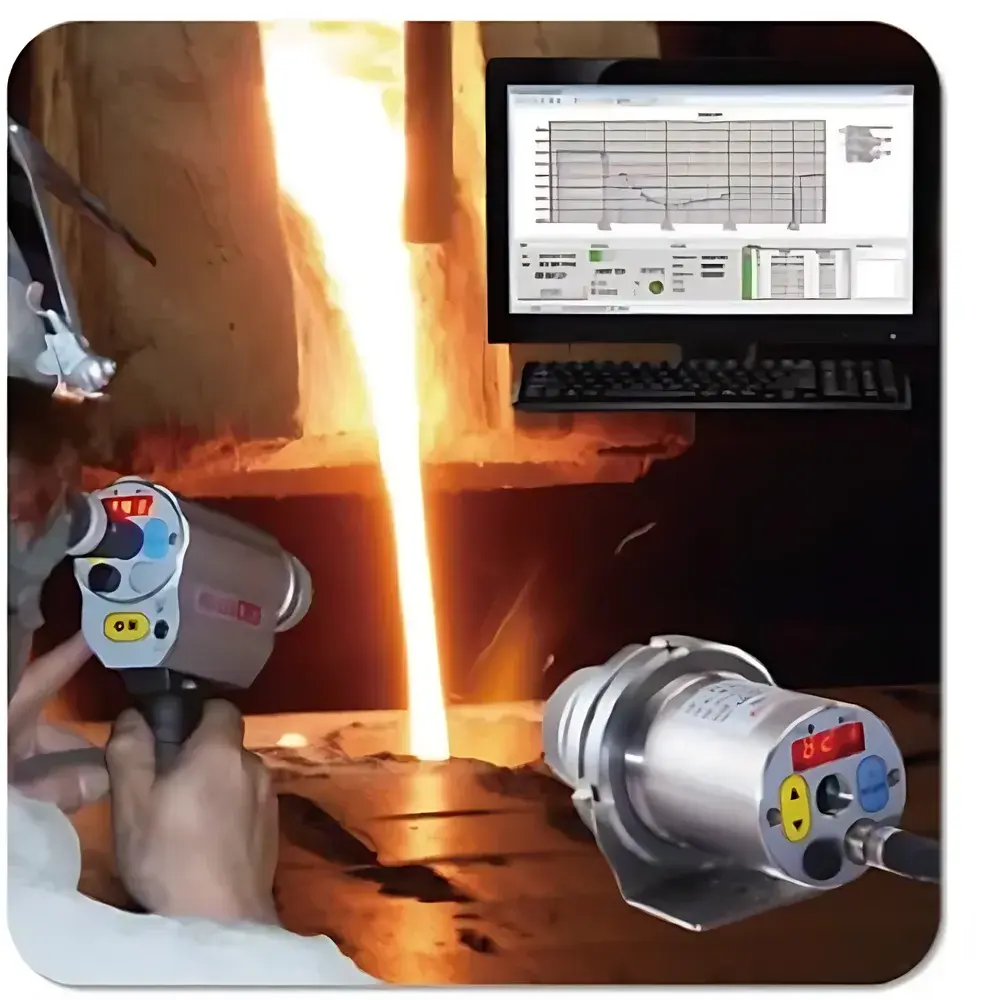
KELLER CellaCast Series Foundry-Specific Infrared Pyrometer
| Brand | KELLER HCW |
|---|---|
| Origin | Germany |
| Model | CellaCast |
| Type | Online Infrared Thermometer |
| Temperature Range | 650–1700 °C |
| Measurement Principle | Two-Color (Ratio) Infrared Radiometry |
| Optical Field of View | Rectangular |
| Special Features | Clean Surface Detection (CSD), Automatic Temperature Detection (ATD), Analog & Serial Data Output, Integrated Alarm Interface, IP65 Housing (with optional air purge & water cooling) |
Overview
The KELLER CellaCast Series is an industrial-grade, online two-color infrared pyrometer engineered specifically for continuous, non-contact temperature measurement of molten metals—including liquid steel, cast iron, aluminum, and copper alloys—in foundry environments. Unlike conventional immersion thermocouples, which introduce measurement uncertainty due to operator-dependent insertion depth, thermal lag, probe degradation, and single-point sampling, the CellaCast operates on the physical principle of spectral radiance ratio analysis. By comparing infrared energy emitted at two closely spaced wavelengths (typically in the near-infrared band), it inherently compensates for partial obscuration caused by steam, dust, smoke, oxidation layers, or slag—common challenges in open-pour, ladle-to-mold, and gating system applications. Its optical design targets clean metallic surfaces only, leveraging the proprietary Clean Surface Detection (CSD) algorithm to reject emissivity-distorting contaminants and ensure metrological traceability under dynamic casting conditions.
Key Features
- Two-color (ratio) infrared measurement technology—immune to signal attenuation from airborne particulates, furnace fumes, or variable emissivity across oxidized metal surfaces
- Automatic Temperature Detection (ATD) function—synchronizes measurement initiation precisely with the start of each mold’s pour cycle, independent of ladle position or stream instability
- Rectangular field-of-view optics—ensures full coverage of the molten metal stream even during lateral drift or nozzle misalignment, eliminating missed measurements per casting cycle
- Clean Surface Detection (CSD) algorithm—dynamically filters out radiation contributions from slag, dross, and oxide films, isolating true base-metal thermal emission for high-fidelity readings
- Robust industrial housing rated IP65 as standard—with optional air purge collars and water-cooled mounting brackets for operation in ambient temperatures up to 80 °C and proximity to radiant heat sources
- Integrated analog (4–20 mA / 0–10 V) and digital (RS485/Modbus RTU) outputs—enabling direct integration into PLC-based foundry control systems, SCADA platforms, or MES data historians
Sample Compatibility & Compliance
The CellaCast is calibrated and validated for use with ferrous and non-ferrous molten metals exhibiting surface temperatures between 650 °C and 1700 °C—covering gray iron, ductile iron, carbon and stainless steels, and high-alloy superalloys. It complies with IEC 61290-1 (laser product safety), EN 61326-1 (EMC for industrial environments), and meets essential requirements of the EU Machinery Directive 2006/42/EC. When integrated into automated casting lines, its real-time temperature logging supports adherence to ISO 9001:2015 clause 8.5.1 (control of production and service provision) and facilitates audit-ready documentation for AS9100 or IATF 16949 quality management systems. Optional software tools provide timestamped, tamper-evident records compliant with FDA 21 CFR Part 11 requirements for electronic records and signatures where applicable.
Software & Data Management
The CellaCast interfaces seamlessly with KELLER’s proprietary CellaSoft Foundry Suite—a Windows-based application enabling live visualization of temperature trends, per-mold statistical summaries (min/max/mean/stdev), and export to CSV or SQL databases. The software supports configurable alarm thresholds with relay-triggered visual/audible alerts, overlay of thermal video feeds (via optional GigE camera integration), and synchronized timestamping aligned to programmable logic controller (PLC) event markers. All measurement data include embedded metadata: mold ID, pour sequence number, UTC timestamp, signal quality index (SQI), and CSD validation status. Audit trails record user logins, parameter changes, and calibration events—supporting GLP/GMP-aligned data integrity frameworks.
Applications
- Real-time monitoring of ladle discharge temperature prior to mold filling in gravity die, centrifugal, and investment casting lines
- Continuous tracking of melt superheat in holding furnaces and tundishes to maintain optimal fluidity for thin-wall components
- Process validation for critical automotive and aerospace castings requiring documented thermal history per ASTM E1441 and ISO 4990
- Feedback control input for automated pouring robots to dynamically adjust flow rate based on measured metal temperature
- Root cause analysis of casting defects—including cold shuts, misruns, and shrink porosity—by correlating temperature deviations with NDT inspection reports
FAQ
How does the CellaCast compensate for emissivity variations caused by oxide layers on molten metal?
It employs two-color (ratio) radiometry, which calculates temperature from the intensity ratio of infrared radiation at two discrete wavelengths. Since emissivity affects both wavelengths nearly identically, the ratio remains stable—even when surface oxidation alters absolute emissivity.
Can the CellaCast measure through flame or intense radiant background?
Yes—the dual-wavelength detection and narrow-band optical filtering minimize interference from combustion byproducts and ambient furnace radiation, provided the target remains within the instrument’s specified field of view.
Is calibration traceable to national standards?
Each unit ships with a factory calibration certificate traceable to PTB (Physikalisch-Technische Bundesanstalt, Germany) via blackbody source comparison at three reference points across its operating range.
What maintenance is required during continuous 24/7 operation?
None beyond periodic inspection of the protective window cleanliness and verification of purge gas flow (if equipped); no consumables, moving parts, or recalibration intervals are specified under normal foundry conditions.
Does the system support integration with Industry 4.0 architectures?
Yes—Modbus TCP and OPC UA gateways are available as add-on modules, enabling direct ingestion into cloud-based analytics platforms such as Siemens MindSphere or PTC ThingWorx for predictive process optimization.