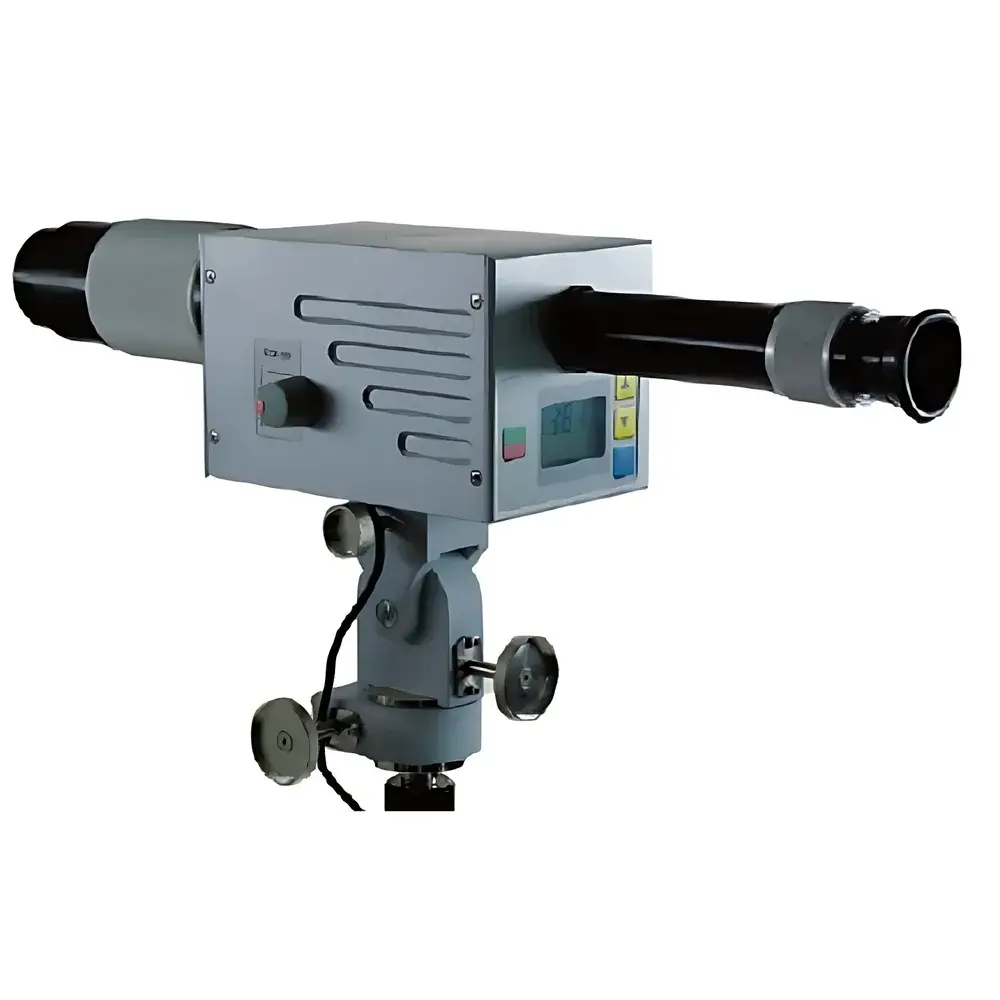
KELLER HCW Mikro Series Optical Pyrometer PV11
| Brand | KELLER HCW |
|---|---|
| Origin | Germany |
| Type | Portable Optical Pyrometer |
| Model | PV11 |
| Temperature Range | 700–3500 °C |
| Minimum Spot Size | 0.1 mm |
| Distance-to-Spot Ratio | up to 5000:1 (e.g., Ø1 mm target at 5 m) |
| Measurement Principle | Visual Intensity Comparison (Two-Color Reference Filament Method) |
| Emissivity Sensitivity | Low |
| Display | Integrated Digital Readout |
Overview
The KELLER HCW Mikro Series Optical Pyrometer PV11 is a precision portable instrument engineered for non-contact, high-temperature measurement of micro-scale targets in research and industrial environments. Based on the classical two-color visual intensity comparison principle—also known as the disappearing-filament method—the PV11 compares the spectral radiance of a calibrated tungsten reference filament against that of the target object within the visible to near-infrared band (typically centered around 650 nm). When the filament’s brightness visually matches the target’s thermal emission through the eyepiece, thermal equilibrium is indicated, and the corresponding temperature is directly derived from Planck’s radiation law and pre-calibrated filament current–temperature relationships. This method inherently minimizes dependence on surface emissivity, making the PV11 especially reliable for materials with unknown or variable emissivity—such as oxidized metals, refractory ceramics, or thin filaments—where conventional single-wavelength infrared thermometers would introduce significant systematic error.
Key Features
- Visual alignment with high-magnification optical system enabling clear imaging of targets as small as 0.1 mm in diameter
- Manually adjustable reference filament brightness via precision potentiometer, ensuring intuitive and repeatable null-point detection
- Integrated digital temperature display synchronized with filament current calibration, eliminating analog scale interpolation errors
- Optical design optimized for high depth-of-field and minimal parallax, supporting stable measurements across variable working distances
- Distance-to-spot ratio up to 5000:1—enabling accurate measurement of a Ø1 mm target from 5 m distance without recalibration
- Rugged aluminum housing rated for laboratory and light industrial use; compliant with IEC 61000-4 electromagnetic immunity standards
Sample Compatibility & Compliance
The PV11 is routinely deployed for temperature characterization of geometrically constrained or transiently heated specimens where contact sensors are impractical or intrusive—including tungsten lamp filaments, sintered uranium oxide pellets, graphite furnace inserts, and laser-heated microsamples. Its measurement validity is traceable to national primary standards (e.g., PTB Germany), and calibration certificates per ISO/IEC 17025 are available upon request. While not certified for continuous process control under SIL or FDA 21 CFR Part 11, the instrument meets general metrological requirements for research-grade thermal validation in GLP-compliant laboratories. It is compatible with standard optical benches and can be mounted on kinematic stages for integration into absorption spectrometers or vacuum chamber viewports (with appropriate quartz or sapphire window transmission matching the 650 nm operating wavelength).
Software & Data Management
The PV11 operates as a standalone optical comparator and does not require external software or drivers. All measurement data is displayed locally on its integrated LCD and may be manually recorded. For traceability-critical applications, users may log readings alongside timestamps and operator IDs in laboratory notebooks or LIMS-compatible spreadsheets. Optional accessories include a digital camera adapter for documentation of alignment and filament matching events—supporting audit-ready image archives aligned with ISO 17025 clause 7.7 (result reporting). No firmware updates or cloud connectivity are implemented, preserving measurement integrity and avoiding cybersecurity exposure vectors common in networked instrumentation.
Applications
- Calibration and verification of IR thermometers and thermographic systems in metrology labs
- Temperature profiling of filament-based light sources during lifetime testing (e.g., halogen, incandescent, and specialty discharge lamps)
- In-situ thermal monitoring of small metallic or ceramic samples inside high-vacuum furnaces or inert-atmosphere gloveboxes
- Validation of heating profiles in atomic absorption spectroscopy graphite tube atomizers
- Material science studies involving rapid resistive heating, spark plasma sintering (SPS), or laser-induced thermal gradients
- Reference-grade temperature assignment in inter-laboratory round-robin studies under ASTM E2319 or ISO 18434-1 guidelines
FAQ
What is the fundamental measurement principle of the PV11?
It employs the visual disappearing-filament method: a calibrated tungsten filament is superimposed optically onto the target image; manual adjustment of filament current brings its brightness into visual equivalence with the target’s thermal emission at ~650 nm.
Does emissivity need to be set before measurement?
No—emissivity influence is intrinsically suppressed by the intensity-matching principle, though optimal accuracy assumes gray-body behavior above 700 °C.
Can the PV11 measure through protective windows?
Yes, provided the window material (e.g., fused silica, sapphire) exhibits ≥85% transmittance at 650 nm and is free of coatings or thermal drift effects.
Is the PV11 suitable for automated or continuous monitoring?
No—it is a manually operated, point-measurement instrument intended for periodic verification, not real-time process control.
What calibration standards support the PV11’s traceability?
Factory calibration is referenced to PTB-traceable blackbody sources; accredited recalibration services follow ISO/IEC 17025 procedures with uncertainty budgets reported per GUM (JCGM 100:2008).