KELLER MSR CellaTemp PA Series Infrared Pyrometer
| Brand | KELLER MSR |
|---|---|
| Origin | Germany |
| Type | Online Infrared Pyrometer |
| Model | PA Series |
| Optical Configurations | 4 Interchangeable Lenses |
| Target Spot Size | Down to 0.3 mm |
| Distance-to-Spot Ratio | Adjustable via Lens Selection |
| Analog Outputs | 2 (configurable as input/output) |
| Input/Output Flexibility | One analog channel可 configured as process input (e.g., furnace reference compensation) |
| Emissivity Compensation | Adjustable + Custom Correction Curve |
| Environmental Compensation | Transmission loss correction for protective windows, ambient radiation compensation |
| Targeting Options | Eyepiece viewfinder, Class 2 laser pointer, external video camera interface |
| Interface | USB, RS-485 (multi-drop network capable) |
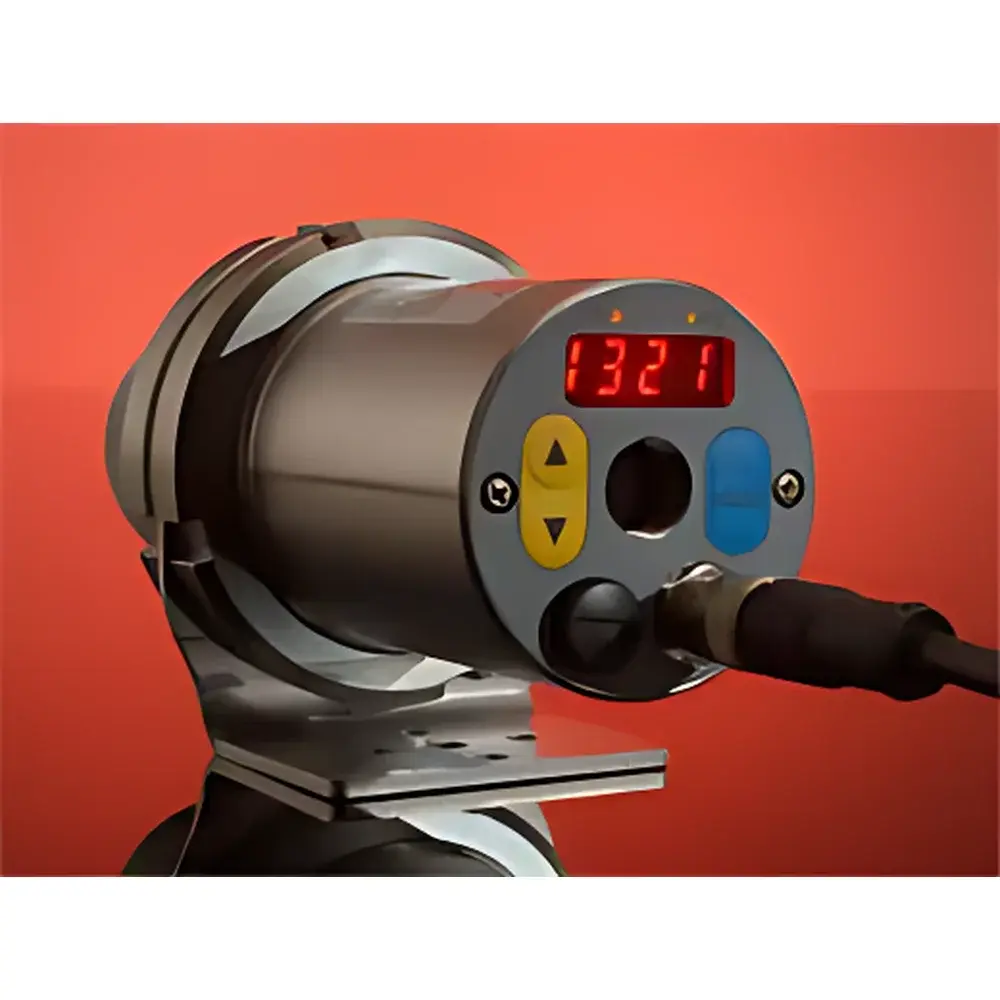
| Display & Control | Integrated LED display + membrane keypad |
| Signal Processing | Adjustable smoothing, linearization, hold functions |
Overview
The KELLER MSR CellaTemp PA Series is a modular, high-precision online infrared pyrometer engineered for industrial process monitoring and control in demanding thermal environments. Operating on the principle of non-contact infrared radiation detection, the PA Series measures surface temperature by capturing emitted mid-infrared energy (typically within 1.0–1.6 µm or 2.2–2.6 µm spectral bands, depending on lens and application configuration) and converting it into a calibrated temperature value using Planck’s law and Stefan-Boltzmann relationships. Its modular architecture—comprising independent optical assemblies, detector modules, signal conditioning electronics, embedded controller, and configurable I/O subsystems—enables field-adaptable deployment across metallurgy, glass manufacturing, semiconductor processing, heat treatment, and ceramic sintering applications where continuous, real-time thermal feedback is critical for quality assurance and process stability.
Key Features
- Modular design with 4 interchangeable precision optics, supporting spot sizes from 0.3 mm up to several centimeters at working distances ranging from millimeters to multiple meters—enabling accurate measurement of micro-components, thin wires, or large-scale furnace zones.
- Dual analog outputs (0/4–20 mA or 0–10 V), each independently assignable to primary temperature, compensated temperature, or derived process variables; one output channel may be reconfigured as an analog input for feed-forward compensation (e.g., integrating furnace wall temperature to correct emissivity drift).
- Advanced radiometric calibration framework including user-definable emissivity tables, transmittance correction for quartz or sapphire protective windows, and ambient radiation compensation algorithms to mitigate reflected background interference.
- Configurable non-linear correction curve (up to 20-point user-defined lookup table) for application-specific linearity optimization across extended or segmented temperature ranges.
- Multi-mode targeting: integrated eyepiece viewfinder with crosshair reticle, Class 2 visible laser pointer (IEC 60825-1 compliant), or optional integration with external machine vision cameras for remote or obscured target acquisition.
- Embedded configuration interface featuring backlit LED display and tactile membrane keypad—supporting full parameter setup without external tools; also compatible with PC-based configuration via USB or industrial RS-485 Modbus RTU communication.
Sample Compatibility & Compliance
The CellaTemp PA accommodates a broad range of emissive and semi-transmissive surfaces—including oxidized metals, molten glass, graphite fixtures, ceramic substrates, and coated silicon wafers—provided spectral band selection aligns with material emissivity characteristics and atmospheric transmission windows. It complies with CE marking requirements under the EU Electromagnetic Compatibility (2014/30/EU) and Low Voltage (2014/35/EU) Directives. All optical interfaces meet IP65 ingress protection when fitted with standard housing options. The device supports traceable calibration per ISO/IEC 17025-accredited procedures and is compatible with GLP/GMP documentation workflows when paired with validated configuration logs and audit-trail-enabled software tools.
Software & Data Management
Configuration and diagnostics are managed via KELLER MSR’s proprietary CellaSoft PC application (Windows-compatible), which provides full access to all instrument parameters—including emissivity mapping, correction curve definition, analog I/O routing, smoothing time constants, and alarm thresholds. RS-485 connectivity enables integration into SCADA, DCS, or PLC systems using standard Modbus RTU protocol, supporting up to 32 devices on a single bus. USB mode allows direct firmware updates and secure parameter backup/restore. All configuration changes are timestamped and logged internally, supporting FDA 21 CFR Part 11-compliant electronic record integrity when used with appropriate validation packages.
Applications
- Continuous monitoring of strip steel annealing furnaces with dynamic emissivity compensation during oxide layer formation.
- Real-time temperature profiling of semiconductor wafer edges during rapid thermal processing (RTP).
- Non-contact control of glass ribbon temperature in float glass production lines, compensating for window fouling over time.
- In-line thermal verification of brazed joints in aerospace component manufacturing.
- Monitoring of additive manufacturing build plates to prevent thermal warping or delamination.
- Quality-critical temperature supervision in pharmaceutical lyophilization chamber shelves.
FAQ
What spectral response options are available for the CellaTemp PA?
Standard configurations operate in either the 1.0–1.6 µm (for high-temperature metals >600 °C) or 2.2–2.6 µm (for lower-emissivity materials and glass) bands; custom spectral filters are available upon request.
Can the CellaTemp PA compensate for dirty protective windows?
Yes—the instrument supports user-input transmittance values for quartz, sapphire, or borosilicate windows, and applies real-time correction based on measured signal attenuation.
Is it possible to integrate the PA Series into an existing Modbus network?
Yes—RS-485 interface supports Modbus RTU protocol with configurable slave ID, baud rate (up to 115.2 kbps), and parity settings for seamless DCS/SCADA integration.
Does the device support alarm outputs or digital switching functions?
While the PA Series does not include dedicated relay outputs, its dual analog channels can be assigned switch-like behavior (e.g., 4–20 mA output toggled between two setpoints) and used with external comparators or PLC logic inputs.
How is calibration traceability maintained?
Each unit ships with a factory calibration certificate referencing NIST-traceable blackbody sources; field recalibration services are available through KELLER MSR authorized labs adhering to ISO/IEC 17025 standards.