
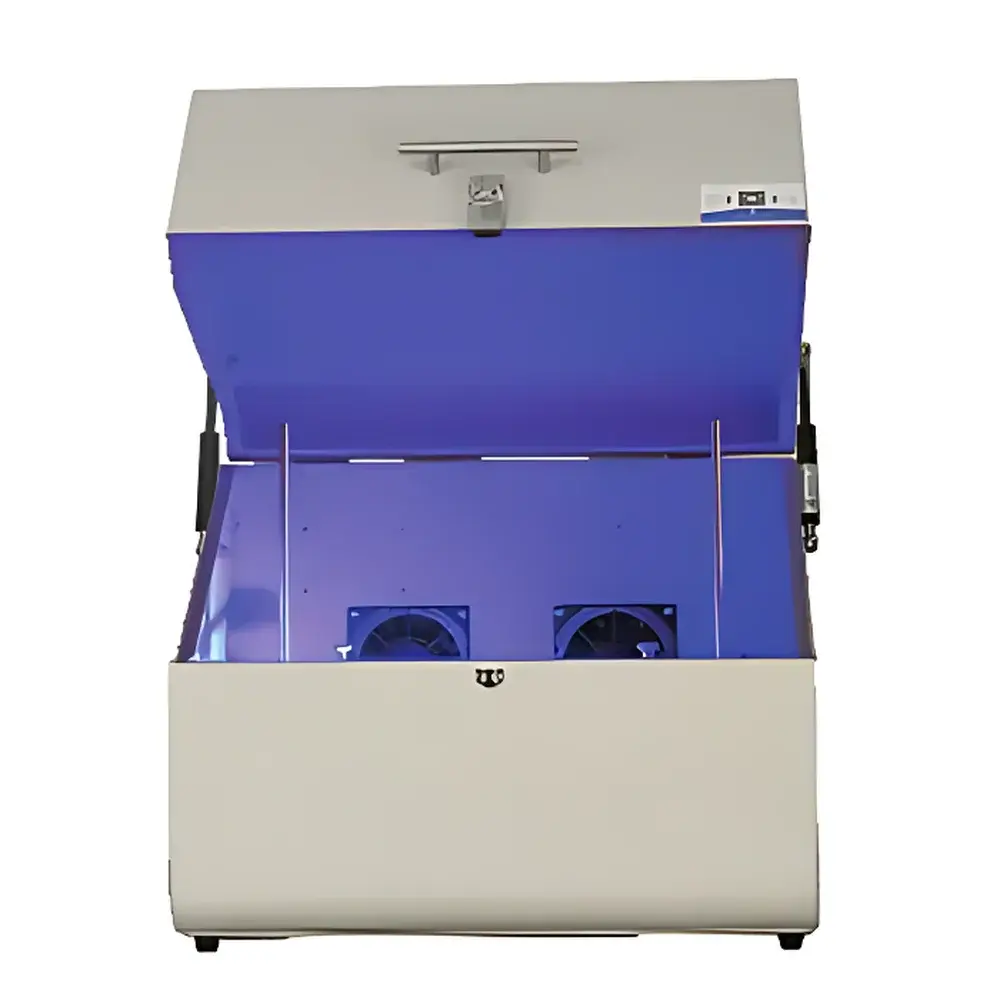
Kessil LED Light Source Enclosure FLB-4
| Brand | Ahkemi |
|---|---|
| Origin | Anhui, China |
| Manufacturer Type | Authorized Distributor |
| Country of Origin | China |
| Model | FLB-4 |
| Price Range | USD 2,800 – 7,000 (FOB) |
| Chamber Capacity | Small-scale (≤50 mL typical use) |
| Operating Pressure | Low-pressure ambient environment |
| Vacuum Capability | Not applicable |
| Structural Material | Anodized aluminum housing with borosilicate glass viewport |
| Cooling System | Dual axial fans (rear-mounted, thermostatically regulated) |
| LED Mounting | Four fixed-position Kessil A365/A400-series compatible sockets (M4 threaded, 12 V DC input) |
| Power Input | 100–240 V AC, 50/60 Hz |
| IP Rating | IP20 (indoor laboratory use only) |
Overview
The Ahkemi FLB-4 Kessil LED Light Source Enclosure is an engineered optical containment system designed specifically for controlled photochemical synthesis and photocatalytic reaction studies under ambient or low-pressure inert atmospheres. Unlike open-bench LED arrays, the FLB-4 integrates four precisely positioned Kessil LED modules—compatible with industry-standard Kessil A365 (365 nm), A400 (400 nm), or multi-wavelength variants—within a rigid, light-tight enclosure. Its operational principle relies on spatially uniform irradiation delivery to reaction vessels placed on a central platform, minimizing stray light exposure and enabling reproducible photon flux dosimetry (measured in mW/cm² at sample plane). The enclosure operates exclusively under atmospheric or slightly sub-atmospheric conditions (no vacuum or pressurization capability), making it suitable for Schlenk-line-integrated workflows, glovebox-adjacent setups, or standalone benchtop photoreactor configurations.
Key Features
- Four independently mountable Kessil LED sockets—engineered for mechanical stability and thermal decoupling from the reaction zone;
- Hinged front-access design with tempered borosilicate glass viewport (UV-transmissive, ≥90% T at 365 nm), facilitating rapid catalyst loading, vial exchange, and real-time visual monitoring without light leakage;
- Dual rear-mounted axial cooling fans with temperature-responsive speed control, maintaining LED junction temperatures ≤65°C during continuous operation and reducing thermal drift in temperature-sensitive photoreactions;
- Anodized aluminum chassis offering electromagnetic shielding, structural rigidity, and corrosion resistance to common organic solvents and mild acid/base vapors;
- Modular power distribution board supporting individual LED channel ON/OFF switching and optional external TTL triggering (via 3.5 mm jack);
- No internal gas manifold or pressure regulation—intended for use with externally supplied inert gas purging via standard 1/8″ Swagelok fittings (not included).
Sample Compatibility & Compliance
The FLB-4 accommodates standard photochemical reaction formats including 5–25 mL screw-cap quartz or Pyrex test tubes, custom 3D-printed reactor inserts, and flat-bottom cuvettes up to 15 mm width. It complies with IEC 61000-6-3 (EMC emission limits) and IEC 61010-1:2010 (safety requirements for electrical equipment for measurement, control, and laboratory use). While not certified to UL or CE for standalone medical or industrial deployment, its construction adheres to GLP-aligned lab infrastructure standards—including traceable material sourcing (aluminum alloy 6061-T6, ASTM B221), non-outgassing internal finishes, and documented thermal derating curves for all LED drivers. No ISO 17025 calibration certificate is provided; users are advised to perform in-situ actinometry (e.g., using potassium ferrioxalate or Aberchrome 540) prior to quantitative quantum yield determination.
Software & Data Management
The FLB-4 operates as a hardware platform without embedded firmware or proprietary software. All LED intensity control, timing sequences, and thermal logging must be managed externally—either via Kessil’s native K-Drive software (v3.2+), LabVIEW-compatible DAQ interfaces (NI USB-6009), or Python-controlled Arduino-based TTL pulse generators. The unit provides no built-in data storage, audit trail, or 21 CFR Part 11 compliance features. For regulated environments (e.g., pharmaceutical process development), integration with validated LIMS or ELN systems requires third-party validation documentation and user-defined SOPs covering light source calibration frequency, fan performance verification, and viewport transmittance decay monitoring (recommended every 500 h of UV operation).
Applications
- Visible-light-mediated C–N, C–O, and C–C cross-coupling reactions (e.g., Ru(bpy)₃²⁺- or Ir(ppy)₃-catalyzed transformations);
- Heterogeneous photocatalysis screening (TiO₂, g-C₃N₄, MOF-based systems) under controlled spectral output;
- Photopolymerization kinetics studies requiring wavelength-specific initiation (e.g., acrylate vs. thiol-ene systems);
- Photoinduced electron transfer (PET) and energy transfer (EnT) mechanistic investigations;
- Preparative-scale solar simulator–alternative setups where spectral tunability and spatial homogeneity outweigh total irradiance requirements.
FAQ
Is the FLB-4 compatible with non-Kessil LED sources?
Yes—provided the alternative LED module conforms to M4 mounting thread, 12 V DC input, and ≤30 W thermal load per socket. Users must verify spectral output alignment and thermal interface compatibility independently.
Can the enclosure be used inside a nitrogen-filled glovebox?
Yes—its compact footprint (W320 × D280 × H260 mm) and absence of internal gas lines allow safe placement inside Class I gloveboxes; external power feedthroughs must maintain glovebox integrity.
Does Ahkemi provide photometric calibration data for the FLB-4?
No—calibration is performed at the LED module level by Kessil. Ahkemi supplies factory test reports confirming socket voltage/current stability and fan airflow (≥25 CFM at 25°C), but not absolute irradiance values.
What maintenance intervals are recommended?
Viewport cleaning with IPA every 20 h of UV operation; fan filter inspection every 100 h; LED socket torque verification (1.2 N·m) every 500 h.
Is there an option for automated gas purging integration?
Not natively—the FLB-4 has two 1/8″ Swagelok ports (inlet/outlet) for user-installed mass flow controllers and purge timers; no OEM gas management module is available.



