
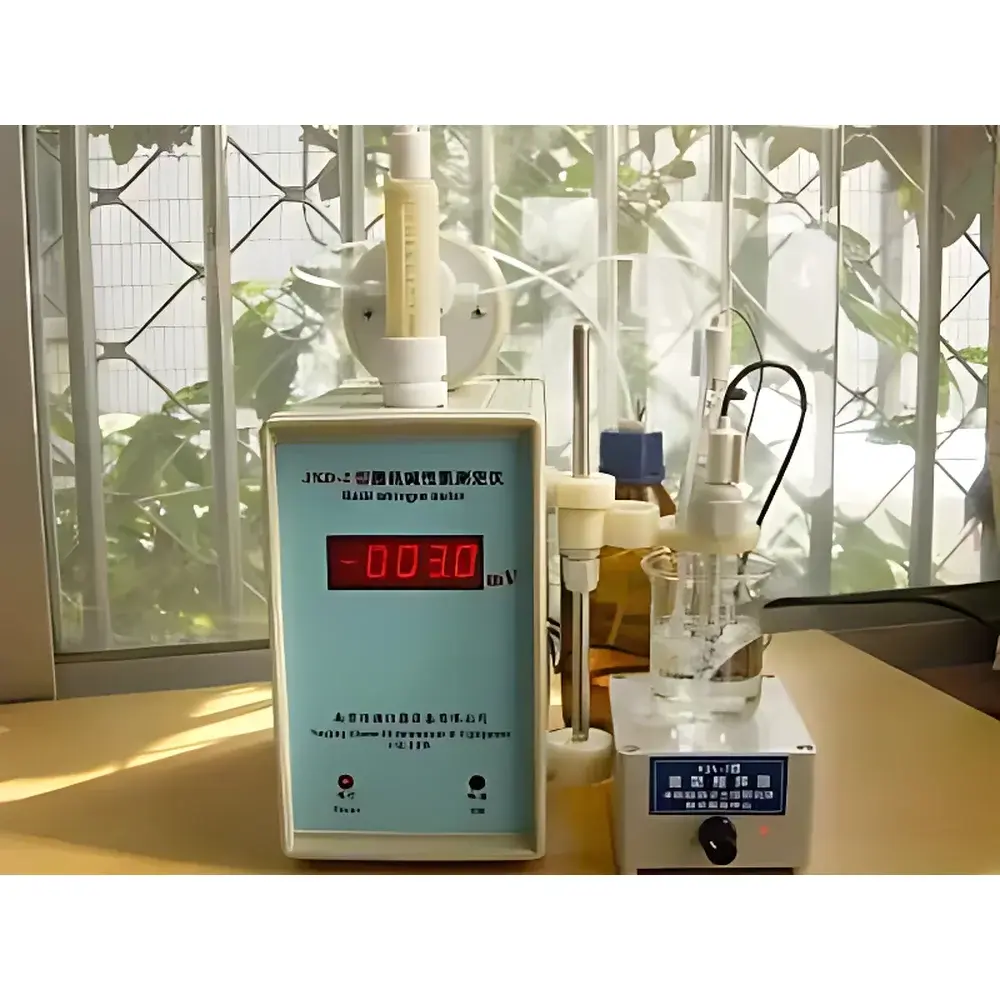
Kew JXD-2 Microcomputer-Based Alkaline Nitrogen Analyzer
| Origin | Jiangsu, China |
|---|---|
| Manufacturer Type | Authorized Distributor |
| Product Origin | Domestic (China) |
| Model | JXD-2 |
| Instrument Type | Alkaline Nitrogen & Mercaptan Sulfur Analyzer |
| Measurement Range | ≥3 µg/g |
| Potential Range | 0 to ±1999.9 mV, Resolution: 0.1 mV |
| Potential Accuracy | ±0.025% of reading + 2 digits |
| Input Impedance | ≥1 × 10¹² Ω |
| Burette Capacity | 10 mL, Minimum Dispense Volume: 0.01 mL |
| Relative Error | ≤5% |
| Repeatability | Compliant with SH/T 0162 |
| Dimensions | 240 × 120 × 210 mm |
| Weight | 5 kg |
| Power Consumption | ≤10 W |
Overview
The Kew JXD-2 Microcomputer-Based Alkaline Nitrogen Analyzer is a dedicated potentiometric titrator engineered for precise quantification of alkaline nitrogen in petroleum products—including gasoline, kerosene, diesel, and lubricating oils—regardless of sample color or matrix complexity. It operates on the principle of non-aqueous potentiometric titration using perchloric acid in glacial acetic acid as the titrant, dissolved in a benzene–glacial acetic acid solvent system. This method enables selective protonation of basic nitrogen-containing compounds (e.g., pyridines, quinolines, and alkylamines), with endpoint detection achieved via high-impedance potential monitoring. Unlike indicator-based methods, the JXD-2 eliminates subjectivity, interferences from colored matrices, and solvent-induced endpoint drift—making it compliant with industry-standard test methods including SH/T 0162 and aligned with ASTM D2597 and IP 352 frameworks for nitrogen speciation in hydrocarbons.
Key Features
- High-stability dual high-impedance input circuitry supporting three-electrode configurations (working, reference, auxiliary), ensuring robust electrode potential stability and reproducible endpoint discrimination.
- Chemically resistant fluidic architecture: all wetted components—including syringe pumps, solenoid valves, PTFE-lined tubing, and diffusion-resistant titration tips—are rated for continuous exposure to concentrated perchloric acid, glacial acetic acid, and aqueous sodium hydroxide solutions.
- Integrated microcomputer control with intuitive menu-driven interface; supports automated reagent replenishment, volumetric accumulation, and programmable rinse cycles (auto or manual via syringe-assisted cleaning).
- Smart endpoint recognition powered by Smooth Titration Endpoint (STE) algorithm—a rule-based expert system that dynamically fits first-derivative curves without requiring user-defined threshold parameters.
- Real-time graphical display of titration curves (E vs. V), intermediate calculation results, and operator-configurable settings—all rendered simultaneously during analysis on the connected PC.
- Full data autonomy: automatic acquisition, arithmetic processing (including blank correction, titer calibration, and mass-normalized reporting), endpoint refinement (e.g., manual override, multi-point validation, post-hoc endpoint deletion/reinsertion), and GLP-compliant audit trail logging.
Sample Compatibility & Compliance
The JXD-2 accommodates a broad range of petroleum distillates and residual fuels, from low-viscosity naphthas to high-boiling lubricant base stocks. Its non-aqueous titration environment mitigates hydrolysis artifacts and enables accurate alkaline nitrogen determination in samples containing sulfur compounds, olefins, or aromatic heterocycles—without cross-interference. The instrument meets mechanical and electrical safety requirements per GB/T 28290 (Chinese national standard for automatic titrators) and supports traceability under ISO/IEC 17025 quality management systems. While not FDA 21 CFR Part 11–certified out-of-the-box, its data export protocols (CSV, XML) and timestamped operation logs are compatible with validated LIMS integration for regulated QC/QA environments.
Software & Data Management
Control and analysis software runs on Windows OS (7/10/11, 64-bit) and provides full local storage of raw potential/volume datasets, processed reports, and annotated titration plots. Each assay record includes operator ID, date/time stamps, reagent lot numbers, calibration history, and digital signatures where enabled. Export formats support laboratory-wide data aggregation and statistical process control (SPC). Audit trails capture all parameter modifications, endpoint adjustments, and manual interventions—ensuring alignment with GLP documentation practices and internal QA review procedures.
Applications
- Refinery QC: Monitoring nitrogen content in hydrotreated feedstocks and finished fuels to ensure catalyst protection and compliance with ultra-low-sulfur diesel (ULSD) specifications.
- Lubricant formulation: Quantifying basic nitrogen additives (e.g., dispersants, corrosion inhibitors) and assessing thermal stability degradation profiles.
- Research laboratories: Studying nitrogen speciation effects on oxidation onset temperature, deposit formation, and NOx emissions in combustion studies.
- Third-party testing labs: Delivering accredited test reports per SH/T 0162 for contract analysis of crude assays, blending components, and marine fuel certifications.
FAQ
What titration method does the JXD-2 use, and why is it preferred for alkaline nitrogen analysis?
It employs non-aqueous potentiometric titration with perchloric acid in glacial acetic acid, offering superior selectivity, reproducibility, and independence from sample color—critical for heterogeneous petroleum matrices.
Is the instrument suitable for mercaptan sulfur analysis as well?
Yes—its hardware platform and electrochemical architecture support dual-method deployment; mercaptan sulfur determination follows IP 57 or ASTM D3229 using silver nitrate titration with appropriate electrode configuration.
Can the JXD-2 be integrated into a networked laboratory information management system (LIMS)?
Yes—via standardized file exports (CSV, XML) and optional OPC UA or TCP/IP communication modules for real-time data streaming to enterprise QA platforms.
Does the system comply with international regulatory standards such as ISO/IEC 17025?
The instrument’s measurement performance, traceable calibration routines, and data integrity features align with ISO/IEC 17025 clause 7.7 (ensuring technical validity of results); formal accreditation requires lab-specific validation per local authority requirements.
What maintenance is required for long-term operational reliability?
Routine maintenance includes periodic verification of burette seal integrity, electrode conditioning (Ag/AgCl reference, platinum indicator), and cleaning of fluidic pathways after high-concentration acid use—typically every 50–100 assays depending on sample load.





