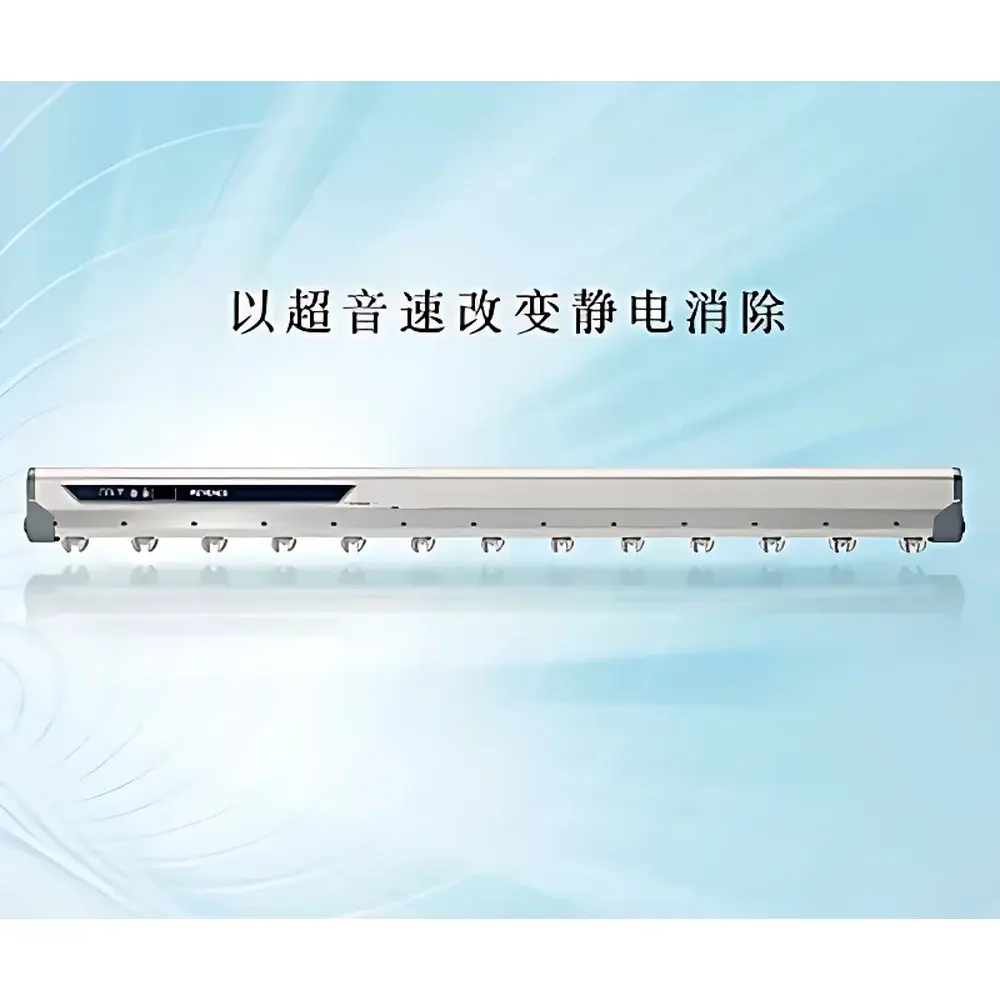
KEYENCE SJ-E Series Hybrid Ultra-High-Speed Induction Static Eliminator
| Brand | KEYENCE |
|---|---|
| Origin | Japan |
| Manufacturer Type | Original Equipment Manufacturer (OEM) |
| Product Origin | Imported |
| Model | SJ-E |
| Pricing | Available Upon Request |
Overview
The KEYENCE SJ-E Series Hybrid Ultra-High-Speed Induction Static Eliminator is an engineered solution for precision static control in high-speed industrial environments—particularly where rapid material handling, cleanroom-compatible operation, and energy-efficient ion generation are critical. Unlike conventional corona-based or AC/DC static bars, the SJ-E leverages a proprietary supersonic ion acceleration architecture that propels ions beyond sonic velocity (~343 m/s in ambient air), enabling significantly faster neutralization kinetics. This principle relies on controlled electrostatic induction combined with pulsed high-voltage field modulation, generating balanced positive and negative ions with minimal residual voltage offset (< ±5 V typical at 300 mm distance). Designed for integration into semiconductor fabrication lines, precision printing, film lamination, and medical device packaging systems, the SJ-E meets the stringent demands of modern automated production—where static-induced defects, particle attraction, and process downtime must be minimized without compromising airflow efficiency or compressed air consumption.
Key Features
- Supersonic Ion Acceleration: Patented “Supersonic Structure” enables ion velocities exceeding Mach 1, achieving static decay times up to 2× faster than legacy KEYENCE SJ series units under identical test conditions (per IEC 61340-5-1:2016 methodology).
- Ultra-Low Air Consumption: Optimized nozzle geometry and pulse-synchronized ion emission reduce compressed air usage by approximately 60% versus prior-generation models—supporting ISO 50001-aligned energy management initiatives.
- Extended Effective Range: Uniform ion distribution across a 2× wider working envelope (up to 600 mm from emitter tip at optimal pressure), validated via calibrated field meter mapping per ANSI/ESD STM3.1.
- Maintenance-Free Operation: Non-contact induction design eliminates electrode contamination and wear; no cleaning intervals or replacement parts required during normal service life (>50,000 hours MTBF).
- Digital Remote Control Interface: RS-485 Modbus RTU and optional EtherNet/IP support enable centralized parameter adjustment—including ion balance offset, pulse frequency, and output intensity—without physical access to the unit.
Sample Compatibility & Compliance
The SJ-E Series is compatible with non-conductive and semi-conductive substrates including PET, PP, PE films, silicon wafers, glass panels, and molded plastic components. It operates effectively across surface resistivities from 10⁹ Ω/sq to >10¹⁴ Ω/sq. Units comply with IEC 61000-6-3 (EMC emission limits), IEC 61000-6-2 (immunity), and UL 61010-1 (safety). All models are CE-marked and meet RoHS 2011/65/EU requirements. For regulated industries, the device supports audit-ready configuration logging and time-stamped operational records when integrated with compliant SCADA or MES platforms—facilitating alignment with FDA 21 CFR Part 11 data integrity expectations where electronic records are retained.
Software & Data Management
KEYENCE provides the free SJ-Config software suite (Windows OS) for local setup, real-time monitoring, and firmware updates. Configuration parameters—including ion balance setpoint (±10 V resolution), pulse repetition rate (1–10 kHz), and auto-calibration cycles—are stored in non-volatile memory with write-protection options. When deployed with KEYENCE’s KV-8000 programmable logic controller or third-party systems supporting Modbus TCP, full traceability is achieved: timestamped event logs (e.g., airflow fault, HV timeout, balance drift alert) can be exported in CSV format for quality documentation. Optional cloud connectivity via KEYENCE Edge Gateway enables remote diagnostics and predictive maintenance analytics based on cumulative operating hours and environmental feedback.
Applications
- Semiconductor wafer handling and photomask inspection stations
- High-speed flexographic and gravure printing presses (web speeds ≥ 500 m/min)
- Cleanroom-grade medical packaging lines (ISO Class 5–7)
- Automated optical film laminating cells for display manufacturing
- Electrostatic-sensitive electronics assembly conveyors (ESD Protected Areas per ANSI/ESD S20.20)
- Pharmaceutical blister packaging and label application zones
FAQ
What is the recommended operating air pressure range?
Optimal performance is achieved at 0.2–0.5 MPa (2–5 bar) supply pressure; minimum functional pressure is 0.15 MPa.
Can the SJ-E operate in nitrogen-purged environments?
Yes—verified operation in N₂ atmospheres with O₂ content <1%; ion lifetime and decay performance remain within specification.
Is ion balance adjustable in real time during production?
Yes—via digital interface with sub-second response; balance correction is applied without interrupting emission cycle.
Does the unit require grounding to the machine frame?
Yes—functional grounding per IEC 61000-5-2 is mandatory for electromagnetic compatibility and operator safety.
How is calibration verified post-installation?
Users may perform field verification using a calibrated electrostatic field meter (e.g., Trek Model 520); KEYENCE recommends annual verification against traceable standards.