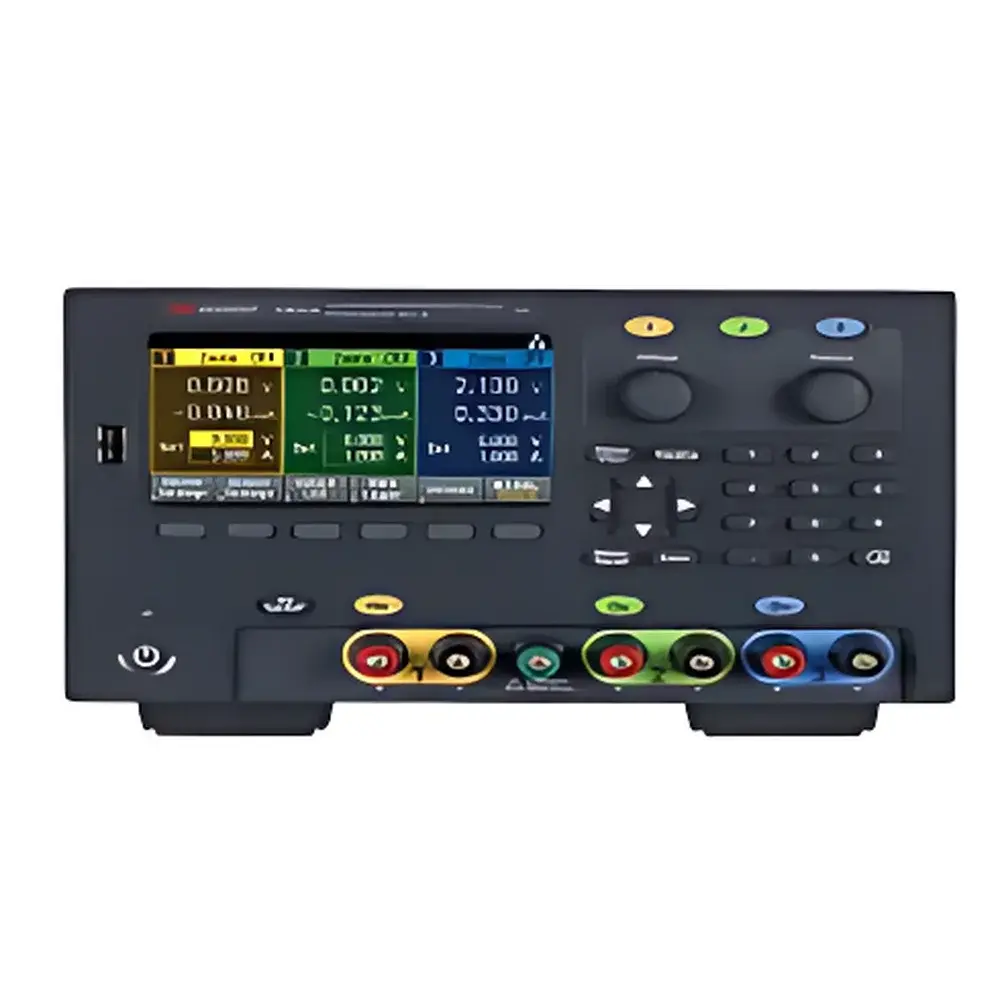
Keysight Technologies E36300 Series Triple-Output DC Power Supply
| Brand | Keysight Technologies |
|---|---|
| Origin | USA |
| Model | E36300 |
| Output Channels | 3 (independently regulated) |
| Display | High-contrast backlit LCD showing simultaneous V/I readouts for all channels |
| Programming Accuracy | ±0.03% of set value (voltage and current) |
| Output Ripple & Noise | <2 mVpp / 350 µVrms (typ.) |
| Interface Options | USB 2.0, LAN (LXI-C compliant), optional GPIB (IEEE-488.2) |
| Front/Rear Output Terminals | Yes |
| Color-Coded Channels | Yes |
| Control | Dedicated voltage/current knobs per channel |
| Data Logging | Built-in time-stamped measurement recording |
| Output Sequencing & Coupling | Independent or ratio-based channel coupling modes |
| Compliance Standards | CE, UKCA, RoHS, UL/CSA 61010-1 |
Overview
The Keysight Technologies E36300 Series Triple-Output DC Power Supply is a precision benchtop instrument engineered for laboratory, R&D, and production test environments requiring stable, low-noise, and highly controllable DC power across three independent channels. Based on linear regulation architecture, the E36300 delivers exceptional voltage and current stability with minimal thermal drift and high long-term reproducibility—critical for powering sensitive analog circuits, validating mixed-signal ICs, and characterizing power management units (PMUs). Each output channel operates with fully isolated, floating, and ground-referenced capability, supporting both series and parallel configurations where required. Its core design emphasizes metrological integrity: the 0.03% programming accuracy—traceable to NIST-calibrated references—and ultra-low output noise (<350 µVrms) ensure measurements remain unaffected by supply-induced artifacts during low-level signal analysis or sensor biasing applications.
Key Features
- Simultaneous real-time display of voltage and current for all three outputs on a single high-contrast LCD—eliminating manual channel switching during multi-rail device testing.
- Independent analog control per channel via dedicated color-coded voltage and current knobs—enabling rapid, tactile adjustment without menu navigation.
- Low-noise linear regulation architecture delivering <2 mVpp peak-to-peak and <350 µVrms broadband noise—essential for powering RF front-ends, MEMS sensors, and precision ADC/DAC reference stages.
- Flexible output coupling modes: series, parallel, and ratio-based tracking—supporting dynamic rail sequencing (e.g., VCC > VIO startup sequences) and matched load sharing.
- Dual-position output terminals (front and rear panel)—facilitating both quick prototyping and permanent rack integration with minimal cabling rework.
- Standard USB 2.0 and LXI-compliant LAN interfaces, with optional IEEE-488.2 GPIB—ensuring compatibility with legacy ATE systems and modern Python/LabVIEW automated test frameworks.
Sample Compatibility & Compliance
The E36300 supports a broad range of electronic components and subsystems, including but not limited to: microcontrollers with multiple supply domains (e.g., core, I/O, analog), FPGA development boards, op-amp characterization fixtures, battery charging circuitry, and electrochemical cell test setups. All models comply with IEC/EN 61010-1 for electrical safety in measurement and laboratory equipment, carry CE and UKCA markings, and conform to RoHS Directive 2011/65/EU. The embedded firmware supports audit-ready operation under GLP and GMP environments: timestamped data logging includes user ID, channel settings, and environmental metadata; remote command logs are retained for traceability per FDA 21 CFR Part 11 requirements when used with validated software clients.
Software & Data Management
Keysight’s PathWave BenchVue software provides intuitive graphical control, automated data capture, and customizable dashboard visualization for the E36300. Users can configure triggered data logging (min/max/avg), export CSV/TXT files with ISO 8601 timestamps, and generate compliance reports aligned with ISO/IEC 17025 documentation standards. SCPI command support ensures full scriptability in Python, MATLAB, or TestStand environments. Firmware updates are delivered via secure HTTPS and digitally signed to maintain cryptographic integrity—critical for maintaining calibration validity in accredited labs.
Applications
- Power integrity validation of multi-rail SoCs and ASICs during pre-silicon and post-silicon debug.
- Biasing and stress testing of photodiodes, laser diodes, and thermoelectric coolers (TECs) under controlled current sweep conditions.
- Calibration of 4–20 mA loop-powered transmitters and industrial field instruments using programmable current sourcing.
- Education and training in electronics fundamentals—demonstrating Kirchhoff’s laws, Thevenin equivalence, and load regulation behavior with visualized real-time feedback.
- Automated functional testing of power supply units (PSUs), DC-DC converters, and voltage regulators in manufacturing QA workflows.
FAQ
What is the maximum combined output power across all three channels?
The E36300 Series offers model-dependent total power ratings: E36311A (100 W), E36312A (160 W), and E36313A (200 W). Channel-specific limits are defined in the datasheet and must be observed to maintain thermal stability and specification compliance.
Can the E36300 perform arbitrary waveform generation or transient simulation?
No—it is a regulated DC source only. For dynamic load or transient response testing, Keysight recommends pairing it with an electronic load (e.g., N6705C) or using external pulse generators synchronized via trigger I/O.
Is remote programming supported over LAN with TLS encryption?
Yes—LXI Class C compliance includes support for HTTPS-based configuration and SCPI command transmission with TLS 1.2 encryption when enabled via firmware version 2.10 or later.
How often does Keysight recommend calibration for metrological traceability?
Annual calibration is recommended for routine lab use; Keysight-certified calibration services include full uncertainty budgets per ISO/IEC 17025 and provide NIST-traceable certificates with as-found/as-left data.
Are rear-panel outputs electrically identical to front-panel terminals?
Yes—both sets are hardwired to the same internal output stage with identical voltage drop, noise performance, and current rating. Rear terminals are intended for fixed installations and include screw-terminal options for secure connections.