
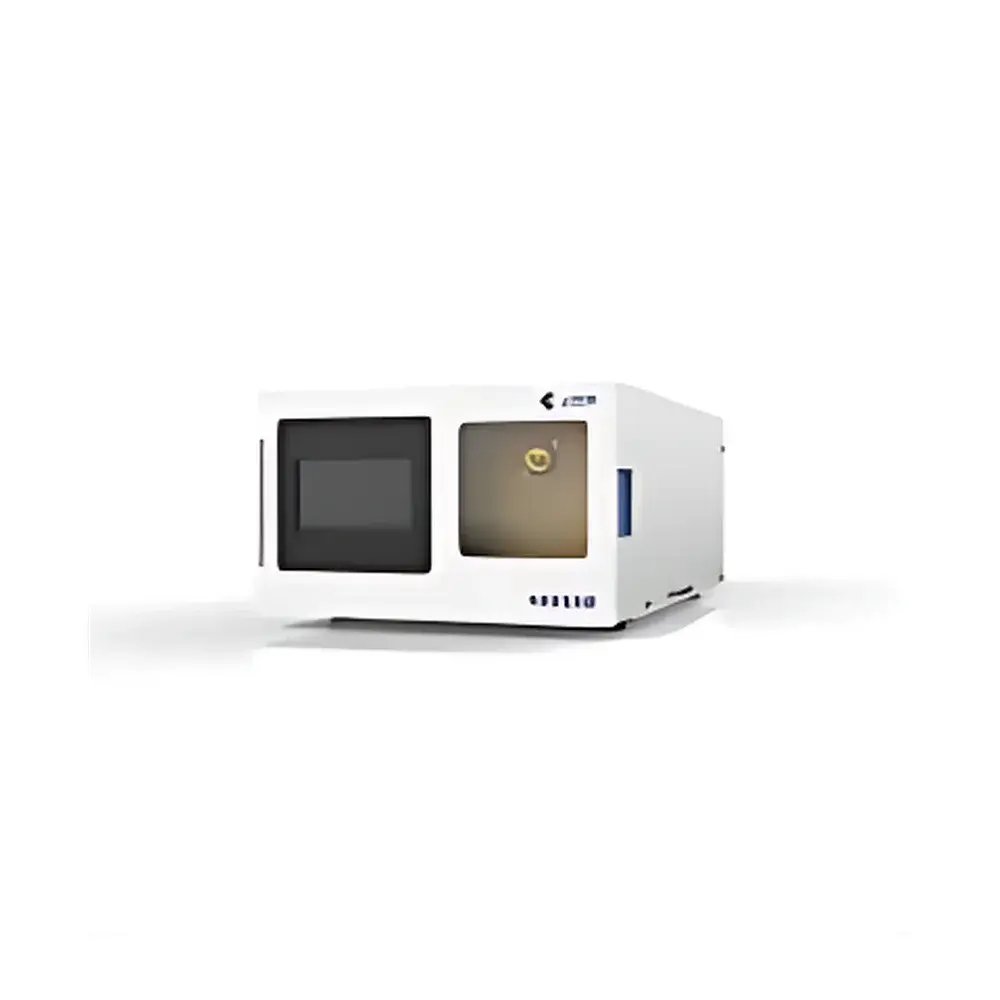
KEZHE CoolMax-2000 Electrospray Detector
| Brand | KEZHE SHANGHAI |
|---|---|
| Origin | Shanghai, China |
| Manufacturer Type | Direct Manufacturer |
| Country of Origin | China |
| Model | CoolMax-2000 |
| Price | ¥200,000 |
| Nebulization Method | FocusJet concentric flow design |
| Mobile Phase Flow Rate | 0.2–2 mL/min |
| Construction Materials | 316 stainless steel, PEEK, fused silica, PTFE |
| Digital Data Acquisition Rate (max) | 100 Hz |
| Digital Noise Filtering | 4th-order low-pass Bessel filter |
| Analog Output Option | 0–1 V DC |
| Evaporation Temperature Settings | 35 °C or 50 °C |
| Preheat Time to 35 °C | <15 min |
| Gas Inlet Pressure | 70–80 psi (0.4–0.5 MPa) |
| Gas Consumption | 4 L/min |
| Gas Pressure Control | Manual |
| Control Interface | PC + integrated touchscreen |
| AD Converter Resolution | 24-bit |
| Detection Limit | pg-level |
Overview
The KEZHE CoolMax-2000 Electrospray Detector is a dedicated universal mass-sensitive detector engineered for high-performance liquid chromatography (HPLC) systems analyzing compounds lacking chromophores—particularly relevant in traditional Chinese medicine (TCM), natural product chemistry, and antibiotic research. Unlike UV-Vis detectors, which rely on electronic transitions in the ultraviolet–visible spectrum, the CoolMax-2000 operates on electrospray ionization (ESI) principles coupled with controlled nebulization, solvent evaporation, and charged particle detection. This enables robust, quantitative response across non-UV-absorbing analytes—including glycosides, polysaccharides, saponins, alkaloid salts, and thermally labile macrolides—without requiring derivatization. Its design emphasizes analytical reproducibility, inter-sample response uniformity, and compatibility with standard HPLC configurations, making it a validated alternative to imported evaporative light scattering detectors (ELSD) and corona-charged aerosol detectors (CAD), especially where regulatory traceability and cost-of-ownership are critical.
Key Features
- FocusJet concentric-flow nebulization system ensures stable droplet generation and minimizes carryover between injections.
- Fully electronic real-time monitoring and computer-controlled regulation of gas flow, pressure, and evaporation temperature via integrated touchscreen and PC interface.
- High-integrity fluidic path constructed from 316 stainless steel, PEEK, fused silica, and PTFE—resistant to aggressive solvents (e.g., chloroform, DMSO, TFA) and compatible with both reversed-phase and HILIC mobile phases.
- Automatic calibration routines for gas flow and temperature actuators reduce operator dependency during method transfer and routine maintenance.
- 24-bit analog-to-digital conversion delivers extended dynamic range (>10⁵) and improved signal-to-noise ratio over legacy 16-bit systems.
- Integrated 4th-order low-pass Bessel digital filtering suppresses high-frequency noise while preserving chromatographic peak shape fidelity.
- Specialized nozzle surface treatment significantly reduces clogging incidence—validated across >500 consecutive injections of crude herbal extracts without cleaning intervention.
- Supports parallel or serial coupling with UV and refractive index (RI) detectors for multi-modal detection strategies in natural product fractionation workflows.
- Optional flow-splitting module enables seamless integration into preparative-scale HPLC systems (up to 20 mL/min total flow).
Sample Compatibility & Compliance
The CoolMax-2000 demonstrates consistent response across diverse compound classes: polar/non-polar small molecules, oligosaccharides, peptides, and quaternary ammonium metabolites. It complies with core instrumentation requirements outlined in USP , ICH Q2(R2), and ISO/IEC 17025 for detector qualification. While not an MS-coupled device, its output meets data integrity expectations under FDA 21 CFR Part 11 when used with the proprietary CoolMax Chromatography Workstation (v3.2+), which supports audit trails, user access levels, electronic signatures, and raw data archiving in vendor-neutral .CDF format. The system has been validated per GLP guidelines in multiple TCM quality control laboratories in China and Southeast Asia for assay of active pharmaceutical ingredients (APIs) in decoction pieces and granule formulations.
Software & Data Management
The CoolMax-2000 is operated exclusively through the KEZHE CoolMax Chromatography Workstation—a Windows-based application supporting method development, instrument control, peak integration, calibration curve generation (linear, quadratic, weighted), and report export (PDF, CSV, Excel). Raw signal data is timestamped and stored with full metadata (gas pressure, temperature setpoint, acquisition rate, filter settings). The software includes built-in compliance tools: session logs, change history tracking, and configurable retention policies aligned with ALCOA+ principles. Integration with third-party CDS platforms (e.g., Waters Empower, Thermo Chromeleon) is supported via ASCII output or optional OPC UA server module.
Applications
- Quantification of UV-silent markers in TCM monographs (e.g., ginsenosides Rb1/Rg1, astragaloside IV, puerarin).
- Stability-indicating assays for heat-sensitive antibiotics (e.g., β-lactams, aminoglycosides) in accelerated degradation studies.
- Profiling of plant secondary metabolites in untargeted natural product screening.
- Residual solvent analysis in botanical extract purification processes.
- Method replacement for ELSD in pharmacopoeial monographs where improved sensitivity and precision are required.
FAQ
Is the CoolMax-2000 compatible with gradient elution methods?
Yes—it maintains stable baseline and linear response across 0–100% organic modifier gradients when operated within specified gas pressure and temperature ranges.
Can it be used with aqueous mobile phases containing >20% buffer salts?
It supports volatile buffers (e.g., ammonium acetate/formate, triethylamine) up to 20 mM; non-volatile salts require post-column diversion or desalting pre-treatment.
Does the system meet GMP documentation requirements?
When deployed with enabled audit trail and electronic signature modules in the workstation, it satisfies GMP Annex 11 and PIC/S PI 011-3 expectations for detector data integrity.
What maintenance intervals are recommended for routine operation?
Nebulizer capillary inspection every 200 injections; annual calibration verification using certified sucrose standards traceable to NIST SRM 2384.
Is remote monitoring supported?
Yes—via secure HTTPS-enabled web interface (optional license), allowing real-time status viewing and alarm notification through enterprise IT infrastructure.



