
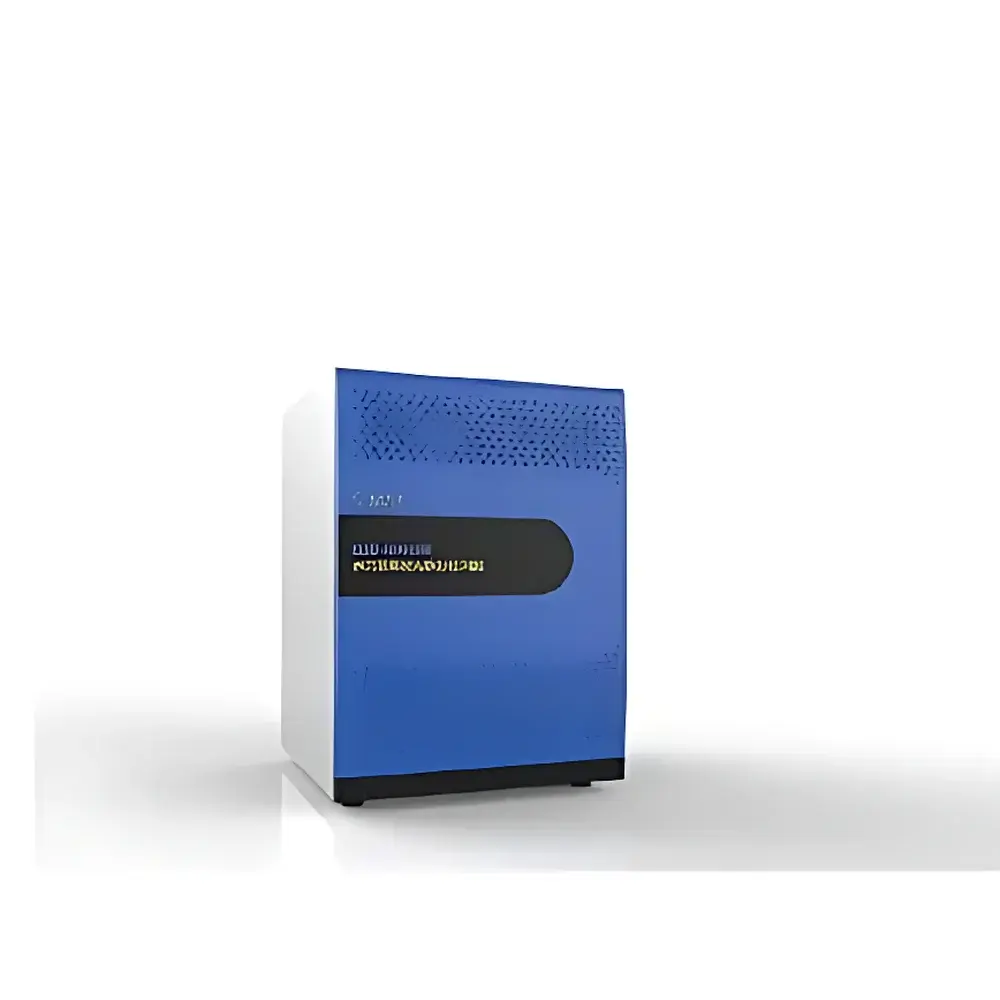
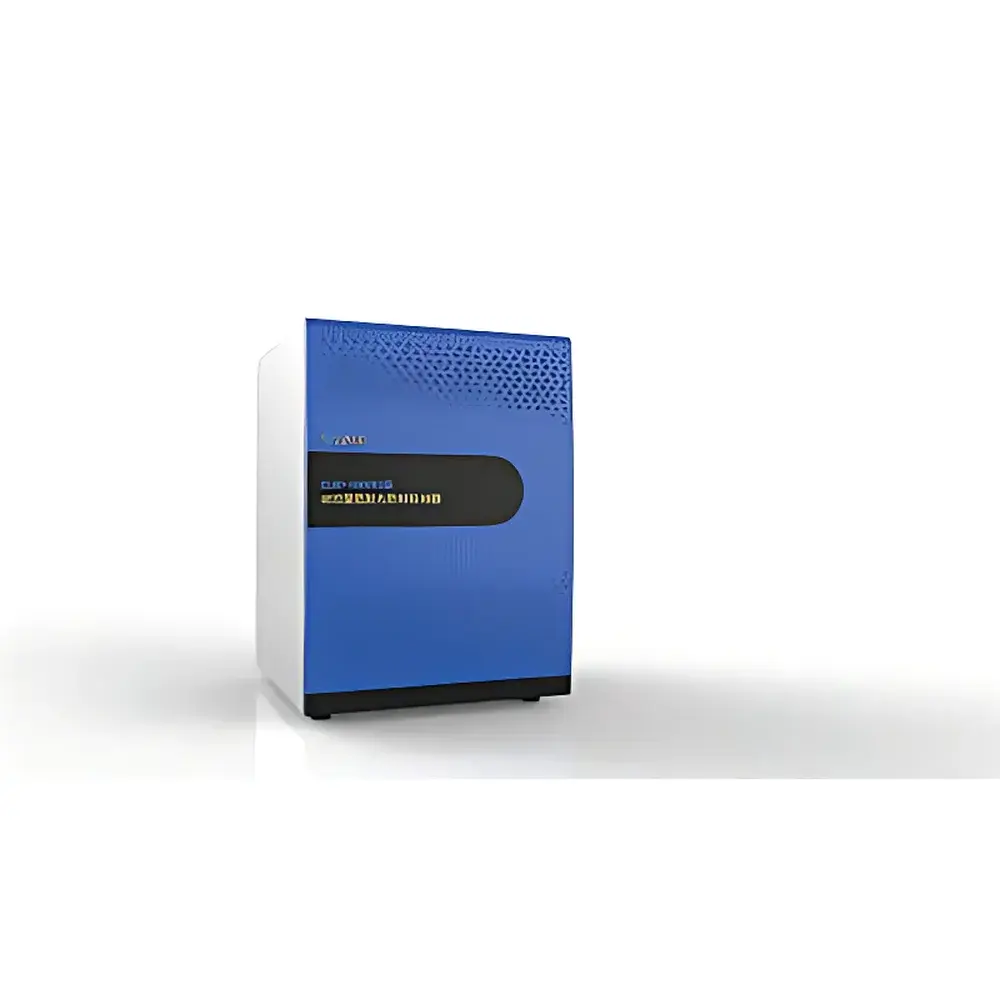
Kezhe ELSD-4000KS Micro-Flow Evaporative Light Scattering Detector
| Brand | Kezhe / KEZHE SHANGHAI |
|---|---|
| Origin | Shanghai, China |
| Manufacturer Type | Direct Manufacturer |
| Instrument Type | Evaporative Light Scattering Detector (ELSD) |
| Wavelength Range | 195–600 nm |
| Detection Mode | Dual-Beam |
| Light Source | Xenon Lamp |
| Gas Flow Range | 0–5 L/min |
| Nebulizer Pressure | 0–100 psi |
| Temperature Control Range | Ambient to 150 °C (±1 °C resolution) |
| Mobile Phase Flow Rate Compatibility | 0–0.5 mL/min |
| Light Source (Standard) | 650 nm Laser |
| Detector | Imported Photomultiplier Tube (PMT) |
| Power Supply | 220 V AC |
| Compatible Carrier Gases | Compressed Air or Nitrogen |
Overview
The Kezhe ELSD-4000KS is a micro-flow evaporative light scattering detector engineered for high-sensitivity, universal detection in liquid chromatography applications where analytes lack strong chromophores or UV absorbance—such as carbohydrates, lipids, surfactants, polymers, and thermally labile natural products. Unlike UV-Vis or fluorescence detectors, the ELSD-4000KS operates on the principle of nebulization, solvent evaporation, and light scattering from non-volatile analyte particles. The sample stream is mixed with a controlled gas flow, atomized into fine droplets via a precision nozzle, and directed through a heated stainless-steel evaporation tube. Volatile mobile phase components are removed under precisely regulated temperature conditions (ambient to 150 °C), leaving behind dried analyte particles that pass through a focused laser beam (650 nm). Scattered light is captured by a high-gain imported photomultiplier tube (PMT) in a dual-beam optical configuration, enabling real-time signal acquisition with low baseline noise and excellent signal-to-noise ratio. Its micro-flow architecture (0–0.5 mL/min) minimizes solvent consumption and enhances detection sensitivity while preserving column integrity—particularly beneficial for UHPLC and capillary-scale separations.
Key Features
- Micro-flow optimized design: Supports flow rates from 0 to 0.5 mL/min, compatible with analytical, narrow-bore, and capillary HPLC systems.
- Dual-beam optical path with 650 nm laser source: Delivers stable baseline performance, reduced thermal drift, and improved signal reproducibility over conventional tungsten-halogen or LED-based ELSDs.
- Stainless-steel evaporation tube and maintenance-free nozzle: Resists corrosion from aggressive solvents (e.g., TFA, formic acid, THF), eliminates frequent cleaning cycles, and prevents clogging during long-term gradient runs.
- Precise temperature control: Digital PID regulation with ±1 °C accuracy across 0–150 °C range enables method transferability and robustness for volatile and semi-volatile analytes.
- Electronic mass flow controller (MFC): Enables repeatable, programmable gas flow (0–5 L/min) and nebulizer pressure (0–100 psi), critical for inter-laboratory method consistency.
- Tail-blown concentration mode: Enhances particle residence time in the detection zone and improves signal intensity without compromising resolution or peak shape.
- Cool-fog nebulization: Low-temperature雾化 (down to ambient) preserves thermally sensitive compounds—ideal for glycoproteins, oligosaccharides, and unstable metabolites.
- Convergent optical geometry and Venturi-enhanced aerosol focusing: Increases particle density in the laser path, resulting in higher scattering efficiency and lower detection limits.
Sample Compatibility & Compliance
The ELSD-4000KS detects any non-volatile or semi-volatile compound independent of optical properties, making it suitable for method development in QC/QA labs following USP , ICH Q2(R2), and ISO/IEC 17025 guidelines. It supports common reversed-phase, HILIC, and normal-phase mobile phases—including aqueous buffers, acetonitrile, methanol, chloroform, and ethyl acetate—provided volatile modifiers are used. The instrument meets electromagnetic compatibility (EMC) requirements per IEC 61326-1 and electrical safety standards per IEC 61010-1. Its firmware architecture supports audit trail functionality and user access control when integrated with compliant chromatography data systems (CDS), facilitating alignment with FDA 21 CFR Part 11 and GLP/GMP documentation workflows.
Software & Data Management
The ELSD-4000KS communicates via USB 2.0 or RS-232 interface and is fully controllable through Kezhe’s dedicated ELSD workstation software, which provides real-time parameter monitoring, method storage, calibration curve generation (log-log response), and export to CSV, TXT, or AIA formats. It supports seamless integration with third-party CDS platforms—including Agilent OpenLab, Waters Empower, Thermo Chromeleon, and Shimadzu LabSolutions—via standard ASCII command protocols. All operational parameters (temperature, gas flow, PMT voltage, gain) are remotely adjustable and logged with timestamps, satisfying traceability requirements for regulated environments.
Applications
- Quantification of carbohydrates (mono-, di-, and polysaccharides) in food, pharmaceutical, and biotech matrices.
- Analysis of phospholipids, triglycerides, and sterols in lipidomics workflows.
- Residual solvent and excipient profiling in generic drug submissions.
- Method development for natural product isolation and purity assessment (e.g., saponins, flavonoid glycosides).
- Stability-indicating assays for degradation products lacking UV chromophores.
- Quality control of surfactants, PEGylated proteins, and synthetic polymers.
FAQ
Is the ELSD-4000KS compatible with UHPLC systems operating at >1000 bar?
Yes—the micro-flow design and low dead-volume interface support backpressure-tolerant configurations when paired with appropriate restrictors and low-dispersion tubing.
Can the detector be used with non-volatile buffers such as phosphate or citrate?
No—non-volatile salts will accumulate in the evaporation tube and scatter light nonspecifically; volatile alternatives (e.g., ammonium acetate/formate, TFA) are required.
What is the typical detection limit for sucrose under standard conditions?
At 0.2 mL/min flow rate, 50 °C drift tube temperature, and 2.5 L/min nitrogen flow, the limit of detection (LOD, S/N = 3) is approximately 10–20 ng on-column.
Does the system support 21 CFR Part 11 compliance out of the box?
The hardware supports secure user authentication and electronic signatures when deployed with validated CDS software; full Part 11 compliance requires site-specific validation of the entire workflow.
How often does the PMT require recalibration?
Under normal operation, annual verification against certified reference standards is recommended; no routine recalibration is needed due to built-in reference beam stabilization.





