

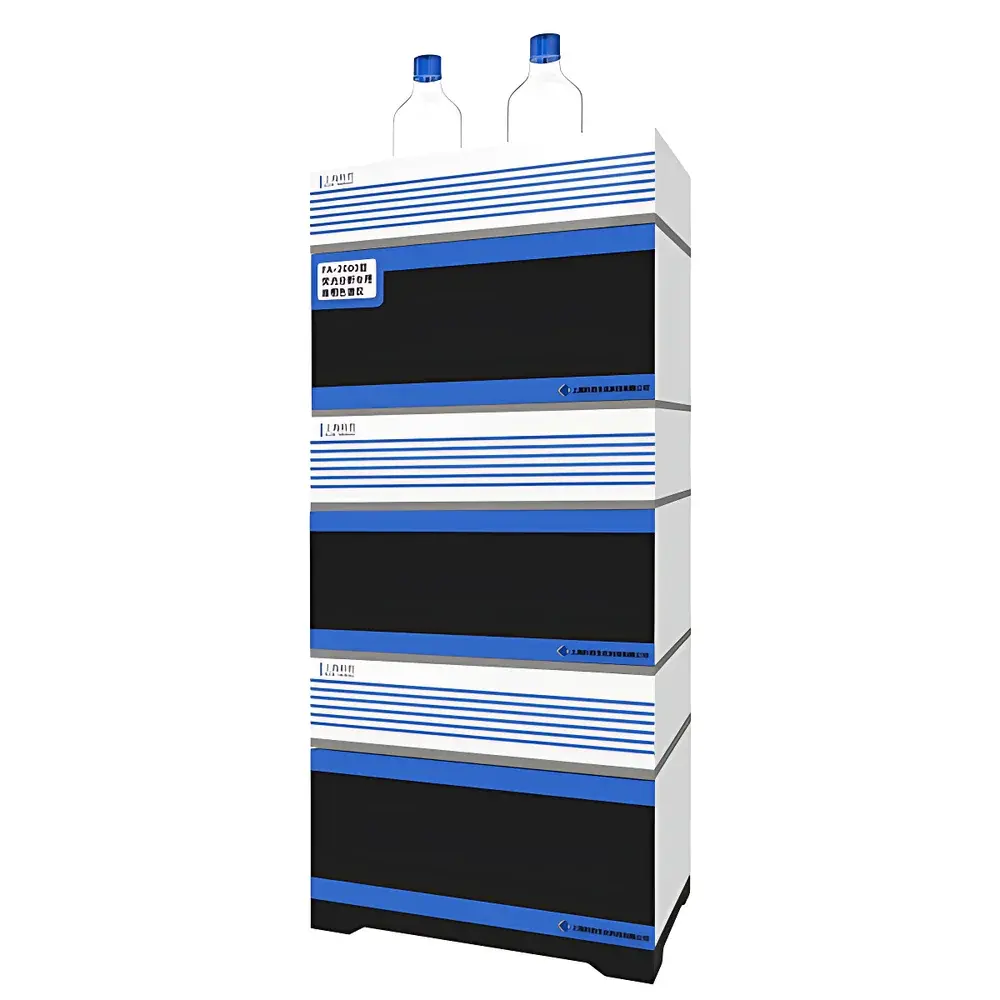
KEZHE FA-2000 Dedicated Fluorescence HPLC System
| Brand | KEZHE SHANGHAI |
|---|---|
| Origin | Shanghai, China |
| Manufacturer Type | Direct Manufacturer |
| Instrument Type | Fluorescence Detector (FD) |
| Wavelength Range | 195–650 nm (Excitation), 200–800 nm (Emission) |
| Measurement Mode | Dual-Beam |
| Light Source | Xenon Lamp |
| Flow Rate Range | 0–10 mL/min |
| Flow Accuracy | ±0.3% |
| Flow Precision (RSD) | ≤0.1% |
| Injection Valve Pressure Rating | 35.0 MPa (5000 psi) |
| Spectral Bandwidth | 10 nm / 20 nm |
| AD Resolution | 24-bit |
| Software Platform | FStar-2000 Chromatography Data System (CDS) for Windows 7/8/10 |
| Compliance | Fully aligned with Chinese Pharmacopoeia (2015 Edition), GLP/GMP principles, and FDA 21 CFR Part 11 audit trail requirements |
Overview
The KEZHE FA-2000 Dedicated Fluorescence HPLC System is a purpose-built high-performance liquid chromatography platform engineered exclusively for trace-level fluorescence detection and quantification. Unlike general-purpose HPLC systems, the FA-2000 integrates a dual-grating monochromator fluorescence detector as its analytical core—ensuring optimal signal-to-noise ratio, minimal baseline drift, and exceptional sensitivity across complex biological and pharmaceutical matrices. Its optical architecture employs a dual-beam configuration with real-time reference-path compensation, eliminating intensity fluctuations caused by lamp aging or environmental thermal drift. The system utilizes a long-life pulsed xenon lamp (195–650 nm excitation range) coupled with a high-gain photomultiplier tube (PMT) detector and 24-bit analog-to-digital conversion, enabling reliable measurement of sub-picomolar fluorescent analytes. All fluidic modules—including the precision dual-plunger reciprocating pump, 7725i high-pressure manual/auto injector, and modular derivatization units—are designed to operate under stringent chromatographic reproducibility standards (flow RSD ≤0.1%). The FA-2000 is not merely an instrument but a validated analytical workflow solution, supporting end-to-end automation from sample introduction through post-column reaction and detection.
Key Features
- Dual-grating monochromator fluorescence detector with independently adjustable excitation (200–700 nm) and emission (200–800 nm) wavelengths
- High-stability xenon light source offering broad spectral coverage and consistent output over extended operational lifetimes
- Dual-beam optical design with active reference channel for real-time baseline correction and enhanced photometric stability
- 24-bit high-resolution ADC enabling detection of ultra-low-intensity fluorescence signals without saturation or quantization error
- Modular architecture: interchangeable pump heads, detector cells, photochemical derivatization modules (254 nm), and column-switching valves
- FStar-2000 chromatography data system with full 21 CFR Part 11 compliance—supporting electronic signatures, audit trails, user role management, and instrument/sample traceability
- Native compatibility with gradient elution upgrade, UV-Vis dual-wavelength detection, column oven integration, and online solid-phase extraction (SPE)
- Pre-configured method templates for pharmacopeial assays including aflatoxin B₁/B₂/G₁/G₂ in herbal medicines and foodstuffs per Chinese Pharmacopoeia 2015 Edition
Sample Compatibility & Compliance
The FA-2000 demonstrates broad applicability across regulated and research-grade fluorescence analysis workflows. It routinely supports quantitative determination of native or derivatized analytes including vitamins (B₂, K₁), quinolones, sulfonamides, estrogens, amino acids, polycyclic aromatic hydrocarbons (PAHs), mycotoxins (aflatoxins, ochratoxin A), and fluorescently labeled biomolecules (e.g., dansylated peptides). Its integrated photochemical derivatization module (254 nm UV irradiation) enables on-line generation of fluorescent derivatives for non-native fluorophores such as aflatoxins—a critical requirement for official food safety testing protocols. The system meets essential regulatory benchmarks: full alignment with Chinese Pharmacopoeia (2015) monographs for aflatoxin analysis; adherence to GLP documentation standards for preclinical toxicology labs; and implementation of GMP-compliant software controls—including secure user authentication, change-controlled method storage, and immutable audit logs. Hardware design conforms to IEC 61010-1 safety standards for laboratory equipment.
Software & Data Management
FStar-2000 is a Windows-native chromatography data system (CDS) developed specifically for fluorescence-centric HPLC workflows. It provides intuitive method development tools—including wavelength optimization wizards, kinetic scan acquisition, and synchronous excitation-emission matrix (EEM) mapping—and supports automated calibration curve generation with weighted linear regression (1/x or 1/x²). Raw data files are stored in vendor-neutral formats compliant with ASTM E1957 and ISO/IEC 17025 metadata requirements. All user actions—including method edits, sequence execution, peak integration, and report export—are recorded in a tamper-evident audit trail meeting FDA 21 CFR Part 11 criteria. The CDS supports LIMS integration via ASTM E1578-compliant interfaces and allows export of validated PDF reports with digital signatures. Remote monitoring and method validation packages are available as optional licensed modules.
Applications
- Pharmaceutical QC/QA: Quantification of vitamin B₂ in multivitamin tablets; assay of quinolone antibiotics (e.g., ciprofloxacin) in bulk drug substances
- Food safety testing: Aflatoxin B₁ detection in peanuts, corn, and traditional Chinese medicinal herbs using post-column iodine or photochemical derivatization
- Clinical research: Measurement of homocysteine, serotonin, and dopamine metabolites in plasma following OPA derivatization
- Natural product analysis: Profiling of isoflavones (genistein, daidzein) in soy extracts and flavonoids in Ginkgo biloba preparations
- Environmental monitoring: Detection of PAHs and polychlorinated biphenyls (PCBs) in soil extracts after silica gel cleanup and fluorescence enhancement
- Life sciences: Time-resolved fluorescence analysis of protein-ligand interactions using labeled antibodies or aptamers
FAQ
Does the FA-2000 support gradient elution?
Yes—the system can be upgraded with a dual-pump gradient module supporting binary or ternary solvent delivery with programmable flow and composition profiles.
Is the fluorescence detector compatible with post-column derivatization?
Yes—it accepts standard 0.25 mm ID PTFE tubing connections and supports integration with commercial or custom-built post-column reactors, including thermal, chemical, and photochemical derivatization units.
Can the system meet FDA 21 CFR Part 11 requirements?
Yes—FStar-2000 implements full electronic signature capability, audit trail logging, user access control, and data integrity safeguards required for regulated submissions.
What is the minimum detectable concentration for typical fluorescent analytes?
Under optimized conditions (e.g., riboflavin at λex/λem = 445/525 nm), the system achieves sub-10 pg injection limits of detection (LOD) on-column, dependent on column efficiency and derivatization yield.
Are hardware upgrades like UV-Vis detection or column ovens factory-installable?
Yes—all optional modules—including dual-wavelength UV-Vis detectors, thermostatted column compartments, and online SPE cartridges—are mechanically and electrically standardized for plug-and-play integration.




