
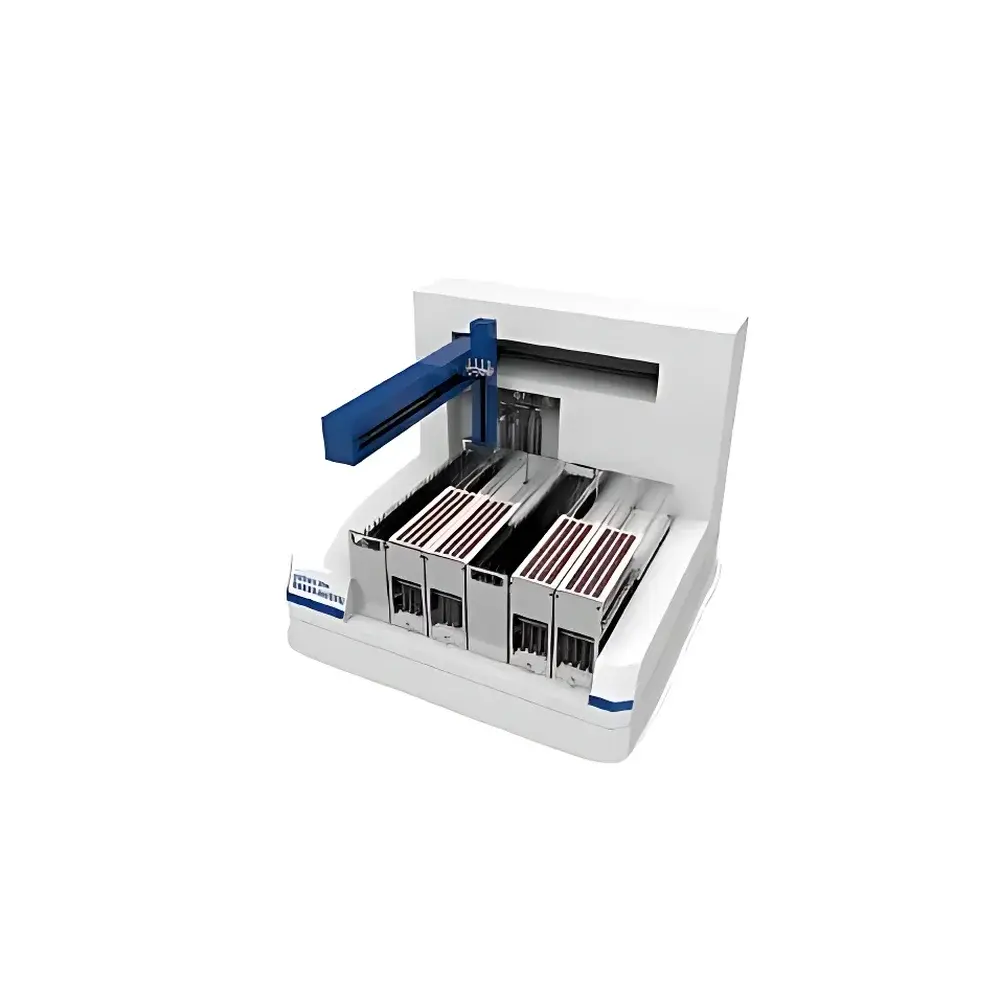
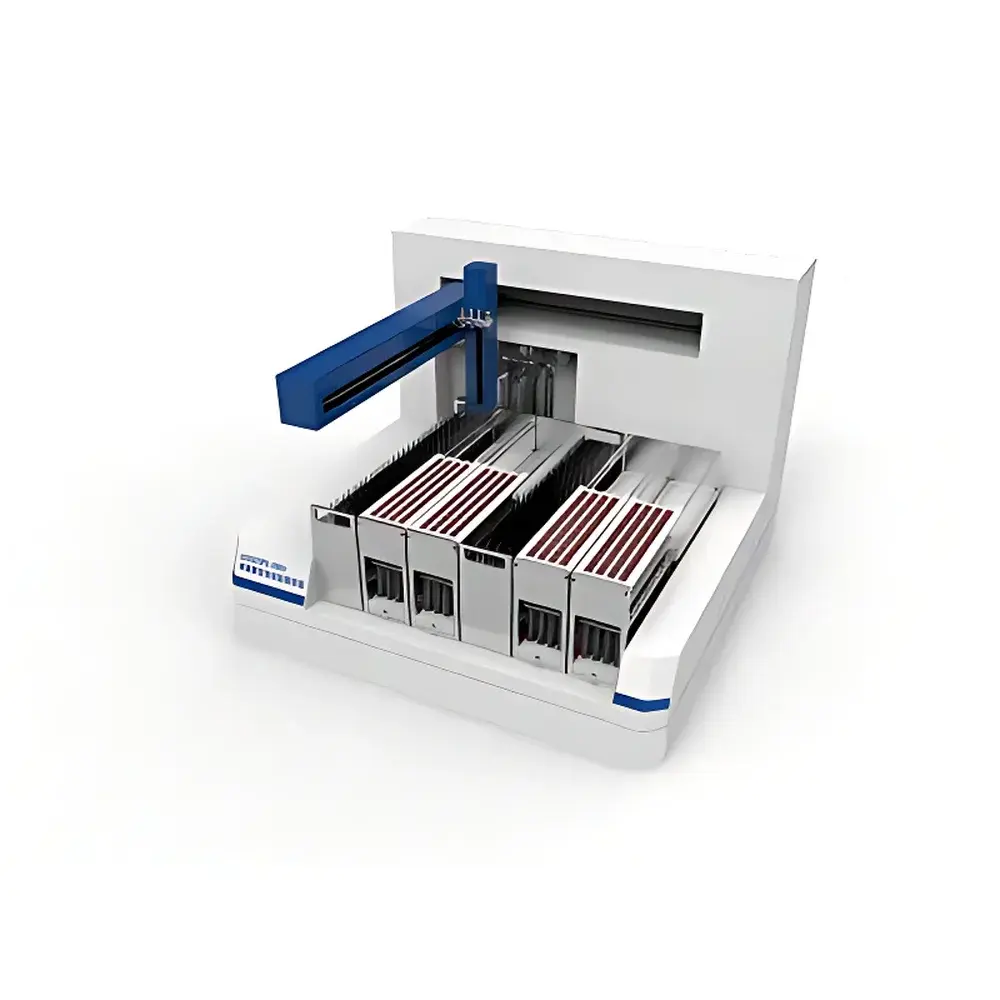
KEZHE GOODSPE-3000 High-Throughput Multi-Channel Fully Automated Solid Phase Extraction System
| Brand | KEZHE SHANGHAI |
|---|---|
| Origin | Shanghai, China |
| Manufacturer Type | Direct Manufacturer |
| Country of Origin | China |
| Model | GOODSPE-3000 |
| Automation Level | Fully Automated |
| Number of Channels | 4 Parallel Channels |
| Extraction Mode | Cartridge-Based SPE |
| Flow Rate Control | 0–30 mL/min per channel |
| Solvent Selection | Up to 5 Pre-Loaded Solvents (Expandable to 10 via Custom 12-Position Non-Metallic Rotary Valve) |
| Sample Capacity | Up to 144 Sequential Samples |
| Sample Loading Volume | 1–50 mL |
| Wetted Materials | PTFE, Borosilicate Glass |
Overview
The KEZHE GOODSPE-3000 is a high-throughput, fully automated solid phase extraction (SPE) system engineered for precision, reproducibility, and unattended operation in regulated analytical laboratories. It implements cartridge-based SPE using positive-pressure liquid handling driven by dual-syringe 10 mL precision pumps, delivering controlled flow rates across four independent channels. Each channel operates under programmable pressure regulation and real-time flow monitoring—enabling robust method transfer from manual or semi-automated protocols. The system is designed for seamless integration into multi-step sample preparation workflows, including offline coupling with gel permeation chromatography (GPC), accelerated solvent extraction (ASE), high-performance liquid chromatography (HPLC), and post-SPE concentration systems. Its architecture supports GLP-compliant data integrity requirements through audit-trail-enabled software, full parameter logging, and user-access control—making it suitable for environmental, food safety, pharmaceutical, and forensic laboratories operating under ISO/IEC 17025, USP , or FDA 21 CFR Part 11 frameworks.
Key Features
- Four independently controlled parallel channels enable true concurrent SPE processing—reducing total run time by up to 75% versus single-channel systems.
- Non-metallic 12-position rotary valve allows selection among up to 10 solvents; standard configuration includes 5 pre-plumbed solvent reservoirs compatible with aggressive organic solvents (e.g., dichloromethane, acetonitrile, methanol).
- High-precision 10 mL syringe pumps deliver flow rates from 0 to 30 mL/min per channel with ≤1% CV repeatability and 0.1 mm robotic arm positioning accuracy.
- Modular cartridge holder accommodates 1 mL, 3 mL, and 6 mL SPE cartridges interchangeably without hardware modification—supporting method development and routine analysis on the same platform.
- Integrated needle-wash station performs internal and external needle rinsing between samples using dedicated wash solvents, minimizing carryover and cross-contamination.
- Programmable fraction collection supports discrete or pooled elution modes; standard 15 mL collector tubes are configurable for custom tube formats including HPLC vials and deep-well plates.
- Over-pressure protection circuitry automatically halts operation if column backpressure exceeds safe thresholds (adjustable per method), safeguarding both consumables and instrument integrity.
- Movable cartridge rack enables full-cycle SPE execution—including conditioning, loading, washing, drying, and elution—within a single stationary platform, eliminating inter-module transfer errors.
Sample Compatibility & Compliance
The GOODSPE-3000 handles aqueous, buffered, and partially organic matrices across diverse application domains. Its PTFE- and borosilicate glass-wetted fluid path ensures chemical resistance to strong acids (e.g., 6 M HCl), bases (e.g., 1 M NaOH), and halogenated solvents. The system complies with ASTM D5907 (determination of suspended solids), EPA Methods 505, 508, 525.3, and 8081B for pesticide residue analysis, as well as EU Commission Regulation (EU) No 37/2010 for veterinary drug residues. All hardware and firmware meet IEC 61000-6-2/6-4 EMC standards. Software supports electronic signatures, audit trails, and raw data archiving—fully aligned with GLP/GMP documentation practices and 21 CFR Part 11 requirements when deployed on validated Windows OS environments (Windows 7/8/10 LTS).
Software & Data Management
The GS-3000 SPE Workstation software provides a unified interface for method building, sequence scheduling, real-time monitoring, and results review. It features three operational modes: (i) Step-by-step method editor for optimization of conditioning/wash/elution volumes and flow gradients; (ii) Batch mode for high-volume unattended runs—supporting up to 144 sequential samples with auto-reload detection; (iii) Fraction management module enabling rule-based tube assignment (e.g., “collect only fractions 3–5” or “pool all eluates”). All method parameters, run logs, error events, and calibration records are stored in encrypted SQLite databases with timestamped backups. USB 2.0 interface ensures compatibility with LIMS integration via CSV export or direct database query.
Applications
The GOODSPE-3000 is routinely deployed in accredited laboratories for quantitative trace analysis requiring rigorous sample cleanup prior to GC-MS, LC-MS/MS, or ICP-MS detection. Key use cases include: extraction of organochlorine pesticides (OCPs), polycyclic aromatic hydrocarbons (PAHs), PCBs, brominated flame retardants (BFRs), dioxins/furans, and endocrine-disrupting compounds from soil, water, and sediment; isolation of veterinary antibiotics (sulfonamides, quinolones), mycotoxins, melamine, and plasticizers (e.g., phthalates, bisphenol A) from milk, meat, infant formula, and beverage matrices; purification of active pharmaceutical ingredients (APIs), leachables from packaging materials, and metabolites from plasma/urine in bioanalytical support; and targeted enrichment of alkaloids, cannabinoids, azo dyes, and synthetic opioids in forensic toxicology and botanical research.
FAQ
Can the GOODSPE-3000 be integrated with an HPLC autosampler?
Yes—via optional HPLC-direct interface module, which delivers eluates directly into standard 2-mL vials compatible with most commercial autosamplers.
Is method validation support available?
KEZHE provides IQ/OQ documentation templates, performance verification protocols (e.g., recovery studies, carryover testing), and on-site installation qualification services.
What maintenance intervals are recommended?
Syringe pump calibration every 6 months; valve rotor seal replacement annually; needle wash station cleaning after each 200-sample batch.
Does the system support gradient elution?
Yes—multi-solvent programming allows stepwise or linear solvent strength ramping across up to 10 discrete steps per channel.
Are third-party SPE cartridges supported?
All industry-standard 1/3/6 mL cartridges from Waters, Agilent, Thermo Fisher, and Phenomenex are mechanically and chemically compatible.



