
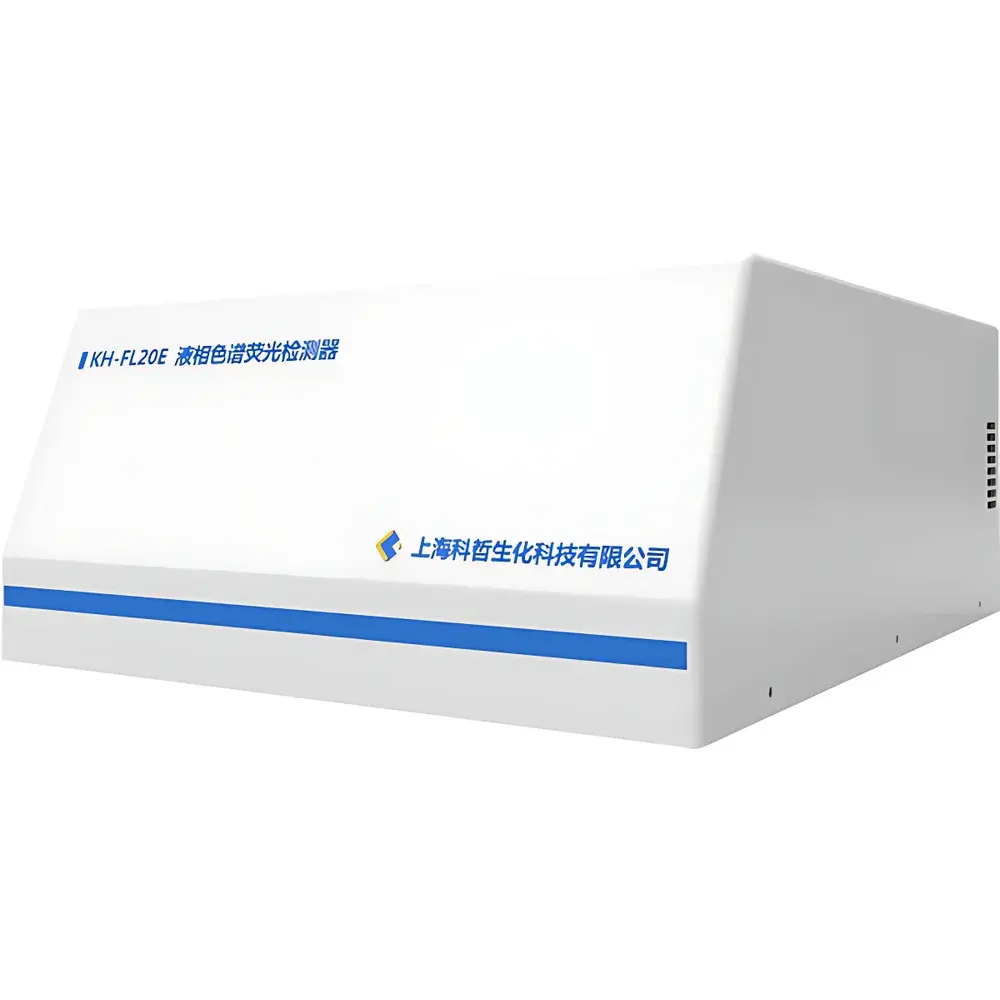
Kezhe KH-FL20E HPLC Fluorescence Detector
| Brand | Kezhe Shanghai |
|---|---|
| Origin | Shanghai, China |
| Manufacturer Type | Direct Manufacturer |
| Product Category | Domestic |
| Model | KH-FL20E |
| Instrument Type | Fluorescence Detector (FD) |
| Excitation Wavelength Range | 190–800 nm |
| Emission Wavelength Range | 190–800 nm |
| Spectral Bandwidth Options | 2 / 5 / 10 / 20 nm |
| Wavelength Accuracy | ±0.2 nm |
| Wavelength Precision | ±1 nm |
| Light Source | Solid-State Discharge Lamp |
| Monochromator | 1200-line Holographic Grating |
| Detector | Photomultiplier Tube (PMT) |
| AD/DA Resolution | 24-bit |
| Temperature Control Range (Flow Cell) | Ambient to 50 °C |
| Compliance | Meets GMP/GLP requirements |
Overview
The Kezhe KH-FL20E is a high-performance, benchtop HPLC fluorescence detector engineered for quantitative trace analysis in regulated pharmaceutical, food safety, and life science laboratories. It operates on the principle of selective molecular excitation and emission detection—measuring fluorescent intensity generated when analytes absorb photons at a defined excitation wavelength and re-emit energy at longer wavelengths. Its dual-grating optical architecture enables independent, programmable selection of both excitation and emission wavelengths across a broad spectral range (190–800 nm), supporting multi-analyte detection without hardware modification. The detector integrates a solid-state discharge lamp for stable, low-noise illumination with extended operational lifetime (>5,000 h), coupled with a 1200-line holographic grating monochromator to ensure high spectral resolution and minimal stray light. A cooled photomultiplier tube (PMT) provides sub-picoamp current sensitivity, while the 24-bit analog-to-digital converter delivers >140 dB dynamic range—critical for simultaneous quantification of major and trace components in complex matrices.
Key Features
- Independent, software-controlled excitation and emission wavelength programming with real-time spectral scanning capability
- Four selectable spectral bandwidths (2, 5, 10, and 20 nm) to optimize signal-to-noise ratio versus selectivity per application
- Automatic wavelength calibration and self-correction routine to maintain long-term photometric accuracy (±0.2 nm)
- Integrated flow cell temperature control (ambient to 50 °C) with PID regulation—preserves retention time reproducibility and peak shape without compromising sensitivity
- Analog output interface compatible with third-party HPLC systems (e.g., Agilent, Waters, Shimadzu) via standard 0–1 V or 0–5 V signals
- Onboard auto-adjustment of lamp energy output to minimize baseline drift and thermal noise during extended runs
- Bio-compatible flow cell design (PEEK and quartz construction) suitable for protein, peptide, and nucleic acid applications
- Fluorescence, phosphorescence, and chemiluminescence measurement modes supported via configurable timing and delay parameters
Sample Compatibility & Compliance
The KH-FL20E is validated for regulatory workflows requiring audit-ready documentation and data integrity. It complies with GLP and GMP principles as implemented in ISO/IEC 17025-accredited laboratories and meets functional requirements outlined in USP , ASTM E2500, and ICH Q2(R2). Its firmware and FM-2000 workstation support 21 CFR Part 11-compliant electronic signatures, role-based access control, and full audit trail generation—including parameter changes, calibration events, and raw data modifications. The detector has been specifically verified for pharmacopeial methods: Chinese Pharmacopoeia Volume IV (2015 Edition) Method 2351 for aflatoxin B₁, B₂, G₁, and G₂; and GB 5009.84–2016 for thiamine (vitamin B₁) quantification in fortified foods and infant formula. Its flow cell geometry and pressure rating (≤20 MPa) are compatible with UHPLC systems using sub-2 µm particles.
Software & Data Management
The FM-2000 Chromatography Workstation provides integrated instrument control, method development, peak integration, and report generation. It supports multi-dimensional fluorescence scanning (excitation-emission matrix, EEM), time-programmed wavelength switching (e.g., different λex/λem pairs across a single chromatogram), and automated calibration curve fitting using linear, quadratic, or weighted regression models. All raw data are stored in vendor-neutral .cdf format (Andersson CDF v2.1), enabling interoperability with third-party platforms such as OpenLab CDS, Chromeleon, or Python-based chemometrics tools. Data archiving follows ALCOA+ principles: attributable, legible, contemporaneous, original, accurate, complete, consistent, enduring, and available. Optional LIMS connectivity is implemented via HL7 v2.5.1 or RESTful API endpoints for automated sample registration and result push.
Applications
The KH-FL20E serves as the core detection module in validated analytical solutions for mycotoxin monitoring, nutritional assay, and biochemical profiling. It is routinely deployed in:
- Aflatoxin analysis using post-column iodine derivatization (paired with optional KH-ZY10E derivatizer)
- Vitamin B₁ (thiamine) quantification in cereals, dairy, and dietary supplements per GB 5009.84–2016
- Polycyclic aromatic hydrocarbons (PAHs) in environmental water and soil extracts
- Amino acid profiling in biological fluids following OPA/FMOC pre-column derivatization
- Fluorescent-tagged monoclonal antibodies and ADC stability studies under forced degradation conditions
Its compatibility with GOOD-SPE2000 automated solid-phase extraction enables end-to-end sample preparation for aflatoxin analysis—reducing analyst exposure to carcinogenic standards while improving recovery consistency (RSD <3% across 40 samples).
FAQ
Does the KH-FL20E support time-resolved fluorescence measurements?
Yes—it offers programmable delay times between excitation pulse and emission acquisition, enabling discrimination of short-lived background fluorescence from long-lived analyte phosphorescence.
Can the detector be operated without the FM-2000 software?
Yes—via analog output mode for integration into legacy HPLC systems; however, full functionality (wavelength programming, calibration, audit trail) requires FM-2000.
Is the flow cell replaceable in the field?
Yes—the PEEK/quartz flow cell is user-serviceable with standard Torx tools and requires no optical realignment.
What is the maximum backpressure rating of the detector?
The optical flow path is rated to 20 MPa (2900 psi), fully compatible with 1.7–1.8 µm particle UHPLC separations.
Does the system support remote diagnostics or firmware updates?
Yes—via secure SSH-enabled Ethernet port; updates are digitally signed and validated prior to installation to ensure traceability and integrity.




