
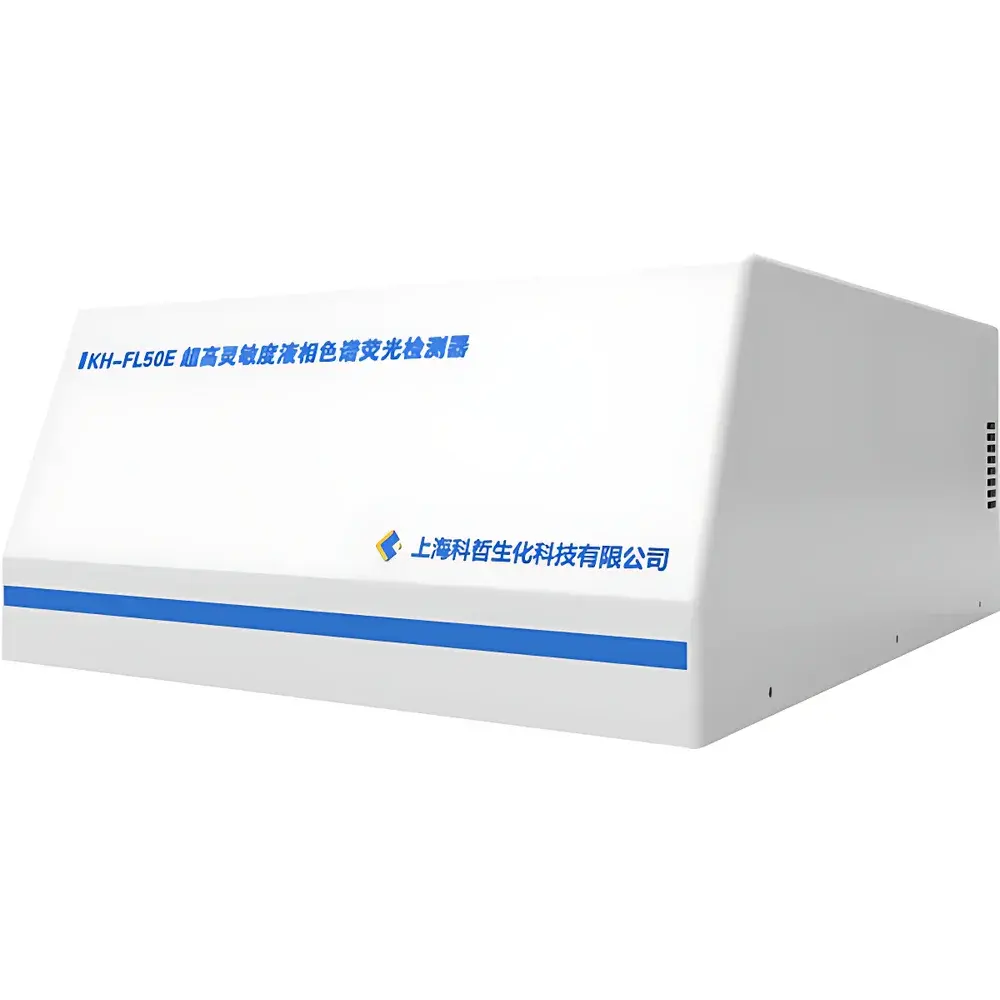
Kezhe KH-FL50E High-Sensitivity HPLC Fluorescence Detector
| Brand | Kezhe Shanghai |
|---|---|
| Origin | Shanghai, China |
| Manufacturer Type | Original Equipment Manufacturer (OEM) |
| Model | KH-FL50E |
| Instrument Type | Fluorescence Detector (FD) |
| Excitation/Emission Wavelength Range | 190–900 nm |
| Detection Modes | Fluorescence, Phosphorescence, Chemiluminescence |
| Light Source | 150 W DC Xenon Lamp or 5 W Pulsed Xenon Lamp |
| Monochromator | 1200-line Holographic Grating |
| Spectral Bandwidth (Excitation & Emission) | 5/10/15/20 nm selectable |
| Wavelength Accuracy | ±0.2 nm |
| Wavelength Precision | ±1 nm |
| AD/DA Resolution | 24-bit |
| Flow Cell Temperature Control | 5–50 °C |
| Detector Options | Single-Photon Counting Module (SPCM) or Variable-Voltage High-Sensitivity PMT |
| Compliance | Chinese Pharmacopoeia 2010/2015, GLP/GMP-ready, LIMS-compatible |
Overview
The Kezhe KH-FL50E is a high-sensitivity, dual-monochromator fluorescence detector engineered for integration with high-performance liquid chromatography (HPLC) systems. It operates on the principle of molecular fluorescence emission following selective excitation—enabling quantitative and qualitative analysis of compounds exhibiting native or derivatized fluorescent properties. Designed for demanding applications in pharmaceutical quality control, environmental monitoring, food safety testing, and life sciences research, the KH-FL50E delivers exceptional signal-to-noise performance through thermoelectrically cooled detection optics, temperature-stabilized flow cells, and precision wavelength selection across an ultra-broad spectral range (190–900 nm). Its architecture supports both single-photon counting (SPCM) and high-gain photomultiplier tube (PMT) detection modalities, ensuring optimal sensitivity across diverse analyte classes—from low-abundance mycotoxins to trace-level polycyclic aromatic hydrocarbons (PAHs) and pharmaceutical actives.
Key Features
- Dual-grating monochromators with 1200-line holographic gratings provide high spectral resolution and minimal stray light, enabling precise excitation and emission wavelength selection.
- Selectably configurable spectral bandwidths (5/10/15/20 nm) for both excitation and emission paths enhance selectivity without compromising sensitivity.
- Thermoelectric cooling of the detector assembly significantly suppresses dark current and thermal noise, yielding stable baselines and extended dynamic range.
- Temperature-controlled flow cell (5–50 °C) minimizes thermal drift and improves retention time reproducibility during gradient elution.
- Auto-calibrating wavelength system ensures long-term spectral accuracy (±0.2 nm) and compensates for mechanical drift over extended operation.
- 24-bit analog-to-digital and digital-to-analog conversion enables >140 dB dynamic range, supporting quantification from sub-picomolar to micromolar concentrations within a single run.
- Integrated lamp energy monitoring and real-time intensity correction reduce baseline drift and improve inter-day reproducibility.
- Flexible light source options: high-energy 150 W DC xenon lamp for broad-spectrum stability or low-heat 5 W pulsed xenon lamp for enhanced S/N in thermally sensitive assays.
Sample Compatibility & Compliance
The KH-FL50E accommodates standard stainless steel, fused silica, and biocompatible PEEK flow cells—ensuring compatibility with reversed-phase, HILIC, and ion-pairing separations. Its design meets critical regulatory expectations for analytical instrumentation used in GxP environments: full audit trail support, electronic signature capability, and secure user access controls align with FDA 21 CFR Part 11 requirements when deployed with compliant software configurations. The detector satisfies method-specific validation criteria outlined in the Chinese Pharmacopoeia (2010 and 2015 editions) for fluorescence-based HPLC assays—including those for aflatoxins, carbamates, vitamin B₂, and therapeutic agents. It is fully compatible with ICH Q2(R2) guidelines for analytical procedure validation, particularly regarding specificity, linearity, LOD/LOQ, and robustness assessment.
Software & Data Management
The KH-FL50E ships with FM-2000 Chromatography Workstation software—a modular, Windows-based platform supporting instrument control, data acquisition, peak integration, calibration curve generation, and report export in PDF, CSV, and XML formats. The software includes built-in tools for time-programmed emission scanning, synchronous fluorescence mode, and post-run spectral deconvolution. All raw and processed data are stored with immutable metadata (operator ID, timestamp, method parameters, calibration history), satisfying GLP/GMP documentation standards. Optional LIMS integration via ASTM E1384-compliant interfaces allows automated sample tracking, result forwarding, and electronic batch record linkage. Audit trails are retained for ≥18 months and support forensic reconstruction of all user actions and parameter modifications.
Applications
This detector is routinely deployed in regulated laboratories for:
- Quantification of mycotoxins (e.g., aflatoxin B₁, ochratoxin A) in cereals, nuts, and dairy products per AOAC Official Method 2005.08 and EU Commission Regulation (EC) No 401/2006.
- Analysis of PAHs in soil, water, and air particulates using EPA Method 8310 and ISO 17858.
- Pharmaceutical impurity profiling and stability-indicating assays for fluorescent APIs (e.g., quinolones, tetracyclines, fluoroquinolones).
- Monitoring of vitamin B₂ (riboflavin) in fortified foods and dietary supplements under USP and EP 2.2.47.
- Life science applications including amino acid analysis (post-column o-phthalaldehyde derivatization), nucleotide detection, and enzyme activity assays based on fluorogenic substrates.
FAQ
What detection technologies does the KH-FL50E support?
It supports fluorescence, phosphorescence, and chemiluminescence detection modes via interchangeable optical modules and configurable PMT/SPCM detection paths.
Is the detector compatible with third-party HPLC systems?
Yes—its analog output interface (0–1 V, 0–5 V, or 0–10 V) and RS-232/USB communication protocols enable seamless integration with Agilent, Waters, Shimadzu, Thermo Fisher, and other major OEM platforms.
How is wavelength calibration maintained over time?
The system performs automatic wavelength self-calibration using internal reference lines; users may also initiate manual calibration with mercury-argon or holmium oxide filters per ISO 17025 requirements.
Can the KH-FL50E be used for column post-derivatization workflows?
Yes—its flexible flow cell design and optional UV2000+ photochemical derivatizer or column post-derivatization module support enhanced sensitivity for non-fluorescent analytes such as amino acids and amines.
Does the instrument meet international regulatory data integrity standards?
When operated with FM-2000 software configured for audit trail logging, electronic signatures, and role-based access control, it complies with FDA 21 CFR Part 11, EU Annex 11, and WHO TRS 996 data integrity principles.





