
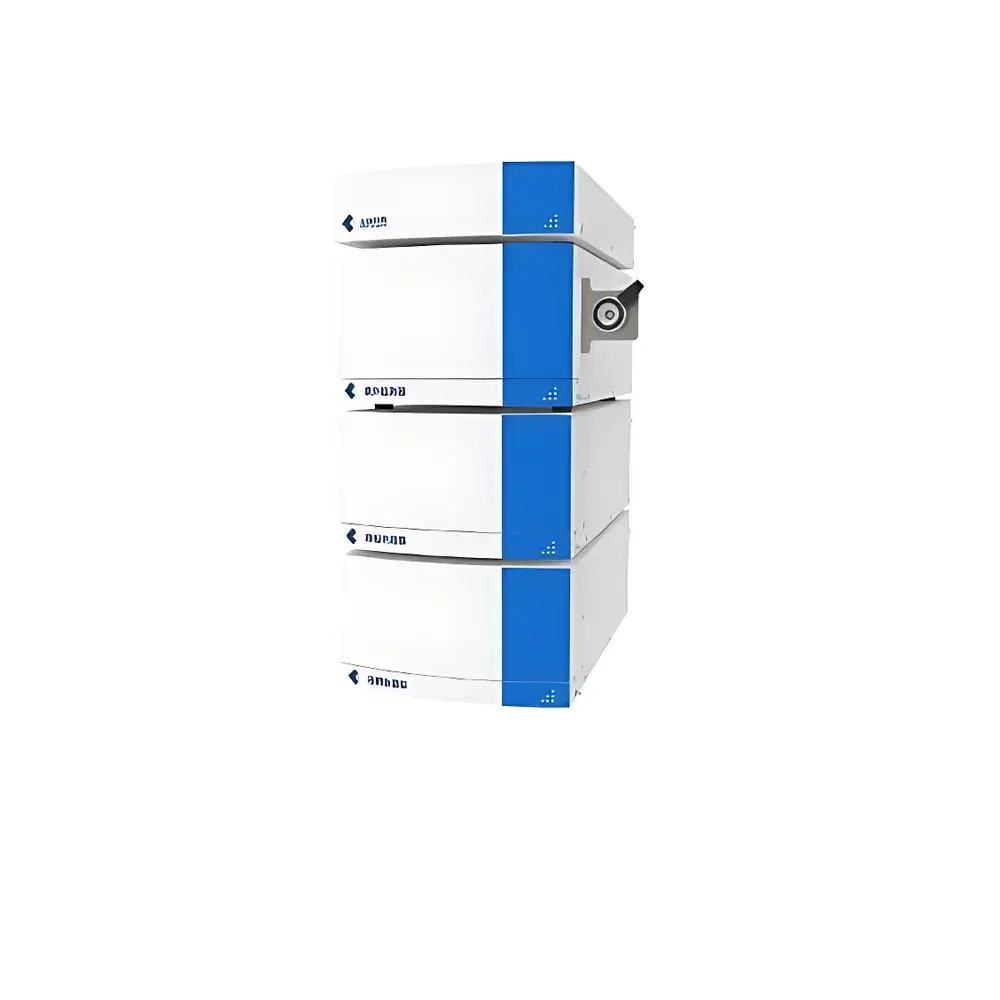
KEZHE PuriSmart-200 Preparative Liquid Chromatography System
| Brand | KEZHE SHANGHAI |
|---|---|
| Origin | Shanghai, China |
| Manufacturer Type | Original Equipment Manufacturer (OEM) |
| Product Category | Domestic |
| Model | PuriSmart-200 |
| Application Level | Laboratory-Scale R&D |
| Instrument Type | High-Pressure Preparative HPLC System |
| Flow Rate Range | 0–100 mL/min |
| Flow Accuracy | ±1.5% |
| Pressure Range | 0–30 MPa |
| Pressure Pulsation | < ±0.2 MPa |
| Wavelength Range | 190–850 nm (dual-wavelength simultaneous detection) |
| Wavelength Accuracy | ±1 nm |
| Wavelength Repeatability | 0.1 nm |
| Baseline Noise | ±0.1 mAU at 254 nm |
| Baseline Drift | 0.2 mAU/30 min at 254 nm |
| Sample Injection Volume | 5 mL (standard), customizable |
| Detector Light Source | Deuterium–Tungsten dual-lamp assembly |
| Monochromator | 1200-line/mm holographic grating |
| Fraction Collection | X-Y matrix-type collector |
Overview
The KEZHE PuriSmart-200 Preparative Liquid Chromatography System is a laboratory-scale, high-pressure preparative HPLC platform engineered for reproducible, scalable separation and purification of natural products—particularly botanical extracts, traditional Chinese medicine (TCM) constituents, and structurally complex small molecules. Built upon core technologies developed under China’s National Major Scientific Instrument Development Program, the system implements classical reversed-phase liquid chromatography principles with binary high-pressure gradient delivery, enabling precise solvent composition control without external degassing. Its architecture supports both analytical method translation and early-stage process development, delivering robust performance in R&D environments where throughput, fraction integrity, and regulatory traceability are critical. The system operates within a maximum pressure limit of 30 MPa and accommodates flow rates from 0 to 100 mL/min—sufficient for columns up to 25 mm internal diameter—making it suitable for milligram-to-gram scale purification tasks.
Key Features
- High-precision dual-plunger preparative pumps with ±1.5% flow accuracy and low pressure pulsation (< ±0.2 MPa), ensuring consistent retention time and peak shape across repeated runs.
- Integrated high-pressure binary gradient mixing module eliminates gradient delay and air bubble formation—no external degasser required.
- Imported high-pressure six-port injection valve with durable ceramic rotor and configurable loop volumes (standard 5 mL), rated for >100,000 cycles under continuous operation.
- Dual-wavelength UV-Vis detector featuring a deuterium–tungsten lamp pair and 1200-line/mm holographic grating, delivering simultaneous monitoring at any two wavelengths between 190 nm and 850 nm.
- Self-diagnostic optical subsystem with lamp life tracking, automatic wavelength calibration, and real-time baseline stability monitoring (±0.1 mAU noise at 254 nm; 0.2 mAU drift over 30 min).
- X-Y robotic fraction collector with programmable spatial addressing—supports up to 144 discrete collection positions per run, exceeding the capacity of conventional multi-port valves.
- Modular hardware design allows seamless integration of optional detectors including ELSD-5000KS (evaporative light scattering), DAD, and RI detectors—enabling orthogonal detection strategies.
Sample Compatibility & Compliance
The PuriSmart-200 is optimized for polar-to-moderately nonpolar analytes commonly found in plant-derived matrices—including flavonoids, alkaloids, terpenoids, saponins, and glycosides. It accepts standard stainless-steel or PEEK-lined preparative columns (e.g., C18, 10 µm, 10 × 250 mm) and is compatible with common HPLC solvents (water, methanol, acetonitrile, buffer systems). While not certified for GMP manufacturing, the system meets essential design criteria aligned with GLP-compliant laboratories: full audit trail capability, role-based user access control, electronic signature support, and immutable raw data storage. Software logs all method parameters, instrument status events, and fraction collection triggers—facilitating 21 CFR Part 11 readiness when deployed with validated IT infrastructure.
Software & Data Management
The modular KEZHE LC Workstation software provides unified visualization of gradient profiles, chromatograms, fraction collection maps, and real-time instrument diagnostics on a single synchronized timeline. It supports concurrent display of multiple detector signals (UV-Vis, ELSD, RI) within a shared retention time axis. Integrated UV-VIS spectral scanning enables on-the-fly acquisition of full 190–850 nm spectra at user-defined retention windows—critical for peak purity assessment and compound identification. Chromatographic data processing includes automated peak detection, Gaussian curve fitting, area/height quantitation, and customizable reporting templates. All user actions—including method edits, sequence modifications, and data exports—are recorded with timestamps and operator IDs. Data files conform to ASTM E1967 and ISO/IEC 17025 metadata requirements, supporting long-term archival and third-party review.
Applications
- Isolation of bioactive compounds from crude herbal extracts for pharmacological screening and structural elucidation.
- Method development and optimization for downstream scale-up to pilot- or production-scale chromatography systems.
- Purification of synthetic intermediates and natural product derivatives prior to NMR or MS analysis.
- Quality control of TCM monographs by reference standard isolation and purity verification.
- Supporting academic and industrial research in phytochemistry, metabolomics, and natural product chemistry where sample scarcity and compound lability demand high recovery and minimal degradation.
FAQ
What column dimensions and packing materials are supported?
Standard configuration includes a C18 column (10 mm i.d. × 250 mm, 10 µm particles); custom columns up to 25 mm i.d. and various stationary phases (C8, phenyl-hexyl, amino, silica) are fully compatible.
Can the system operate under GLP or 21 CFR Part 11-compliant conditions?
Yes—the software provides audit trail, electronic signatures, and data integrity controls; formal validation documentation and IQ/OQ protocols are available upon request for regulated environments.
Is UV spectral library matching supported?
The workstation supports export of full-spectrum data in JCAMP-DX format for post-run analysis in third-party spectral libraries (e.g., NIST, SDBS), though real-time matching is not embedded.
What maintenance intervals are recommended for the UV detector lamp?
Lamp usage is continuously monitored; replacement is advised after 1,500–2,000 hours of operation or when signal-to-noise ratio degrades beyond specification.
Does the X-Y collector support timed or peak-triggered fractionation?
Both modes are supported: fractions can be collected based on absolute time, peak apex detection, threshold absorbance, or user-defined retention time windows.
Related Products




