
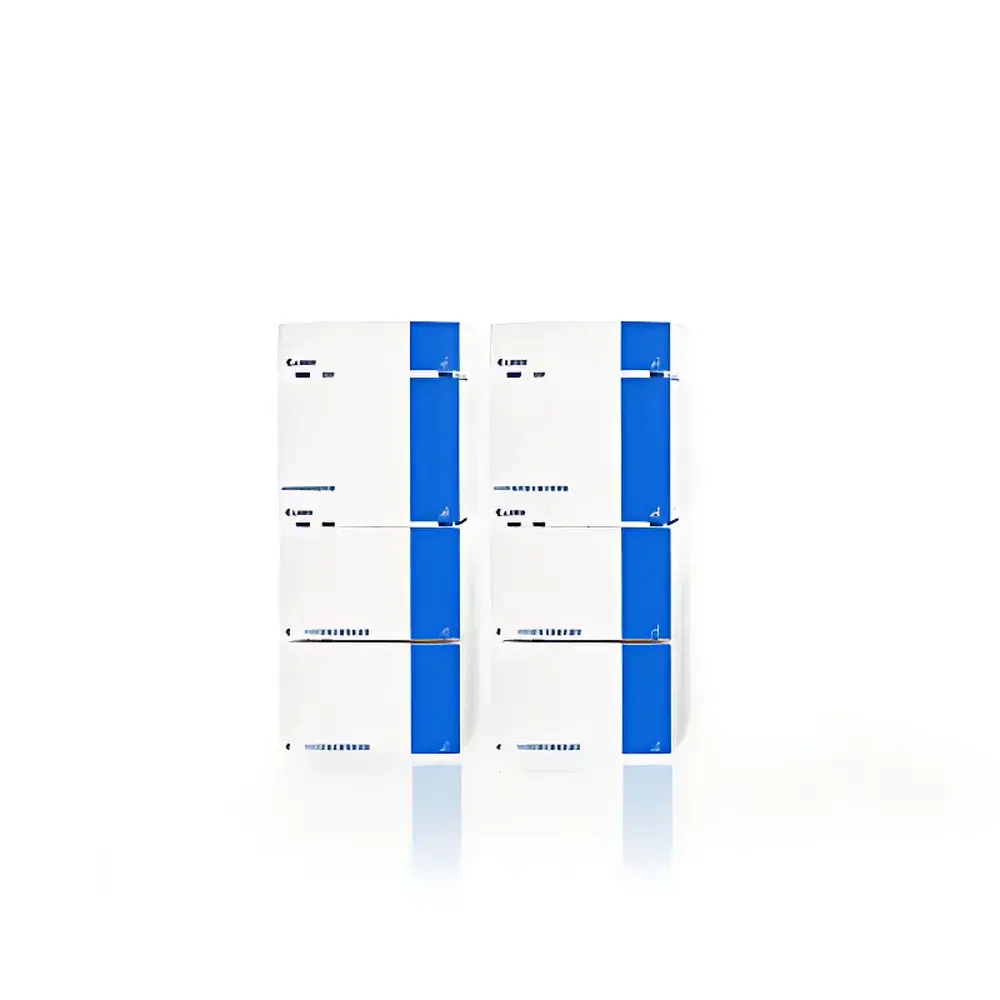
KEZHE SHANGHAI 2DMax1100A3/P3 Orthogonal Normal-Phase & Reversed-Phase Two-Dimensional Liquid Chromatography System
| Brand | KEZHE SHANGHAI |
|---|---|
| Origin | Shanghai, China |
| Manufacturer Type | Original Equipment Manufacturer (OEM) |
| Product Category | Domestic |
| Model | 2DMax1100A3 / 2DMax1100P3 |
| Price | Upon Request |
| Pump Flow Range | 0–200 mL/min (customizable higher flow available) |
| Maximum Pressure | 4000 psi with overpressure protection |
| UV-Vis Detector Wavelength Range | 190–850 nm (quad-wavelength simultaneous detection), wavelength accuracy: ±0.2 nm |
| Light Source | Deuterium lamp + Tungsten lamp |
| Autosampler Capacity | 144 vials (sealed vial design with needle wash function) |
| Fraction Collector (2DMax1100P3 only) | 160-tube rack, 15 mm tube diameter |
| Software Platform | Windows 7/10 (64-bit) |
| Communication Interface | Ethernet |
Overview
The KEZHE SHANGHAI 2DMax1100A3/P3 is a modular, orthogonal two-dimensional liquid chromatography (2D-LC) system engineered for high-resolution separation of chemically complex mixtures—particularly in natural product analysis, traditional Chinese medicine (TCM) quality control, synthetic organic chemistry, and pharmaceutical impurity profiling. Unlike conventional one-dimensional HPLC, this system implements comprehensive orthogonality by coupling normal-phase (NP) and reversed-phase (RP) separation mechanisms in sequence, leveraging complementary selectivity to significantly expand peak capacity beyond the limits of single-dimension methods. The core architecture integrates two independently controlled LC modules—each with dedicated gradient pumps, column compartments, and detector pathways—interfaced via a high-precision, low-dead-volume switching valve system. This design enables both heart-cutting (LC-LC) and comprehensive (LC×LC) 2D-LC configurations, supporting method development flexibility without hardware reconfiguration.
Key Features
- Orthogonal column pairing: Simultaneous or sequential use of normal-phase and reversed-phase columns to maximize chemical resolution and minimize co-elution in multi-component samples.
- Modular dual-pump architecture: High-pressure quaternary gradient pump systems on both dimensions ensure precise solvent delivery across diverse mobile phase compositions—including chloroform/hexane (NP) and acetonitrile/water (RP) gradients—with seamless solvent compatibility management.
- Quad-wavelength UV-Vis detection: Real-time spectral acquisition at four user-defined wavelengths (190–850 nm) with ±0.2 nm accuracy, enabling selective detection of chromophores with varying absorption maxima across fractions.
- Intelligent valve-driven 2D synchronization: A programmable, low-diffusion switching valve coordinates fraction transfer from the first-dimension column to the second-dimension column with sub-second timing precision and minimal band broadening.
- Sealed-vial autosampler with integrated needle wash: 144-position tray accommodates standard 2 mL vials; automated needle rinse between injections prevents cross-contamination—critical for trace-level analysis and regulated environments.
- Configurable platform: 2DMax1100A3 optimized for analytical-scale quantitation and method scouting; 2DMax1100P3 extends functionality with a programmable fraction collector (160 × 15 mm tubes) and preparative-capable column oven, supporting isolation of purified compounds for NMR or bioassay.
Sample Compatibility & Compliance
The system is validated for use with a broad range of sample matrices—including crude herbal extracts, fermentation broths, reaction mixtures, and purified small-molecule libraries. Its solvent-flexible design accommodates high-boiling-point NP solvents (e.g., dichloromethane, ethyl acetate) and aqueous RP eluents without compromise in system integrity or baseline stability. All fluidic components are constructed from inert, HPLC-grade stainless steel and PEEK, ensuring compatibility with aggressive solvents and long-term reproducibility. The instrument supports audit-trail-enabled operation per FDA 21 CFR Part 11 requirements when used with compliant software configuration, and data files adhere to ASTM E1946-20 (Standard Practice for Chromatographic Data Exchange) and ISO/IEC 17025:2017 documentation standards for testing laboratories. Method parameters, injection logs, and detector events are time-stamped and digitally signed to satisfy GLP/GMP documentation workflows.
Software & Data Management
The modular LC workstation provides unified control of all hardware modules—including pump gradients, valve sequencing, detector acquisition, autosampler scheduling, and (in P3 model) fraction trigger logic. The interface supports intuitive drag-and-drop method building for both 1D and 2D workflows, with real-time visualization of modulation cycles and fraction boundaries. Raw chromatographic data is stored in vendor-neutral .cdf format (compatible with OpenChrom, Chromeleon, and MassHunter), while processed reports export to PDF, CSV, or XML for LIMS integration. Built-in tools include peak tracking across dimensions, retention time alignment correction, and orthogonal selectivity scoring (based on correlation coefficients between NP and RP retention indices). Software validation documentation (IQ/OQ protocols) is provided for laboratory qualification under ISO/IEC 17025 or pharmaceutical QA frameworks.
Applications
- Comprehensive profiling of TCM extracts: Resolving structurally similar flavonoids, saponins, and alkaloids that co-elute in 1D-RP-HPLC.
- Synthetic reaction monitoring: Tracking starting materials, intermediates, and side products in parallel synthesis where polarity shifts span >5 logP units.
- Pharmaceutical impurity identification: Isolating and concentrating low-abundance degradants (<0.1%) from forced degradation studies for subsequent HRMS characterization.
- Natural product dereplication: Coupling TLC-based pre-fractionation (via optional interface) with 2D-LC for targeted compound enrichment prior to isolation.
- Quality-by-Design (QbD) method development: Mapping resolution landscapes across NP/RP solvent strength and selectivity space to define robust operating ranges.
FAQ
What distinguishes orthogonal 2D-LC from tandem (heart-cut) LC?
Orthogonal 2D-LC employs full modulation—where the entire first-dimension effluent is sampled at regular intervals and transferred to the second dimension—enabling comprehensive peak capacity enhancement. Heart-cutting transfers only selected regions, limiting coverage but improving sensitivity for targeted analytes.
Can the system operate in 1D mode only?
Yes—both dimensions can be operated independently as standalone HPLC systems, allowing full utilization of hardware for routine QC assays when 2D capability is not required.
Is method transfer between 2DMax1100A3 and 2DMax1100P3 feasible?
Method parameters (gradients, valve timing, detection settings) are fully interchangeable; only fraction collection logic requires minor adaptation in the P3 version.
Does the system support mass spectrometry coupling?
The flow cell and valve architecture are compatible with post-column splitting for LC-MS interfacing; recommended split ratios and interface tubing specifications are provided in the technical supplement.
What maintenance protocols are recommended for long-term NP/RP solvent switching?
A standardized solvent transition procedure—including intermediate flushes with IPA and THF—is embedded in the software’s maintenance wizard to prevent precipitate formation and seal degradation.





