
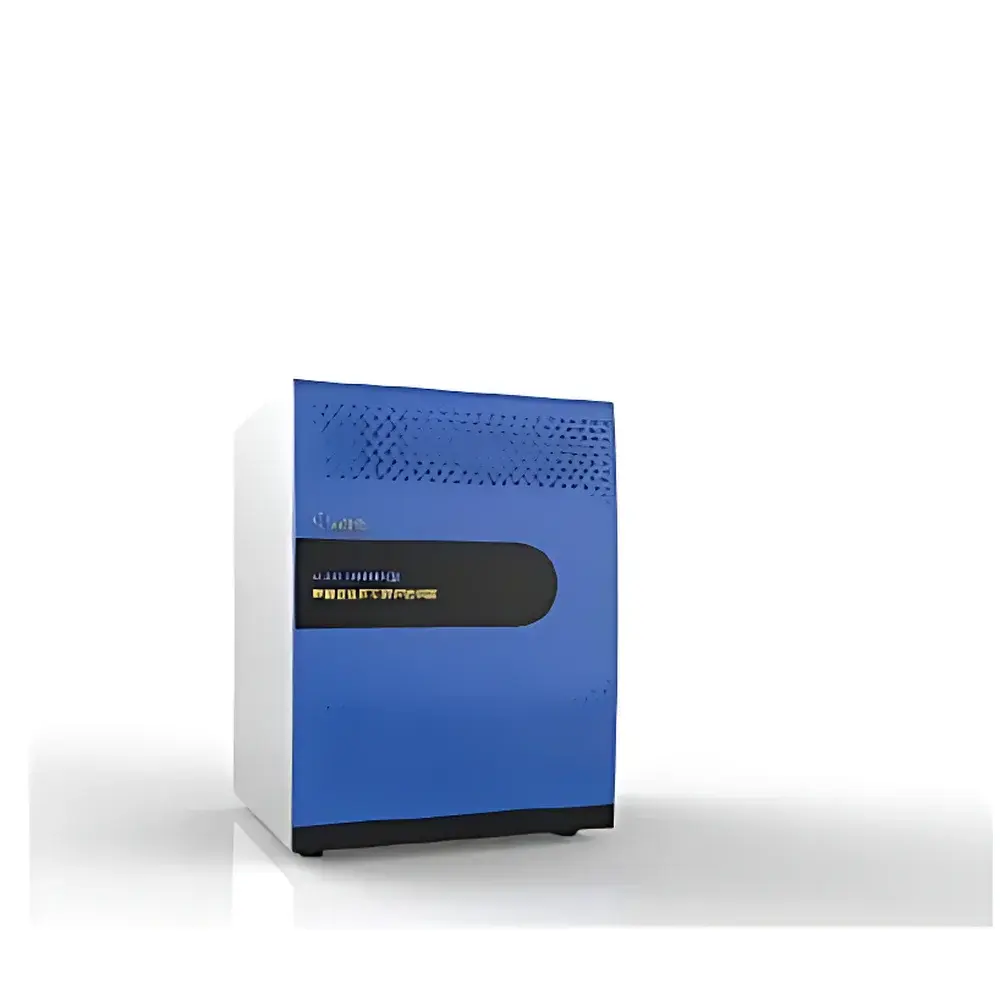
KEZHE SHANGHAI ELSD-5000KS Preparative Evaporative Light Scattering Detector
| Brand | KEZHE SHANGHAI |
|---|---|
| Origin | Shanghai, China |
| Manufacturer Type | Direct Manufacturer |
| Instrument Type | Evaporative Light Scattering Detector (ELSD) |
| Model | ELSD-5000KS |
| Wavelength Range | 200–800 nm (standard), optional 200–400 nm or 200–1100 nm |
| Detection Mode | Dual-beam |
| Light Source | Standard 650 nm laser + D₂/W lamp combination |
| Nebulizer Gas Flow | 0–5 L/min |
| Nebulizer Pressure | 0–150 psi |
| Drift Tube Temperature | Ambient to 200 °C (1 °C resolution) |
| Mobile Phase Flow Rate | 0–200 mL/min |
| Fraction Capacity | 160 positions |
| Collection Mechanism | X-Y-Z three-axis robotic arm |
| Gas Supply | Compressed air or nitrogen |
| Software | ELSD-5000KS Preparative Chromatography Workstation |
Overview
The KEZHE SHANGHAI ELSD-5000KS Preparative Evaporative Light Scattering Detector is an integrated, multi-detection preparative chromatography platform engineered for comprehensive compound characterization and high-fidelity fraction collection. Unlike conventional UV-only detection systems, the ELSD-5000KS combines evaporative light scattering detection (ELSD) with a full-spectrum diode array detector (DAD) in a single, unified architecture. ELSD operates on the principle of nebulization, solvent evaporation, and light scattering measurement of non-volatile analytes—making it inherently universal, mass-sensitive, and independent of chromophore presence. Coupled with DAD’s wavelength-resolved absorbance profiling (200–800 nm standard), the system delivers orthogonal detection data essential for natural product isolation, synthetic intermediate purification, and impurity profiling where UV-inactive components co-elute with UV-active species. Designed for compatibility with all major preparative HPLC systems—including low- and high-pressure gradient configurations—the ELSD-5000KS supports both analytical-scale method development and milligram-to-gram scale purification workflows.
Key Features
- Integrated dual-detection module: Simultaneous ELSD and DAD acquisition enables real-time correlation of mass-based (ELSD) and absorbance-based (DAD) signals—critical for peak identification and fraction decision logic.
- Preparative-grade fraction collector with X-Y-Z robotic arm: Supports up to 160 collection positions; accommodates standard test tubes, round-bottom flasks, and 96-well microplates via programmable tray geometry mapping.
- Flexible triggering logic: Fractions can be collected based on peak threshold, analog voltage level, elapsed time, or external TTL signal—enabling synchronization with third-party detectors or fraction-triggered MS interfaces.
- Onboard solvent recovery valve system: Integrates a solenoid-controlled solvent diversion path to separate and recover clean eluent fractions, reducing hazardous waste volume and operational cost.
- Full-spectrum DAD with selectable wavelength modes: Offers single-, dual-, multi-, and full-wavelength acquisition; spectral data are stored per scan for post-run peak purity assessment and library matching.
- Drift tube temperature control: Precise thermal regulation (ambient to 200 °C, ±1 °C stability) ensures consistent aerosol formation across volatile and semi-volatile mobile phases, including acetonitrile/water, methanol/chloroform, and TFA-containing gradients.
- Modular design with preparative flow splitter: Allows dynamic flow routing between analytical monitoring (low-flow DAD/ELSD) and preparative collection (high-flow bypass), preserving detection sensitivity while scaling throughput.
Sample Compatibility & Compliance
The ELSD-5000KS detects non-UV-absorbing compounds—including lipids, carbohydrates, saponins, polymers, and organometallics—that remain invisible to conventional UV detectors. Its response is proportional to analyte mass rather than extinction coefficient, enabling semi-quantitative analysis without reference standards. The system complies with fundamental requirements for GLP-compliant purification workflows: audit-trail-enabled software logging, user-access controls, electronic signature support (per FDA 21 CFR Part 11 guidelines), and instrument parameter traceability. All optical and thermal subsystems undergo factory calibration verification against NIST-traceable references. No regulatory certification (e.g., CE, UL) is claimed unless explicitly validated per regional jurisdiction; users are advised to perform site-specific IQ/OQ/PQ protocols prior to GMP use.
Software & Data Management
The dedicated ELSD-5000KS Preparative Chromatography Workstation provides synchronized visualization of ELSD scatter intensity, DAD absorbance chromatograms at multiple wavelengths, and real-time spectral overlays. It features a 3D chromatographic view—displaying retention time, wavelength, and absorbance intensity simultaneously—to resolve co-eluting peaks with distinct spectral signatures. Fraction collection status is rendered graphically with position mapping, fill-level indicators, and error alerts (e.g., vial misalignment, valve timeout). Raw data are saved in vendor-neutral .cdf format (compatible with OpenChrom and Chromeleon), and method files include full instrument configuration metadata. Batch processing tools support automated integration, baseline correction, and spectral deconvolution using built-in target factor analysis algorithms.
Applications
- Natural product isolation: Purification of flavonoids, alkaloids, terpenes, and glycosides from botanical extracts—especially where UV-weak or UV-transparent compounds dominate.
- Pharmaceutical process development: Fraction-guided isolation of synthetic intermediates, chiral impurities, and degradation products during route scouting and stability studies.
- Polysaccharide and polymer characterization: Detection of high-MW carbohydrates and synthetic polymers lacking chromophores, with compatibility for aqueous SEC and organic-phase GPC.
- Toxicology and food safety: Multi-residue analysis of mycotoxins, pesticide metabolites, and adulterants in complex matrices—leveraging ELSD’s insensitivity to gradient-induced baseline drift.
- Combinatorial chemistry: High-throughput purification of compound libraries with heterogeneous functional group composition, where universal detection avoids repeated method re-optimization.
FAQ
What mobile phase compositions are compatible with the ELSD-5000KS?
The system supports common reversed-phase solvents (e.g., water/acetonitrile, water/methanol) and normal-phase mixtures (e.g., hexane/isopropanol), provided volatile modifiers (e.g., formic acid, ammonium acetate ≤20 mM) are used. Non-volatile buffers (e.g., phosphate, sulfate) must be avoided to prevent nozzle clogging and detector contamination.
Can the ELSD-5000KS be used with supercritical fluid chromatography (SFC)?
Yes—when equipped with a CO₂-compatible nebulizer head and back-pressure regulator, the system accepts SFC eluents (CO₂/methanol) with appropriate gas flow and pressure tuning.
Is the DAD module capable of peak purity analysis?
Yes—the workstation includes spectral homogeneity evaluation tools that compare spectra across peak apex, leading edge, and trailing edge to assess co-elution risk.
Does the system support remote monitoring and control?
The workstation offers TCP/IP-based network interface for secure remote access via authenticated VNC or web-based thin client, subject to local firewall configuration.
What maintenance intervals are recommended for routine operation?
Nebulizer capillary cleaning every 50 hours of operation; drift tube inspection and wipe-down weekly; DAD lamp intensity verification monthly; full optical alignment annually by certified service engineer.






