
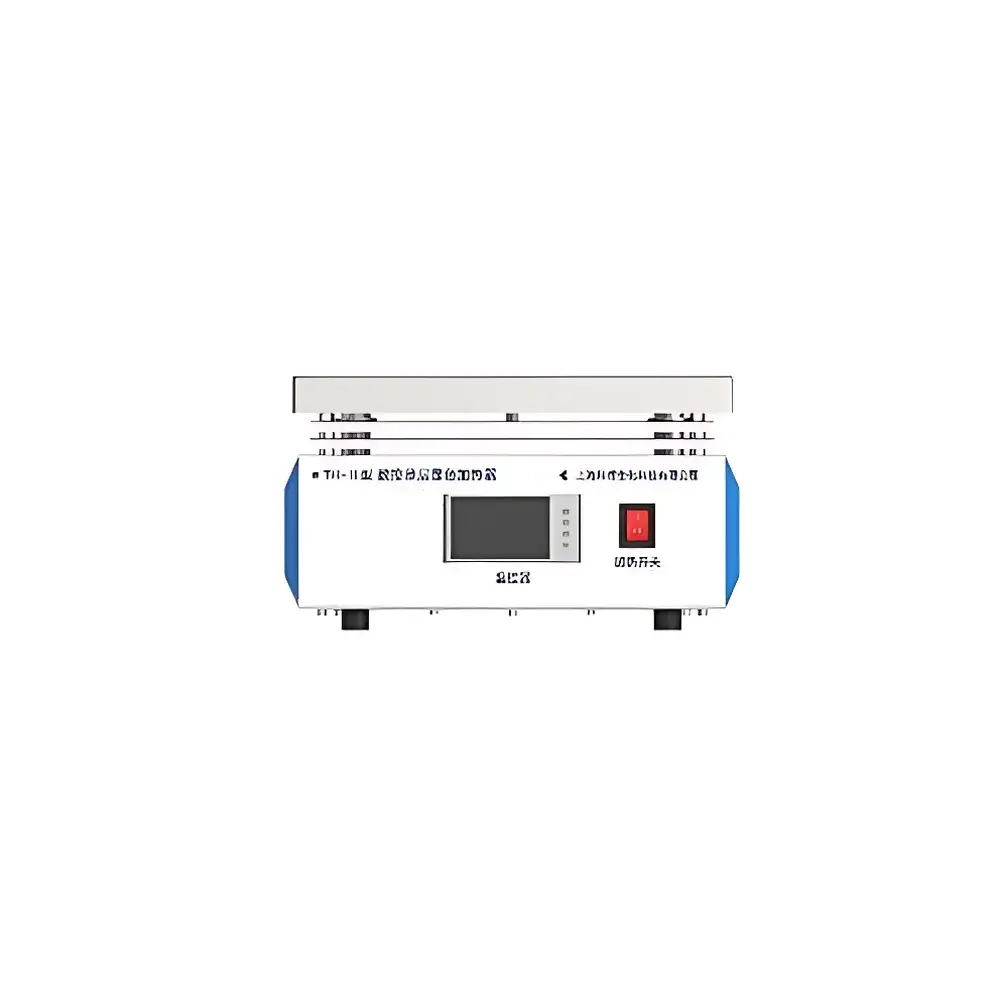
KEZHE SHANGHAI TH-II Digital Thin-Layer Chromatography Heater
| Brand | KEZHE SHANGHAI |
|---|---|
| Origin | Shanghai, China |
| Manufacturer Type | Direct Manufacturer |
| Product Category | Domestic (China-made) |
| Model | TH-II |
| Instrument Type | TLC Ancillary Equipment |
| Detection Modes | Reflectance Absorption, Reflectance Fluorescence, Transmittance Absorption, Transmittance Fluorescence |
| Wavelength Range | 190–800 nm |
| Light Sources | Xenon Lamp, Tungsten-Halogen Lamp, High-Pressure Mercury Lamp |
| Monochromator | Holographic Grating (1200 lines/mm), Nitrogen Purge Capable |
| Spectral Bandwidth | 5 nm |
| Wavelength Accuracy | < 1 nm |
| Wavelength Repeatability | < 0.2 nm |
| Minimum Spatial Resolution | 25 µm |
| Imaging Wavelengths | 254 nm, 365 nm, White Light |
| Sample Stage Capacity | 200 mm × 200 mm TLC Plate |
| Maximum Scan Speed | 100 mm/s |
| Temperature Range | 0–200 °C |
| Temperature Accuracy | ≤ ±1 °C |
| Heating Platform Dimensions | 300 mm × 250 mm |
| Power Supply | 220 V AC, 600 W |
| Heating Element | Cast-Aluminum Block with Uniform-Heat Plate |
| Construction | Stainless Steel Sample Tray, Digital PID Temperature Controller |
Overview
The KEZHE SHANGHAI TH-II Digital Thin-Layer Chromatography Heater is a precision-engineered thermal activation and solvent removal system designed specifically for post-development processing of thin-layer chromatography (TLC) plates. Unlike conventional ovens or hot plates, the TH-II integrates programmable digital temperature control with a thermally stable cast-aluminum heating block to deliver uniform, reproducible surface heating across the full 300 mm × 250 mm platform. Its primary function is to facilitate controlled thermal derivatization—such as acid-catalyzed charring (e.g., anisaldehyde-sulfuric acid or vanillin-sulfuric acid reagents) and solvent evaporation—without inducing plate degradation, carbonization artifacts, or corrosive off-gassing. This capability is critical in pharmaceutical QC labs where quantitative densitometric analysis of herbal matrices (e.g., Rehmannia glutinosa) requires clean, high-contrast band development. The system operates independently of optical detection modules but is fully compatible with downstream TLC scanners and imaging systems operating across UV-Vis spectral bands (190–800 nm), including standard excitation at 254 nm and 365 nm.
Key Features
- Digital PID temperature controller with 0–200 °C range and ≤ ±1 °C accuracy, enabling precise method transfer and inter-laboratory reproducibility.
- Monolithic cast-aluminum heating block with integrated uniform-heat plate—eliminates hot spots, prevents warping, and ensures long-term electrical safety (no exposed resistive wire elements).
- Stainless steel sample tray resistant to chemical corrosion from acidic or oxidative reagents commonly used in TLC visualization (e.g., sulfuric acid–ethanol mixtures).
- Surface-treated platform for enhanced durability, ease of cleaning, and resistance to staining or residue buildup after repeated use.
- Compact footprint and low thermal inertia enable rapid ramp-up and cooldown cycles—reducing turnaround time between TLC plate batches.
- Designed for integration into GLP-compliant workflows: temperature setpoints and dwell times are manually logged; optional external data logging via analog output (0–5 V) is supported.
Sample Compatibility & Compliance
The TH-II accommodates standard and oversized TLC plates up to 200 mm × 200 mm, including silica gel, alumina, cellulose, and reversed-phase (RP-18) layers. It supports all common derivatization protocols requiring thermal activation—particularly those involving Brønsted or Lewis acid reagents that decompose volatile byproducts (e.g., SO₂, NOₓ, or organic vapors) under uncontrolled heating. By maintaining precise, localized surface temperatures—rather than ambient chamber heating—the TH-II mitigates plate blackening, background fluorescence quenching, and instrument corrosion observed in forced-air ovens. While not certified to IEC 61010-1 or UL 61010B as a standalone analytical instrument, its construction adheres to general electrical safety principles for laboratory benchtop equipment. It is routinely deployed in environments complying with Chinese GMP (CFDA Guideline 2010), USP , and ISO/IEC 17025-accredited testing laboratories performing herbal identity and assay validation per pharmacopoeial monographs.
Software & Data Management
The TH-II operates as a hardware-only thermal module with no embedded firmware or proprietary software. Temperature programming is performed via front-panel keypad with real-time LED display. All operational parameters—including setpoint, actual surface temperature, and elapsed heating time—are visible during operation. For audit-trail compliance in regulated environments, users may pair the unit with external temperature dataloggers (e.g., Omega OM-DAQPRO-5300 or Testo 176 T4) connected to the analog output port. No cloud connectivity, remote access, or FDA 21 CFR Part 11 electronic signature functionality is provided; manual logbook entries remain the default record-keeping method. This design prioritizes reliability, electromagnetic compatibility, and minimal maintenance over digital complexity.
Applications
- Thermal activation of charring reagents for glycoside-rich botanicals (e.g., catalpol in Rehmannia, ginsenosides in Panax).
- Rapid solvent removal post-development to prevent band diffusion prior to densitometric scanning.
- Pre-chromatographic plate activation (e.g., 110 °C for 30 min) to remove adsorbed moisture from silica gel layers.
- Controlled drying of iodine-stained or phosphomolybdic acid (PMA)-treated plates where excessive heat causes reagent decomposition.
- Method development support for stability-indicating TLC assays requiring strict thermal control to distinguish degradation products from actives.
FAQ
Does the TH-II include built-in UV illumination or imaging capabilities?
No. The TH-II is a dedicated thermal activation device only. Optical detection must be performed separately using a compatible TLC scanner or UV cabinet.
Can the heating platform accommodate glass-backed TLC plates?
Yes—provided total thickness does not exceed 5 mm and thermal expansion coefficients are compatible. Avoid prolonged exposure above 150 °C with fused-silica backed plates.
Is nitrogen purge functionality available on the TH-II itself?
No. Nitrogen purging applies only to the optional spectrophotometric detection module (not included), not the heater unit.
What maintenance is required for long-term calibration stability?
Annual verification of temperature accuracy using a NIST-traceable surface probe (e.g., Fluke 54II with thin-film thermocouple) is recommended. No internal recalibration is user-accessible.
Is the TH-II suitable for use in explosion-proof laboratory zones?
No. It lacks ATEX or IECEx certification and is intended for general laboratory use only.





