
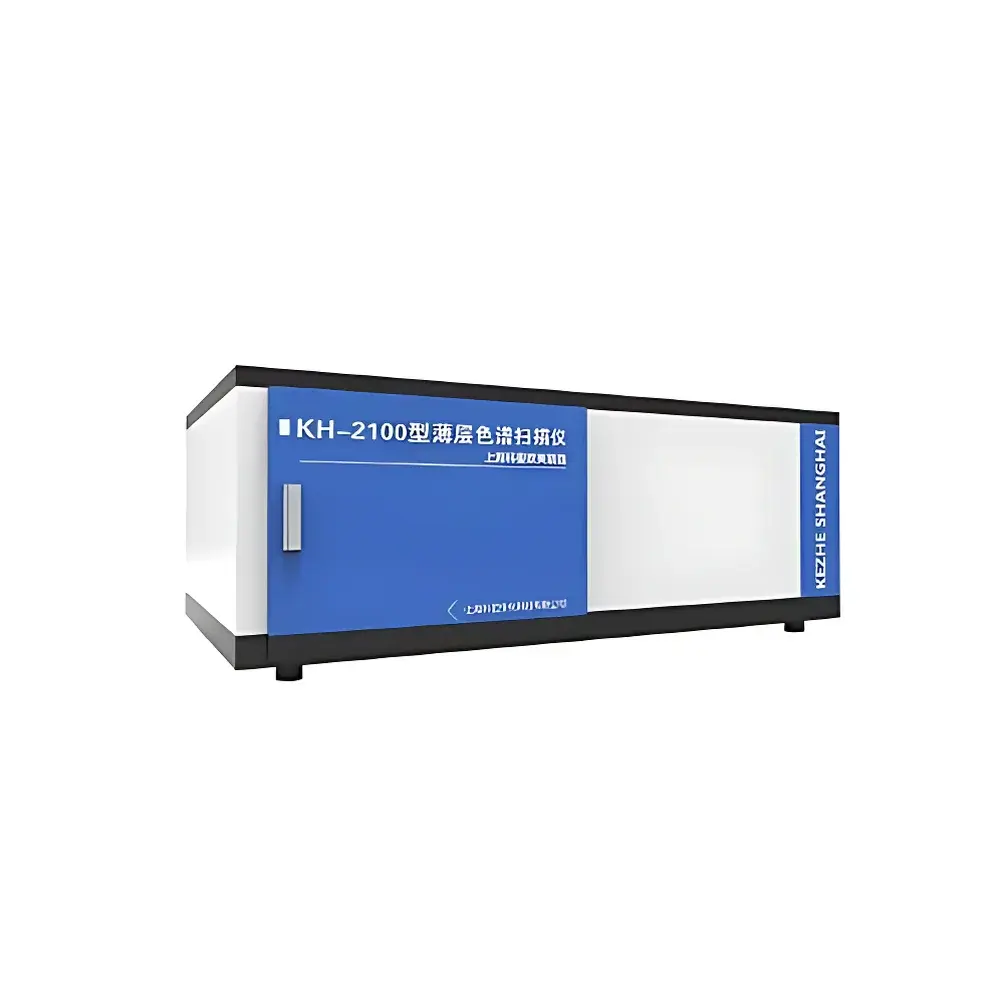
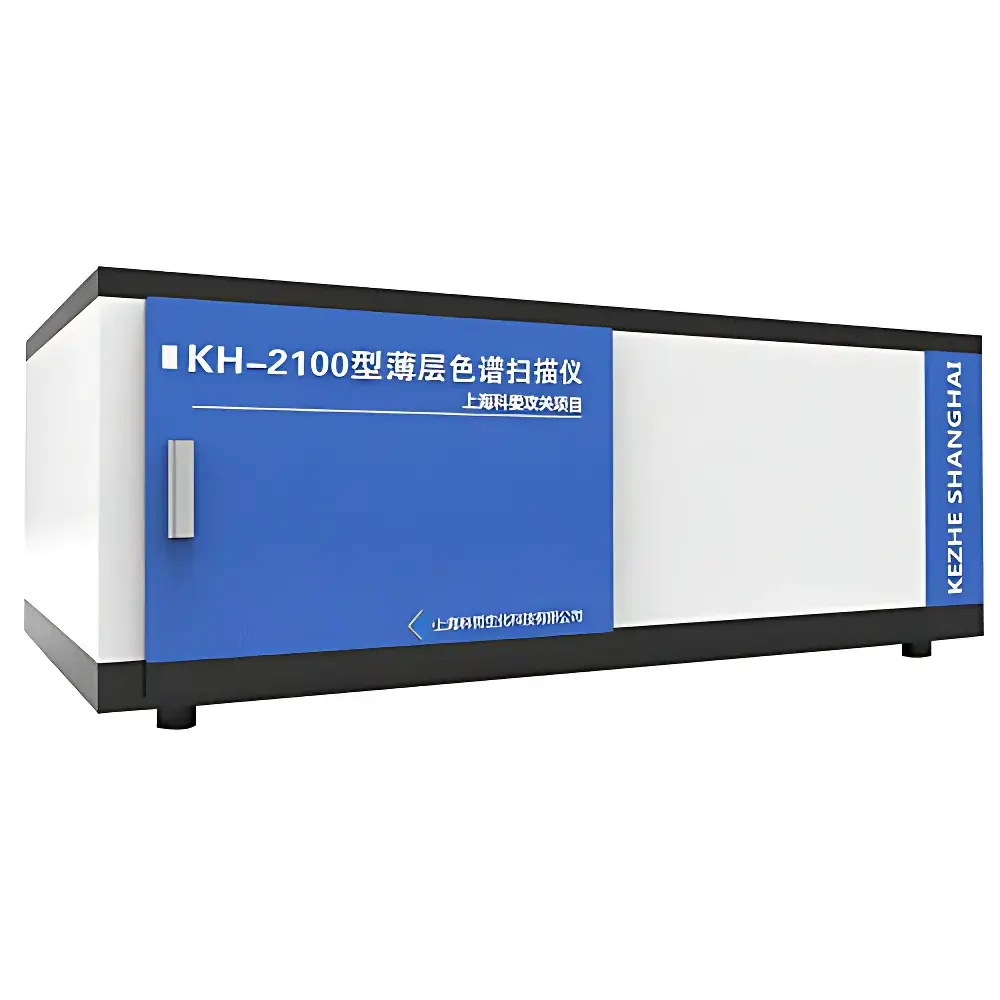
KEZHE SHANGHAI KH-2100 Regulatory-Compliant Thin Layer Chromatography Scanner
| Brand | KEZHE SHANGHAI |
|---|---|
| Origin | Shanghai, China |
| Manufacturer Type | Direct Manufacturer |
| Instrument Type | TLC Scanner |
| Operation Mode | Fully Automatic |
| Measurement Modes | Reflectance, Fluorescence (optional), Absorbance |
| Wavelength Range | 190–700 nm (auto-configurable) |
| Light Source | Deuterium Lamp + Tungsten-Halogen Lamp |
| Monochromator | Holographic Grating |
| Spectral Bandwidth | 5 nm |
| Wavelength Accuracy | ≤ ±1 nm |
| Wavelength Repeatability | RSD ≤ 2.0% |
| Minimum Spatial Resolution | 25 µm |
| Imaging Wavelength Range | 190–700 nm |
| Sample Stage Capacity | Accommodates 200 mm × 200 mm TLC plates |
| Maximum Scan Speed | 100 mm/s |
Overview
The KEZHE SHANGHAI KH-2100 Regulatory-Compliant Thin Layer Chromatography (TLC) Scanner is a dedicated, fully automated densitometric instrument engineered for pharmaceutical quality control laboratories operating under Chinese Pharmacopoeia (ChP) compliance requirements. It implements quantitative reflectance and absorbance scanning based on the principle of monochromatic light densitometry—where a precisely collimated beam, selected via a holographic grating monochromator, is raster-scanned across a developed TLC plate in the direction parallel to solvent migration. The reflected or transmitted intensity is measured at discrete spatial coordinates, enabling peak area integration and calibration-based quantification. Designed specifically for routine batch analysis in traditional Chinese medicine (TCM) manufacturing and QC environments, the KH-2100 satisfies all technical specifications defined in the ChP (2005, 2010, 2015, and 2020 editions), the Standard Operating Procedures for Pharmaceutical Inspection (SOP-TLC), and the National Verification Regulation for TLC Scanners (JJG 938–2019). Its architecture integrates a dual-lamp optical system (deuterium for UV, tungsten-halogen for visible), high-stability X-Y translation stage, and real-time signal processing electronics to ensure traceable, reproducible measurements aligned with GLP-aligned workflows.
Key Features
- Fully automated scanning operation with pre-loaded ChP-compliant methods for over 80 pharmacopoeial TLC assays—including quantitative determinations for ginsenosides, berberine, glycyrrhizin, and other TCM marker compounds.
- Dual-wavelength scanning capability with auto-wavelength selection across 190–700 nm, supporting both fixed-wavelength and wavelength-switching protocols per USP/ChP method requirements.
- Optical system certified to ≤ ±1 nm wavelength accuracy and RSD ≤ 2.0% repeatability—verified per JJG 938–2019 metrological standards.
- High-resolution spatial sampling at 25 µm step intervals, ensuring accurate peak boundary definition even for closely eluting bands on silica gel or RP-18 plates.
- Robust mechanical platform accommodating standard 200 mm × 200 mm TLC plates, compatible with both hand-spotted and machine-spotted plates from KEZHE’s SP-II, TD-II, and TK-10 accessories.
- Integrated background drift compensation and baseline noise suppression (≤ ±0.02 Abs), critical for low-concentration quantitation in herbal extracts.
Sample Compatibility & Compliance
The KH-2100 supports all common stationary phases used in pharmacopoeial TLC—including silica gel GF254, aluminum oxide, cellulose, and reversed-phase C18 layers—and accommodates both UV-active and derivatized analytes. Its measurement modes cover reflectance absorbance (for UV-absorbing compounds), fluorescence scanning (with optional excitation/emission filters), and transmission-based quantification where applicable. From a regulatory standpoint, the instrument meets the functional and performance criteria outlined in the Chinese Pharmacopoeia General Chapter 0502 (Thin-Layer Chromatography), the State Administration for Market Regulation’s Verification Regulation JJG 938–2019, and ISO/IEC 17025–2017 requirements for analytical instrument validation. While not FDA 21 CFR Part 11–certified out-of-the-box, its TStar-2100 software supports audit-trail-enabling configurations and user-access controls suitable for GMP-aligned documentation practices when deployed within validated laboratory environments.
Software & Data Management
The KH-2100 operates exclusively with TStar-2100—a Windows 7/10-native chromatographic workstation designed for regulatory-grade data handling. The software provides full method lifecycle management: method creation, parameter validation, raw data acquisition, peak detection (with adjustable threshold and smoothing), calibration curve generation (linear, quadratic, or weighted), and report export in PDF, CSV, and XML formats. All data files are timestamped and user-logged; raw scan profiles (.tsd) retain full spectral-spatial metadata for retrospective reprocessing. Quantitative workflows support external standardization, internal standard correction, and normalization—all compliant with ChP-referenced calculation logic. Audit trails record operator actions, parameter changes, and result modifications, satisfying minimum ALCOA+ principles for data integrity in regulated labs.
Applications
- Quantitative assay of active pharmaceutical ingredients (APIs) in TCM preparations per ChP monographs (e.g., Huang Qin, Dan Shen, and Yin Chen Hao formulations).
- Stability-indicating analysis of degradation products during accelerated and long-term stability studies.
- Identity confirmation and purity assessment of botanical extracts prior to formulation.
- Batch release testing for herbal granules, tablets, and injectables where TLC remains the compendial method.
- Method transfer support between R&D and QC labs due to standardized hardware and pre-validated software templates.
FAQ
Does the KH-2100 comply with international pharmacopoeias such as USP or EP?
The KH-2100 is explicitly engineered and verified against Chinese Pharmacopoeia and national verification regulations. While its optical and mechanical specifications meet or exceed typical USP and Ph. Eur. 2.2.27 requirements for TLC densitometry, formal USP/EP compliance documentation requires site-specific method validation per ICH Q2(R2).
Is fluorescence scanning included as standard or optional?
Fluorescence mode is available as a factory-configured option requiring installation of appropriate excitation source and emission filter sets; it is not enabled by default in base configurations.
Can the KH-2100 be integrated into a LIMS environment?
Yes—TStar-2100 supports ODBC-compliant database export and structured CSV/PDF reporting, enabling manual or scripted ingestion into third-party LIMS platforms.
What maintenance is required to sustain metrological compliance?
Annual verification using NIST-traceable neutral density filters and wavelength standards is recommended; KEZHE provides certified calibration services and maintains a documented maintenance log template aligned with ISO 9001:2015.
Is remote diagnostics or software update support available?
KEZHE offers secure remote assistance via TeamViewer (with client authorization) and quarterly software patch releases distributed through authenticated download portals.
Related Products






