
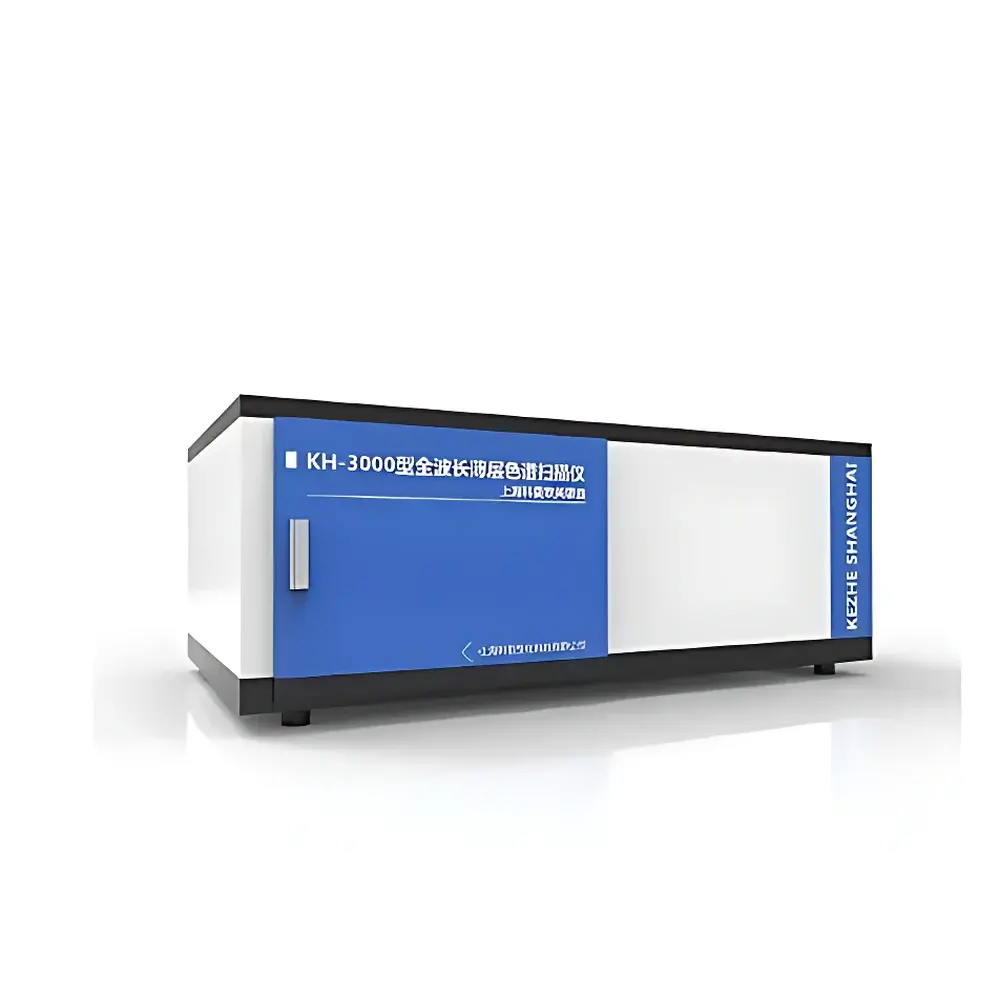
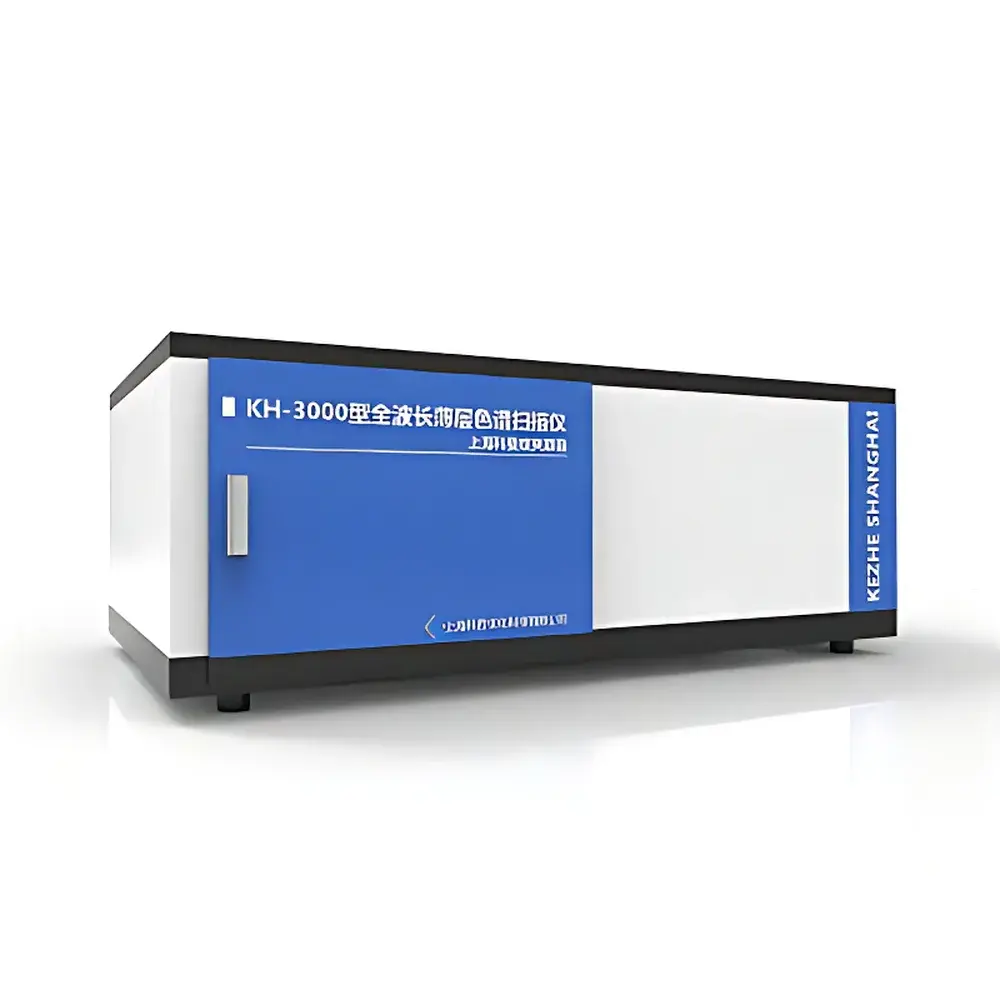
KEZHE SHANGHAI KH-3000 Full-Spectrum Thin-Layer Chromatography Scanner
| Brand | KEZHE SHANGHAI |
|---|---|
| Origin | Shanghai, China |
| Manufacturer Type | Direct Manufacturer |
| Model | KH-3000 |
| Instrument Category | TLC Scanner |
| Wavelength Range | 190–900 nm (continuously adjustable) |
| Light Sources | Deuterium lamp & tungsten-halogen lamp (auto-switching) |
| Monochromator | Holographic grating (1200 lines/mm) |
| Spectral Bandwidth | 10 nm |
| Wavelength Accuracy | ±0.5 nm |
| Minimum Resolution | 25–50 µm |
| Sample Stage | Accommodates 200 mm × 200 mm TLC plates |
| Scan Speed | 0–120 mm/s |
| Detection Modes | Absorbance & optional Fluorescence |
Overview
The KEZHE SHANGHAI KH-3000 Full-Spectrum Thin-Layer Chromatography Scanner is an automated, high-precision densitometric instrument engineered for quantitative and qualitative analysis of compounds separated on planar stationary phases. It operates on the principle of reflectance absorbance and fluorescence densitometry—measuring light attenuation or emission intensity at defined wavelengths across a developed TLC plate. Unlike conventional fixed-wavelength scanners, the KH-3000 integrates a dual-lamp optical system with continuous spectral coverage from 190 nm to 900 nm, enabling method development, peak identification, and spectral optimization directly on the chromatogram. Designed in collaboration with Shanghai Jiao Tong University and supported by the Shanghai Science and Technology Commission as a key R&D project, the instrument complies with the instrumental performance criteria specified in the Chinese Pharmacopoeia (ChP) 2005, 2010, and 2015 editions for TLC scanning. Its architecture supports regulatory-compliant workflows in pharmaceutical quality control laboratories, particularly for herbal medicine standardization, new TCM drug development, and natural product profiling.
Key Features
- Dual-light-source auto-switching system: Deuterium lamp (190–400 nm UV) and tungsten-halogen lamp (350–900 nm Vis-NIR) ensure optimal signal-to-noise ratio across the full spectral range.
- Holographic monochromator with 1200 lines/mm grating delivers high spectral purity and consistent wavelength resolution (10 nm bandwidth), critical for accurate peak integration in complex herbal matrices.
- Automatic wavelength calibration and lamp energy monitoring: Real-time diagnostics flag declining lamp output and initiate recalibration to maintain long-term photometric stability.
- High-resolution scanning stage with 25–50 µm spatial resolution accommodates standard and oversized 200 mm × 200 mm TLC plates—compatible with silica gel, aluminum oxide, cellulose, and RP-18 layers.
- Variable scan speed (0–120 mm/s) enables rapid screening or high-fidelity acquisition depending on spot morphology and analyte concentration gradients.
- Fully computer-controlled operation via USB 2.0 interface; no external serial adapters or proprietary hardware drivers required.
- Integrated UV spectral scanning mode: Acquires full reflectance spectra (200–850 nm) at user-defined locations—supporting unknown compound characterization and optimal wavelength selection prior to quantitative scanning.
Sample Compatibility & Compliance
The KH-3000 supports a broad spectrum of sample types commonly encountered in phytochemical and pharmaceutical QC labs, including crude herb extracts (e.g., Panax notoginseng, Coptis chinensis, Astragalus membranaceus), finished TCM formulations (e.g., Liu Wei Di Huang Wan, Huang Lian Shang Qing Wan), and bioactive small molecules (e.g., aflatoxins, macrolides, nucleic acid dyes). Its measurement protocols align with ChP general chapter 0502 “Thin-Layer Chromatography” and are adaptable to ICH Q2(R2) guidelines for analytical method validation. The Tstar-3000 workstation enforces role-based access control, electronic signature support, and full audit trail functionality—including timestamped parameter changes, method versioning, and raw data integrity logs—meeting GLP and GMP requirements under 21 CFR Part 11 when deployed with appropriate IT infrastructure and SOPs.
Software & Data Management
The Tstar-3000 professional TLC workstation provides a unified platform for instrument control, method development, data acquisition, and report generation. Pre-configured analytical methods for over 200 herbal monographs (ChP 2000–2015) are embedded and accessible with one-click loading. Users may define multi-wavelength absorbance/fluorescence scans, perform baseline correction using polynomial or rolling ball algorithms, integrate peaks with customizable thresholds, and apply internal standard or external calibration curves. All raw scan profiles (.tsd), processed chromatograms (.tch), and quantitation reports (.pdf/.xlsx) are stored with metadata tags (operator ID, date/time, plate ID, method name). Data export conforms to ASTM E1382-95 standards for chromatographic data interchange, facilitating integration with LIMS environments.
Applications
- Quantitative assay of marker compounds in herbal materials and extracts per ChP specifications.
- Stability-indicating analysis of TCM formulations under accelerated storage conditions.
- Fingerprint profiling of multi-component botanicals for batch-to-batch consistency assessment.
- Method development and validation for impurity detection in natural product-derived APIs.
- Fluorescence-based detection of non-UV-absorbing analytes (e.g., alkaloids, glycosides) using derivatization reagents.
- Educational use in university analytical chemistry and pharmacognosy laboratories for hands-on TLC densitometry training.
FAQ
Does the KH-3000 support fluorescence scanning?
Yes—fluorescence detection is available as a factory-configurable option, requiring installation of a UV excitation source and appropriate emission filters.
Is the instrument compatible with Windows 10 64-bit operating systems?
Yes—the Tstar-3000 software supports both Windows 7 (32-bit) and Windows 10 (64-bit) platforms with signed device drivers.
Can raw scan data be exported for third-party statistical analysis?
Yes—intensity profiles and peak tables can be exported in CSV, TXT, or Excel format with full coordinate and wavelength metadata.
What maintenance routines are recommended for long-term wavelength accuracy?
The system performs automatic grating calibration at startup; users should replace lamps according to manufacturer-specified lifetime limits (typically 1000 h for deuterium, 2000 h for halogen) and clean optics quarterly with spectroscopic-grade solvents.
Is remote instrument monitoring supported?
No native remote desktop or cloud connectivity is provided; however, local network sharing of the Tstar-3000 data folder enables centralized backup and collaborative review within secure intranet environments.





