
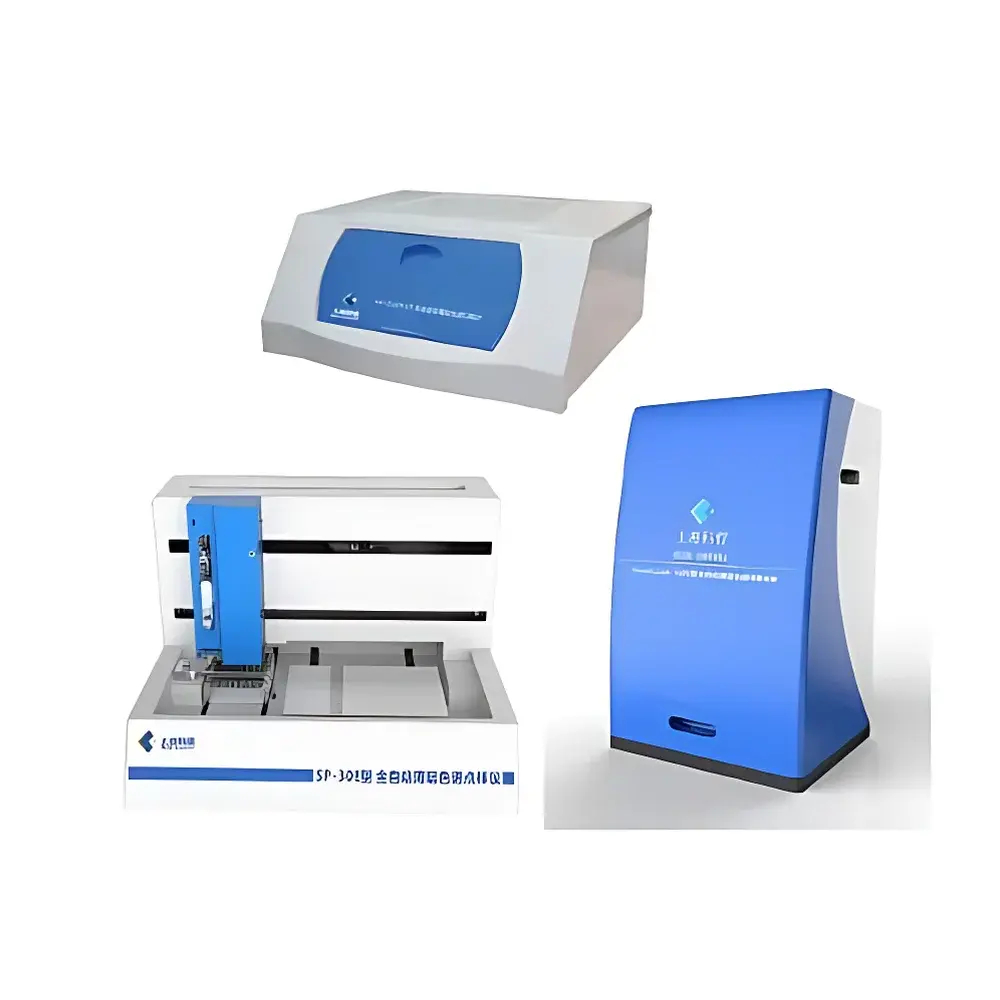
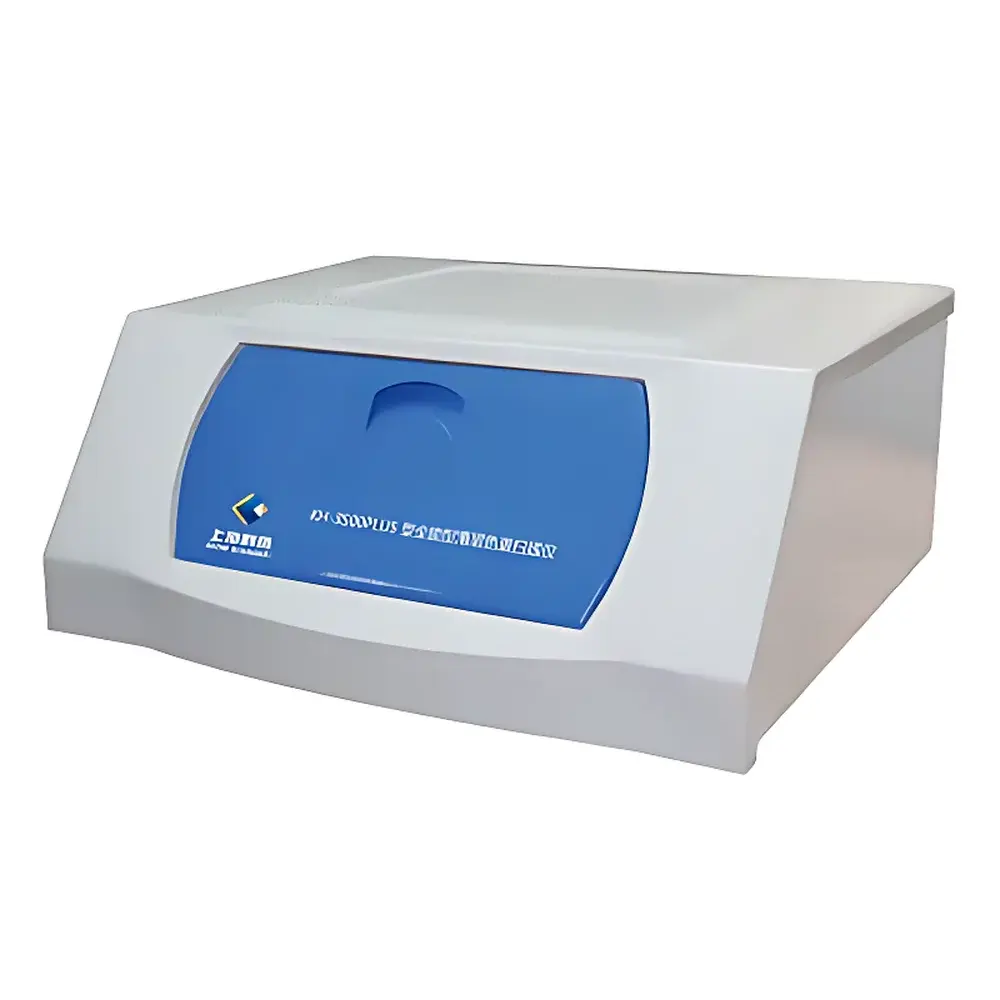
KEZHE SHANGHAI KH-3500Plus Universal Thin-Layer Chromatography Scanner
| Brand | KEZHE SHANGHAI |
|---|---|
| Origin | Shanghai, China |
| Manufacturer Type | OEM Manufacturer |
| Instrument Type | TLC Scanner |
| Measurement Modes | Reflectance Absorption, Reflectance Fluorescence, Transmittance Absorption, Transmittance Fluorescence, Chemiluminescence |
| Wavelength Range | 190 nm – 1000 nm |
| Light Sources | Tungsten-Halogen Lamp, Deuterium Lamp, Mercury Lamp (Auto-Switching) |
| Monochromator | Holographic Grating (1200 lines/mm) with Nitrogen Purge Function |
| Spectral Bandwidth | 5 nm / 10 nm / 20 nm (Selectable) |
| Wavelength Accuracy | ±0.5 nm |
| Wavelength Reproducibility | < 0.1 nm |
| Minimum Spatial Resolution | 10–25 µm |
| Imaging Wavelengths | 254 nm, 365 nm, White Light (Fully Automated Control) |
| Sample Stage | Accommodates 200 mm × 200 mm TLC plates (customizable to 300 mm × 200 mm) |
| Scan Speed | 0–120 mm/s |
| A/D Converter | 24-bit, 8-channel, 20 µs dual conversion |
| Slit Dimensions | Length 0–8 mm, Width 0–4 mm (Continuously Variable, PC-Controlled) |
| Fluorescence Filters | Standard set of six (K320, K360, K400, K450, K510, K550) |
| Detector | Photomultiplier Tube (PMT) |
| Data Acquisition Rate | 30,000 data points per second |
| Communication Interface | USB 2.0 |
| Compliance | Fully supports 21 CFR Part 11, electronic signatures, and IQ/OQ/PQ validation protocols |
Overview
The KEZHE SHANGHAI KH-3500Plus Universal Thin-Layer Chromatography (TLC) Scanner is an integrated analytical platform engineered for high-precision, multi-modal detection in pharmaceutical, natural product, and quality control laboratories. It operates on the fundamental principles of quantitative densitometry—measuring analyte absorbance or fluorescence intensity directly on stationary-phase TLC plates via controlled monochromatic illumination and photometric detection. Unlike conventional single-mode scanners, the KH-3500Plus implements simultaneous optical and digital imaging pathways: one dedicated to high-sensitivity photometric scanning (using a PMT detector), and another to high-fidelity plate documentation (via GoodLook-1000 imaging system). This dual-detection architecture enables real-time trajectory tracking, automated band alignment, and cross-validated quantitation—critical for regulatory submissions under ICH Q5, USP , and Chinese Pharmacopoeia (ChP) 2020 Edition Section 0502 (Thin-Layer Chromatography). Its extended spectral range (190–1000 nm), combined with auto-switching deuterium/tungsten/mercury light sources and nitrogen-purged grating optics, ensures reliable UV-Vis-NIR performance across diverse compound classes—including low-UV-absorbing flavonoids, near-IR dyes, and chemiluminescent derivatives.
Key Features
- True two-dimensional scanning capability along both X- and Y-axes—enabling precise contour mapping of irregular bands and gradient elution zones.
- Computer-controlled variable slit (0–8 mm length × 0–4 mm width), optimized for signal-to-noise ratio across varying spot sizes and plate thicknesses.
- 24-bit, 8-channel analog-to-digital conversion with 20 µs dual sampling—delivering high dynamic range (>10⁵) and sub-picogram detection limits for trace analysis.
- Integrated GoodLook-1000 imaging station with calibrated 254 nm, 365 nm, and white-light LED illumination—fully compliant with ChP 2020 TLC imaging requirements and GLP audit trails.
- Pre-installed Tstar-3500Plus workstation software supporting full 21 CFR Part 11 compliance: electronic signatures, audit logging, user role management, and immutable data archiving.
- SP-30E automated band applicator with microstepping motor control—enabling reproducible, uniform strip application (CV < 2.5%) directly registered into scan coordinates.
- Eight-position filter wheel with six standard fluorescence filters (K320–K550) and four customizable slots—supporting multi-wavelength excitation/emission profiling for complex natural product matrices.
Sample Compatibility & Compliance
The KH-3500Plus accommodates standard silica gel, alumina, cellulose, and reversed-phase (RP-18) TLC plates up to 200 mm × 200 mm (optionally 300 mm × 200 mm). Its modular optical path supports all major detection modes required by pharmacopoeial methods: reflectance absorption (e.g., ChP general chapter 0502), reflectance fluorescence (USP ), transmittance fluorescence (ICH Q5A), and chemiluminescence (for peroxidase-coupled assays). The system meets ISO/IEC 17025:2017 calibration traceability standards and includes built-in verification routines for wavelength accuracy (NIST-traceable holmium oxide filter), photometric linearity (neutral density step wedges), and spatial resolution (USP stage micrometer). All firmware and software modules are validated per GAMP5 guidelines and support full IQ/OQ/PQ documentation packages for FDA, EMA, and NMPA submissions.
Software & Data Management
Tstar-3500Plus is a validated, Windows 10–compatible workstation integrating scanner control, image acquisition, densitometric quantitation, and multivariate statistical analysis. It features embedded Chinese Herbal Medicine (CHM) fingerprinting tools—including hierarchical clustering (HCA), principal component analysis (PCA), and similarity coefficient calculation per ChP 2020 Annex VI. Raw data files (.khd, .tiff) are stored in vendor-neutral formats with embedded metadata (plate ID, operator, timestamp, instrument parameters). Audit trails record every parameter change, integration event, and report export—retained for ≥30 years per 21 CFR Part 11 §11.10(e). Data export supports CSV, PDF/A-2, and XML for LIMS integration. Optional modules include peak purity assessment (via spectral library matching) and forced degradation study templates aligned with ICH Q1A–Q1E.
Applications
- Quantitative analysis of active pharmaceutical ingredients (APIs) and impurities in herbal extracts per ChP monographs (e.g., Ginseng, Astragalus, Scutellaria).
- Fingerprint profiling of botanical drug substances for batch-to-batch consistency and adulterant screening.
- Stability-indicating method development for forced degradation studies (acid/base/oxidative/thermal).
- Residual solvent and pesticide residue screening using derivatized silica plates.
- Method transfer from HPTLC to preparative TLC via coordinate-mapped band isolation.
- Academic research in natural product chemistry requiring high-throughput, multi-wavelength screening of fraction libraries.
FAQ
Does the KH-3500Plus comply with 21 CFR Part 11 for regulated environments?
Yes—the Tstar-3500Plus software includes full electronic signature workflows, audit trail generation, and secure user authentication per FDA requirements.
Can the system perform both scanning and imaging simultaneously?
No—scanning and imaging are sequential but fully synchronized; the imaging module guides scan path definition prior to densitometric acquisition.
Is nitrogen purge mandatory for UV measurements below 220 nm?
Nitrogen purging is recommended for optimal signal stability at 190–210 nm; the system includes automatic purge timing and pressure monitoring.
What validation documentation is provided?
Comprehensive IQ/OQ/PQ protocols, installation checklists, and test reports are included; site-specific OQ execution support is available upon request.
Can third-party HPLC or GC data be imported for comparative analysis?
Yes—CSV and AIA-format chromatograms can be overlaid with TLC densitograms for cross-platform method correlation.




