
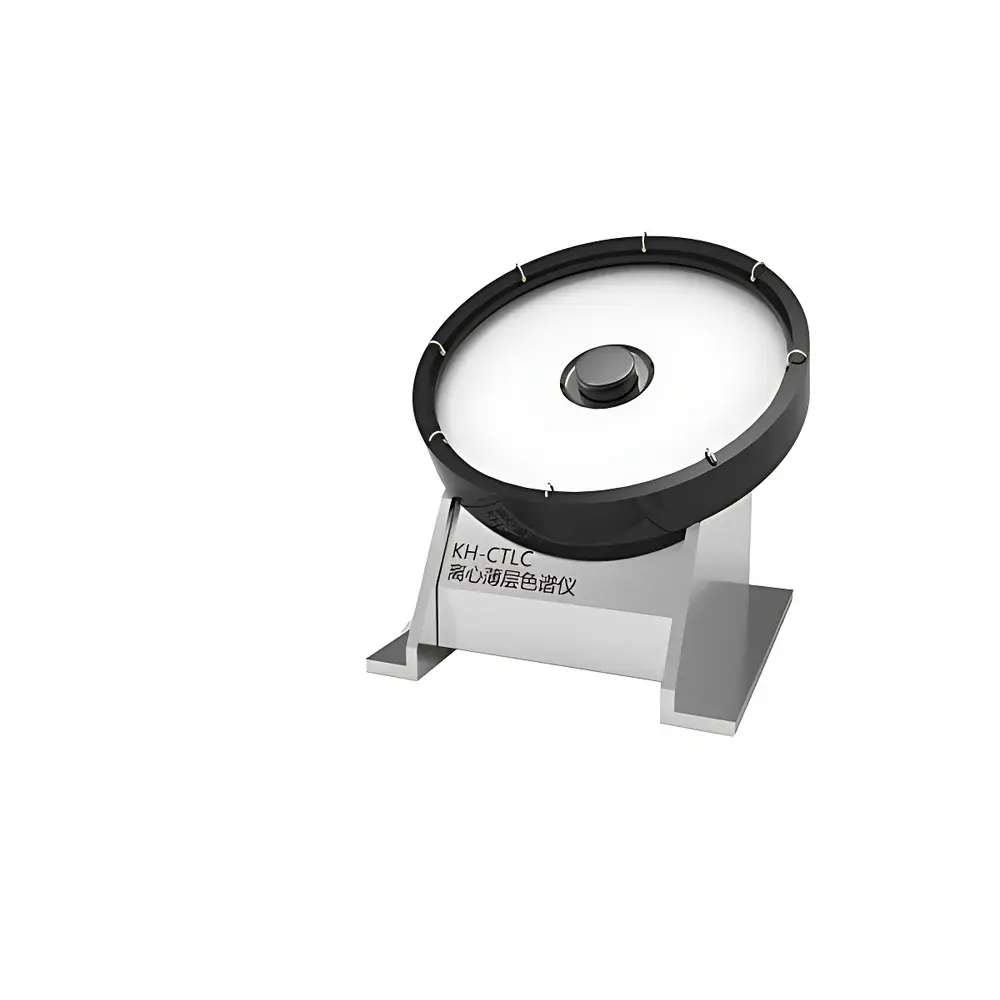
KEZHE SHANGHAI KH-CTLC-II Preparative Centrifugal Thin-Layer Chromatograph
| Brand | KEZHE SHANGHAI |
|---|---|
| Origin | Shanghai, China |
| Manufacturer Type | Direct Manufacturer |
| Instrument Type | Preparative Thin-Layer Chromatograph |
| Model | KH-CTLC-II |
| Wavelengths | 254 nm and 365 nm (UV) |
| Light Source | Dual-band UV Lamp |
| Sample Platform | Rotating Circular TLC Plate (Ø245 mm) |
| Flow Rate Range | 0–15 mL/min |
| Flow Accuracy | ±1% |
| Separation Capacity | 100 mg–2 g per run |
| Rotational Speed | 100–1450 rpm |
| Plate Thickness Options | 1, 2, 3, 4, 6, 8 mm |
Overview
The KEZHE SHANGHAI KH-CTLC-II Preparative Centrifugal Thin-Layer Chromatograph is an engineered solution for medium-resolution, milligram-to-gram scale compound isolation in synthetic organic chemistry, natural product purification, and pharmaceutical process development. Unlike conventional planar TLC or flash chromatography systems, the KH-CTLC-II employs centrifugal force to drive mobile phase radially across a rotating circular silica gel plate—enabling rapid, reproducible, and solvent-efficient separations without column packing or high-pressure hardware. This principle—centrifugal thin-layer chromatography (cTLC)—leverages controlled rotational dynamics and laminar radial flow to achieve resolution comparable to low-pressure liquid chromatography while retaining the simplicity, visual monitoring capability, and low operational cost of traditional TLC. Designed for laboratories requiring routine preparative work without investment in HPLC or MPLC infrastructure, the KH-CTLC-II bridges the gap between analytical screening and scalable purification.
Key Features
- Rotating circular TLC plate (Ø245 mm) with digitally adjustable speed (100–1450 rpm), enabling precise control over migration kinetics and band sharpening.
- Integrated stepper motor–driven constant-flow pump delivering 0–15 mL/min with ±1% volumetric accuracy—calibrated for consistent eluent delivery across variable backpressure conditions.
- Dual-wavelength UV observation system (254 nm and 365 nm) housed in a hinged optical cover with safety interlock, allowing real-time visualization of fluorescent or UV-absorbing compounds during separation.
- CNC-machined rotational assembly ensuring sub-50 µm concentricity tolerance—critical for uniform solvent front propagation and minimizing band distortion.
- On-line sample filtration module with replaceable cartridges to prevent irreversible adsorption of particulates or strongly retained impurities on the stationary phase.
- Modular plate preparation kit including刮板 (scrapers) and adjustable-thickness plate casters (1, 2, 3, 4, 6, and 8 mm options) for method optimization across polarity ranges and loading capacities.
- Compact footprint (<0.5 m²), fan-cooled operation, and solid-state electronics designed for continuous unattended runs in ISO Class 7–8 laboratory environments.
Sample Compatibility & Compliance
The KH-CTLC-II accommodates standard silica gel, alumina, and reversed-phase (C18) precoated circular plates, as well as user-poured slurries. It supports common organic solvents (e.g., hexane, ethyl acetate, methanol, chloroform, DCM) and aqueous–organic gradients up to 100% water content. All wetted components are chemically resistant (PTFE, borosilicate glass, 316 stainless steel). The instrument complies with IEC 61010-1:2010 for electrical safety and meets CE marking requirements for laboratory equipment. While not certified for GMP production, its traceable flow control, mechanical repeatability, and audit-ready operational logs support GLP-compliant documentation when paired with external electronic lab notebooks (ELNs). UV lamp output stability conforms to ASTM E259–22 for qualitative fluorescence detection in research settings.
Software & Data Management
The KH-CTLC-II operates via embedded firmware with local keypad and LCD interface—no PC dependency required for basic operation. Optional USB-connected software (KH-CTLC Control Suite v3.1) enables method storage, run scheduling, flow/rotation profile logging, and export of timestamped CSV reports compatible with LIMS integration. All parameter changes—including speed ramping profiles, flow setpoints, and dwell times—are recorded with operator ID and system timestamp. Audit trail functionality satisfies FDA 21 CFR Part 11 requirements when deployed with validated Windows-based host systems and digital signature modules.
Applications
- Purification of reaction mixtures post-Suzuki, Heck, or amidation couplings (typical recovery: 85–92%, Rf resolution ≥0.25).
- Isolation of alkaloids, flavonoids, terpenes, and glycosides from crude plant extracts (100 mg–2 g load per 245 mm plate).
- Removal of catalyst residues (e.g., Pd, Ru) and phosphine ligands prior to NMR characterization.
- Parallel fraction collection using segmented collection trays aligned with radial elution zones.
- Method scouting for subsequent scaling to medium-pressure liquid chromatography (MPLC) or prep-HPLC.
FAQ
What is the maximum sample loading capacity per run?
Up to 2 g on a 245 mm diameter plate with 2 mm layer thickness—subject to compound solubility and Rf distribution.
Can the KH-CTLC-II be used with reversed-phase plates?
Yes; C18 and CN-bonded circular plates are fully supported under standard mobile phase conditions.
Is gradient elution possible?
Manual two-solvent switching is supported via dual-channel valve; automated gradient capability requires optional auxiliary solvent selector module.
How often does the UV lamp require replacement?
Lamp lifetime exceeds 2,000 hours at nominal intensity; output degradation is monitored via integrated photodiode feedback.
Does the system support regulatory-compliant data archiving?
When used with validated KH-CTLC Control Suite and compliant ELN/LIMS, full 21 CFR Part 11 audit trails—including electronic signatures and change history—are achievable.
Related Products





