
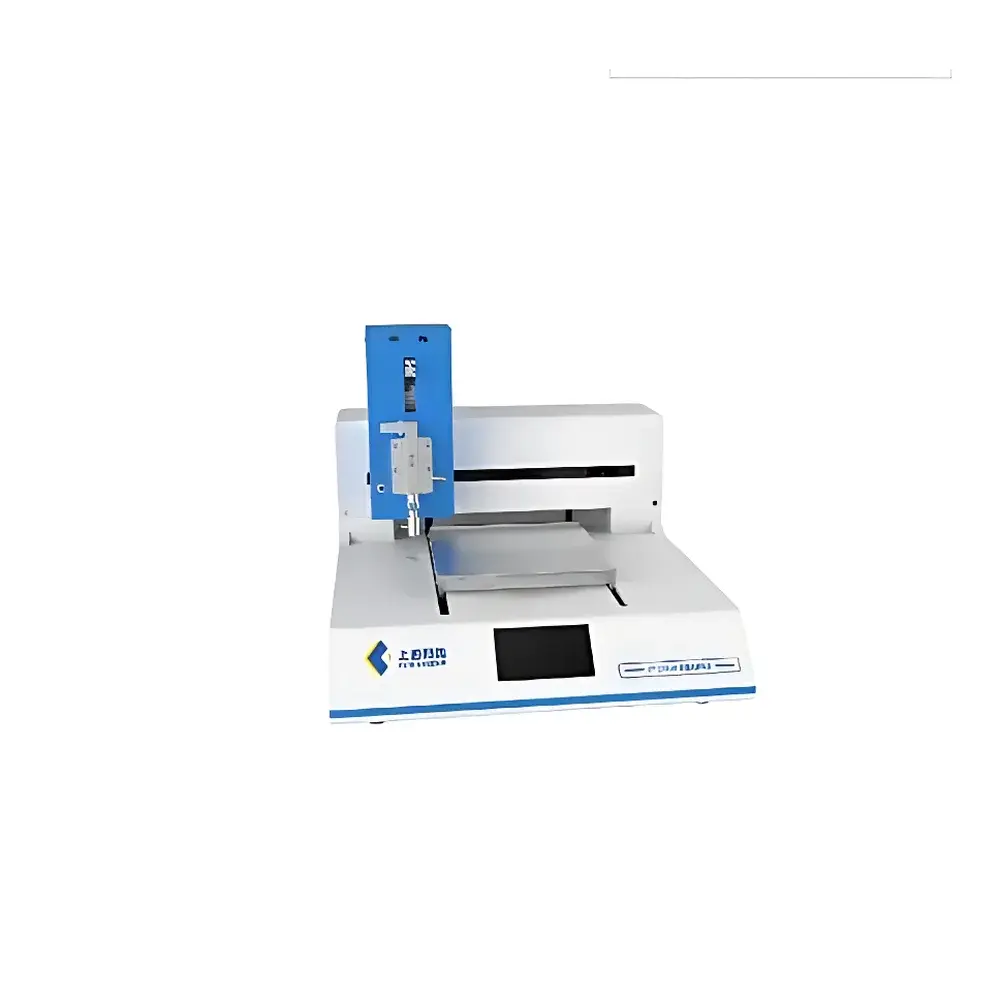
KEZHE SHANGHAI SP-20Start Intelligent TLC Sample Spotter
| Brand | KEZHE SHANGHAI |
|---|---|
| Origin | Shanghai, China |
| Manufacturer Type | Direct Manufacturer |
| Product Category | Domestic |
| Model | SP-20Start |
| Instrument Type | Thin-Layer Chromatography (TLC) Sample Spotter |
| Spotting Mode | Non-contact |
| Spot Shape | Circular or Linear Band |
| Maximum Spotting Length | 150 mm |
| Plate Size Compatibility | 200 mm × 200 mm |
| Spotting Volume Range | 1–20 µL (customizable up to 100 µL) |
| Spotting Accuracy | < 0.2% RSD |
| Spotting Reproducibility | < 0.5% RSD |
| Minimum Band Width | 0.2 mm |
| Syringe Options | 10, 25 (standard), 50, and 100 µL |
| X-Axis Resolution | 200 steps/mm |
| Y-Axis Resolution | 400 steps/mm |
| Syringe Drive Resolution | 3200 steps/mm (6400 steps/µL for 25 µL syringe) |
| Operating Pressure | 0.4 MPa (N₂ or compressed air) |
| Gas Flow Rate | 2–3 L/min |
| Heating Stage Temperature Range | Ambient to 60 °C (±1 °C stability) |
| Power Supply | 220 V, 50 Hz, 90 W |
| Control Interface | Integrated 7-inch capacitive touchscreen |
Overview
The KEZHE SHANGHAI SP-20Start Intelligent TLC Sample Spotter is a dedicated non-contact sample deposition system engineered for high-precision, automated spot application in thin-layer chromatography (TLC) workflows. Unlike conventional manual spotters or generic liquid handlers, the SP-20Start employs a pneumatically driven, syringe-based dispensing mechanism synchronized with high-resolution stepper motor positioning (X/Y axes) to achieve repeatable, quantitative sample placement on standard or custom TLC plates (up to 200 mm × 200 mm). Its core function—controlled micro-volume deposition without physical contact—eliminates plate surface damage, solvent spreading, and carryover, thereby preserving chromatographic integrity and enabling robust quantitative analysis when coupled with subsequent densitometric scanning. Designed specifically as an upstream companion to TLC scanners (e.g., CAMAG TLC Scanner 4 or DESAGA CD60), the SP-20Start bridges the gap between manual sample preparation and fully integrated analytical pipelines in pharmaceutical QC, natural product isolation, forensic toxicology, and academic phytochemical research.
Key Features
- Non-contact pneumatic spotting with programmable volume delivery (1–20 µL per spot; optional extended range up to 100 µL)
- Linear band spotting capability (minimum width: 0.2 mm), optimized for high-resolution densitometric quantification
- Integrated 7-inch capacitive touchscreen interface — no external PC required for method setup, execution, or real-time monitoring
- Dual-mode operation: discrete point spotting and continuous linear band deposition with adjustable speed (1–20 µL/min)
- Modular syringe configuration supporting 10, 25 (standard), 50, and 100 µL glass syringes, each calibrated for volumetric accuracy
- Heated sample stage (ambient to 60 °C, ±1 °C stability) to control solvent evaporation kinetics during multi-layer or sequential spotting
- High positional fidelity: X-axis resolution of 200 steps/mm; Y-axis resolution of 400 steps/mm; syringe drive resolution of 3200 steps/mm (6400 steps/µL for 25 µL syringe)
- Compressed air or nitrogen-compatible gas supply (0.4 MPa, 2–3 L/min flow rate) ensuring stable, pulse-free dispensing
Sample Compatibility & Compliance
The SP-20Start accommodates a broad range of sample matrices—including aqueous solutions, organic solvent extracts (e.g., methanol, chloroform, ethyl acetate), viscous plant tinctures, and derivatized standards—without clogging or cross-contamination, thanks to its inert fluid path and programmable rinse cycles. It supports all commercially available silica gel, alumina, cellulose, and reversed-phase TLC plates (including pre-coated HPTLC plates). While not certified to ISO/IEC 17025 or FDA 21 CFR Part 11 out-of-the-box, the instrument’s deterministic motion control, audit-ready parameter logging (via optional USB export), and reproducible spotting performance align with GLP and GMP principles for method validation in regulated environments. Users may document operational parameters—including syringe type, volume, speed, temperature, and gas pressure—for inclusion in SOPs and analytical method files compliant with ICH Q2(R2) and USP <621>.
Software & Data Management
Operation is managed entirely through the embedded touchscreen GUI, which provides intuitive access to preloaded spotting templates (e.g., “8×12 grid”, “linear gradient”, “multi-concentration series”) and allows full customization of coordinates, volumes, dwell times, and layering sequences. All method parameters are stored locally in non-volatile memory with timestamped versioning. Raw positional and dispensing logs can be exported via USB flash drive in CSV format for traceability and integration into LIMS or ELN platforms. Though no proprietary desktop software is required, KEZHE provides a configuration utility (Windows-compatible) for advanced users needing batch method generation or firmware updates. No cloud connectivity or remote access functionality is implemented — consistent with laboratory cybersecurity best practices for standalone instrumentation.
Applications
- Routine QC of herbal extracts and traditional medicines using validated HPTLC methods (e.g., WHO monographs, Chinese Pharmacopoeia)
- Method development for forced degradation studies, where precise multi-spot overlays enable kinetic profiling of degradation products
- Preparative TLC fraction collection support — accurate band placement ensures consistent elution zones across multiple plates
- Academic teaching labs requiring student-safe, error-resistant spotting for undergraduate chromatography courses
- Forensic laboratories performing rapid screening of seized substances (e.g., opioids, stimulants) via comparative TLC fingerprinting
- Stability-indicating assays in pharmaceutical development, particularly for low-dose APIs where sub-microgram spotting accuracy is critical
FAQ
Is the SP-20Start compatible with CAMAG or Desaga TLC scanners?
Yes — it accepts standard 200 mm × 200 mm plates used by CAMAG ADC2, TLC Scanner 4, and DESAGA CD60 systems, and its 0.2 mm band width meets HPTLC densitometry resolution requirements.
Can I use organic solvents like chloroform or DCM without damaging the fluid path?
The syringe, tubing, and valve components are chemically resistant to common TLC solvents; however, prolonged exposure to strong halogenated solvents requires post-run rinsing with ethanol or isopropanol.
Does the instrument support method validation documentation?
While it lacks electronic signatures or 21 CFR Part 11 compliance features, all user-defined parameters and execution logs are exportable for inclusion in validation protocols under GMP/GLP frameworks.
What maintenance is required for long-term precision?
Monthly calibration verification using gravimetric measurement of dispensed volumes and biannual inspection of syringe seals and pneumatic fittings are recommended.
Is nitrogen gas mandatory, or can compressed air be used?
Either is acceptable; nitrogen is preferred for moisture-sensitive or oxidation-prone samples, while oil-free compressed air suffices for routine applications.





