
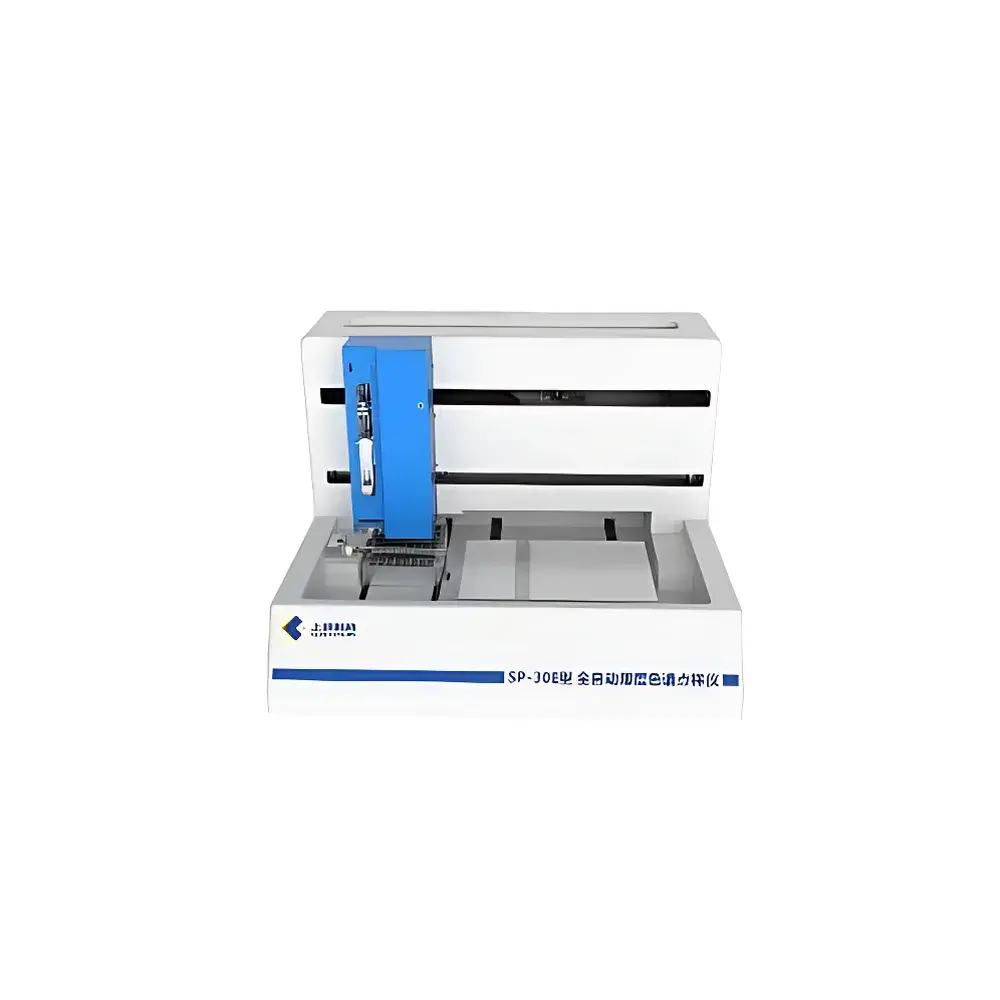
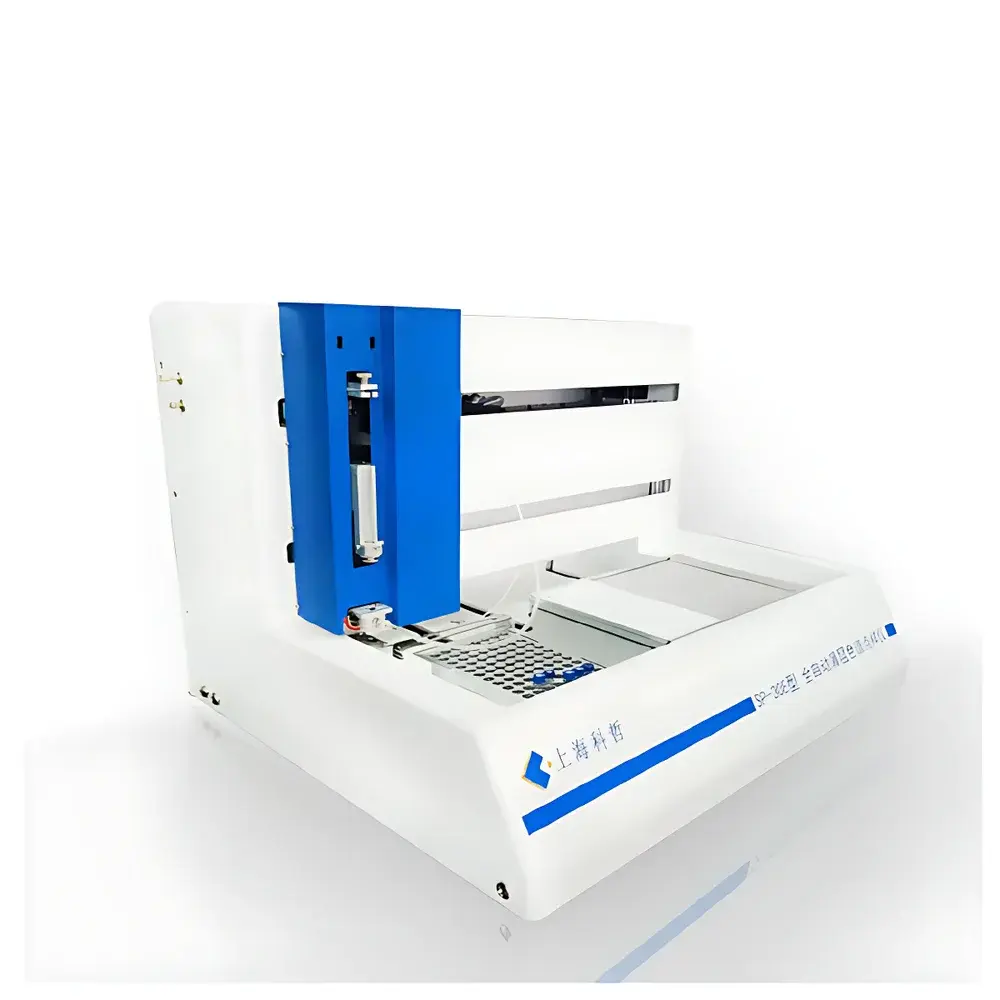
KEZHE SHANGHAI SP-30E Automated Thin-Layer Chromatography (TLC) Sample Spotter
| Brand | KEZHE SHANGHAI |
|---|---|
| Origin | Shanghai, China |
| Manufacturer Type | Direct Manufacturer |
| Model | SP-30E |
| Instrument Category | TLC Sample Spotter |
| Measurement Modes | Reflectance Absorption, Reflectance Fluorescence, Transmission Absorption, Transmission Fluorescence |
| Wavelength Range | 190–800 nm |
| Light Sources | Xenon Lamp, Tungsten-Halogen Lamp, High-Pressure Mercury Lamp |
| Monochromator | Holographic Grating (1200 lines/mm) with Nitrogen Purge Capability |
| Spectral Bandwidth | 5 nm |
| Wavelength Accuracy | <1 nm |
| Wavelength Repeatability | <0.2 nm |
| Minimum Resolution | 25 µm |
| Imaging Wavelengths | 254 nm, 365 nm, White Light |
| Sample Stage Capacity | Up to 200 mm × 200 mm TLC Plates |
| Maximum Scanning Speed | 100 mm/s |
| Spotting Volume Range | 10 nL – 2 mL |
| Spotting Precision | ±1.25 nL (with 25 µL syringe) |
| Syringe Options | 10 µL, 25 µL (standard), 50 µL, 100 µL |
| X/Y/Axial Drive Resolution | 200 steps/mm (X), 400 steps/mm (Y), 3200 steps/mm (syringe) |
| Heating Stage Range | Ambient to 60 °C (±1 °C) |
| Heated Nozzle | 30–80 °C |
| Auto-sampler Capacity | 96 × 2 mL vials |
| Gas Supply | 0.4 MPa, N₂ or compressed air |
| Flow Rate | 2–3 L/min |
Overview
The KEZHE SHANGHAI SP-30E Automated Thin-Layer Chromatography (TLC) Sample Spotter is an engineered solution for high-precision, reproducible sample application onto planar stationary phases in regulated and research-grade chromatographic laboratories. Designed around the principles of controlled pneumatic dispensing and computer-guided XYZ-stage positioning, the SP-30E delivers deterministic spot geometry—whether discrete dots, continuous bands, or custom-defined rectangular deposits—enabling method transfer between TLC development and subsequent quantitative densitometric scanning. Its architecture integrates thermal management (heated stage and nozzle), automated vial handling (including septum-piercing and vortex agitation), and real-time process monitoring to address analytical challenges inherent in viscous, thermally labile, or particulate-prone samples—such as botanical extracts, pharmaceutical formulations, and natural product isolates. As a Class I dedicated TLC spotting platform compliant with GLP-aligned workflow design, it serves as a critical pre-analytical interface between sample preparation and chromatographic quantification.
Key Features
- Integrated temperature-controlled stage (ambient to 60 °C, ±1 °C) and heated nozzle (30–80 °C) for rapid solvent evaporation and consistent deposition of high-boiling-point or viscous matrices
- 96-position auto-sampler with septum-piercing mechanism and programmable vortex agitation to prevent precipitation in herbal or suspension-based samples
- Pneumatically actuated microdispensing system with flow-stabilized nozzle capable of sub-0.3 mm spot width and repeatable nanoliter-to-milliliter volume delivery (10 nL–2 mL)
- Modular spotting geometry support: point, linear band, and square-shaped deposits—optimized for enhanced loading capacity and improved chromatographic resolution
- In situ syringe rinsing and de-bubbling without manual removal—minimizing cross-contamination and operator intervention
- High-resolution motion control: 200 steps/mm (X), 400 steps/mm (Y), 3200 steps/mm (syringe axis) enabling ±1.25 nL volumetric accuracy using a 25 µL syringe
- Nitrogen-purged monochromator (1200 lines/mm holographic grating) supporting spectral acquisition across 190–800 nm for post-development reflectance/fluorescence densitometry
- Direct data handoff to compatible TLC scanners via standardized coordinate mapping—ensuring traceable alignment between spotting position and scanning path
Sample Compatibility & Compliance
The SP-30E accommodates a broad range of sample types—including aqueous suspensions, organic solutions, viscous oils, and lyophilized reconstitutes—without requiring derivatization or dilution. Its sealed vial handling and inert gas-compatible fluidics reduce oxidation and volatilization losses during extended run sequences. From a regulatory standpoint, the instrument supports audit-trail-capable operation through its workstation software, which logs user actions, parameter changes, and execution timestamps—facilitating compliance with FDA 21 CFR Part 11 requirements when deployed in GMP/GLP environments. The system meets ISO/IEC 17025-relevant criteria for measurement traceability in accredited testing laboratories, particularly where TLC remains a compendial method (e.g., USP , Ph. Eur. 2.2.27).
Software & Data Management
The proprietary TLC Spotting Workstation Software provides full method definition, sequence programming, and real-time status visualization—including syringe position, pressure feedback, vial indexing, and spotting progress. Each sample entry is assigned a unique identifier linked to vial location, spotting coordinates, shape parameters, and delivered volume. All session data are stored in structured XML format with SHA-256 checksum integrity verification. Export options include CSV for LIMS integration and JSON for API-driven laboratory automation systems. Audit trails are immutable and exportable in PDF/A-2 format for internal review or regulatory submission. Software updates follow a documented change control process aligned with ICH Q9 principles.
Applications
- Quantitative assay of active pharmaceutical ingredients (APIs) and degradation products per pharmacopoeial TLC methods
- Stability-indicating analysis of herbal medicines and traditional Chinese medicine (TCM) preparations
- Impurity profiling in synthetic intermediates and fine chemical batches
- Method development for chiral separations on silica or cellulose-based layers
- High-throughput screening of reaction mixtures in medicinal chemistry workflows
- Densitometric calibration curve generation using band-spotted standards for enhanced linearity and dynamic range
FAQ
What sample volumes can the SP-30E dispense with validated accuracy?
The system achieves ±1.25 nL precision using a 25 µL syringe across the 10 nL–2 mL range. Accuracy is verified per ISO 8655-6 for piston-type volumetric apparatus.
Is nitrogen purging mandatory for the monochromator?
Nitrogen purge is optional but recommended for measurements below 220 nm to eliminate ozone-forming oxygen absorption and ensure photometric stability.
Can the SP-30E integrate with third-party TLC scanners?
Yes—coordinate mapping files (.csv or .txt) generated during spotting can be imported into commercial densitometers (e.g., CAMAG TLC Scanner 4, Desaga DC-Smart) to align scanning paths with deposited zones.
How is carryover mitigated between samples?
The system performs automated needle wash cycles (up to 3 solvents) with vacuum-assisted drying between injections, validated by blank injection testing per USP Analytical Instrument Qualification.
Does the software support electronic signatures per 21 CFR Part 11?
Electronic signature capability is available as an optional module, including role-based access control, biometric or token-based authentication, and full audit trail generation compliant with ALCOA+ principles.





