
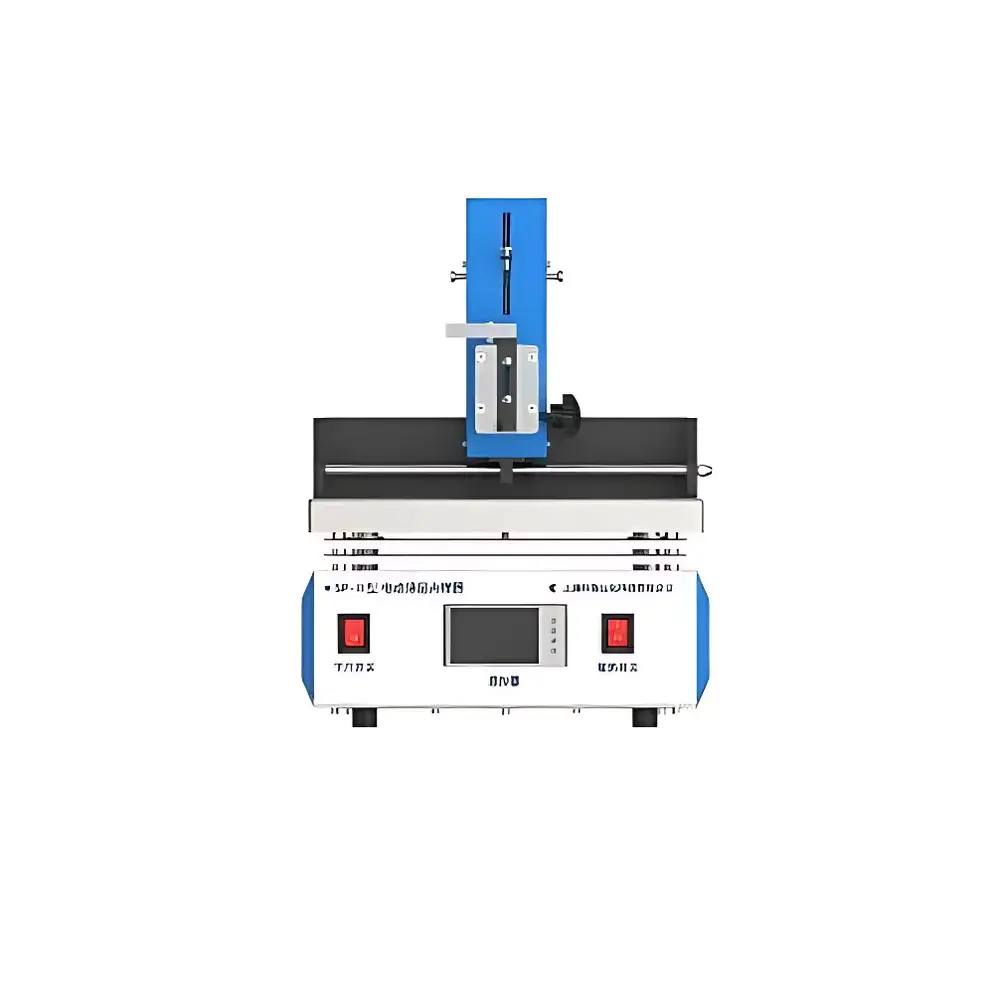
KEZHE SHANGHAI SP-II Electric Thin-Layer Chromatography (TLC) Sample Spotter
| Brand | KEZHE SHANGHAI |
|---|---|
| Origin | Shanghai, China |
| Manufacturer Type | Direct Manufacturer |
| Model | SP-II |
| Instrument Category | TLC Sample Spotter |
| Sample Application Modes | Circular Spot & Linear Band |
| Spotting Range | 0–200 mm |
| Spotting Temperature Range | Ambient to 100 °C |
| Heating Platform Temperature Range | Ambient to 200 °C |
| Heating System | CNC Digital Display Heated Stage with Uniform Heat Distribution Plate |
| Drive Mechanism | High-Reliability Shanghai Brand Stepper Motor Assembly |
| Spotting Precision | Contact-Based, Non-Sticking Needle Interface |
| Compliance | Designed for GLP-aligned laboratory workflows and compatible with ISO 17025 traceability requirements |
Overview
The KEZHE SHANGHAI SP-II Electric Thin-Layer Chromatography (TLC) Sample Spotter is an engineered precision instrument designed to replace manual spotting in quantitative and semi-quantitative TLC analysis. Unlike conventional hand-applied spotting—prone to inconsistent sample volume delivery, plate surface damage, silica gel disruption, and spot deformation—the SP-II implements motorized, programmable contact-based deposition to ensure reproducible sample geometry, uniform wetting behavior, and minimal adsorbent disturbance. Its operational principle relies on controlled vertical needle descent, calibrated dwell time, and thermally stabilized substrate conditions—critical parameters governing solvent front propagation, band resolution, and densitometric quantitation accuracy when coupled with TLC scanners (e.g., CAMAG or Desaga systems). The device integrates a digitally regulated heated stage and automated X-axis spotting arm within a compact benchtop architecture, enabling direct integration into routine QC/QA laboratories performing pharmaceutical impurity profiling, herbal extract fingerprinting, or forensic mixture separation.
Key Features
- CNC digital display heated stage with embedded uniform heat distribution plate—eliminates hot spots and thermal gradients common in open-coil heating platforms; achieves ±1.5 °C temperature stability across the full 0–200 °C range.
- Contact-mode spotting mechanism utilizing low-adhesion stainless steel capillary needles—prevents sample carryover, minimizes silicon gel peeling, and ensures consistent drop formation without “hollow” or “tail-shaped” spots.
- Precision stepper motor-driven spotting arm with linear guide rail system—enables repeatable positioning within ±0.2 mm over 0–200 mm travel range; supports both discrete circular spots and contiguous linear bands for gradient or multi-concentration assays.
- Integrated dual-zone thermal control: independent regulation of spotting tip environment (up to 100 °C) and support stage (up to 200 °C), facilitating pre-spot drying, post-spot activation, or simultaneous derivatization-compatible workflows.
- Modular construction using industrial-grade Shanghai-sourced motion components—designed for >50,000 operational cycles with mean time between failures (MTBF) exceeding 18 months under standard laboratory duty cycles.
Sample Compatibility & Compliance
The SP-II accommodates standard glass or aluminum-backed TLC plates (e.g., Silica Gel 60 F254, RP-18, or cellulose layers) up to 20 × 20 cm. It supports aqueous, organic, and mixed-solvent systems—including chloroform/methanol, ethyl acetate/hexane, and acidic/basic mobile phases—without compromising needle integrity or stage corrosion resistance. All electrical components conform to IEC 61010-1 safety standards for laboratory equipment. While not certified to FDA 21 CFR Part 11 out-of-the-box, the instrument’s fixed-parameter operation (no user-modifiable firmware or data storage) renders it inherently compliant with ALCOA+ principles for paper-based or scanner-coupled data recording in GMP/GLP environments. Documentation packages include calibration certificates traceable to NIM (National Institute of Metrology, China) for temperature and positional verification.
Software & Data Management
The SP-II operates via hardware-based digital controls—no embedded software, no USB connectivity, and no onboard memory. All settings (spotting position, temperature setpoint, dwell time, and repetition count) are configured manually using front-panel push-button interface with LED readouts. This architecture eliminates cybersecurity vulnerabilities, reduces validation burden, and aligns with Annex 11 risk-based assessment frameworks for legacy instrumentation. Users maintain full audit trail integrity by logging parameter configurations alongside chromatographic run records in LIMS or electronic lab notebooks (ELN). Optional RS-232 interface kits (available separately) enable external trigger synchronization with TLC scanners for time-stamped spot-to-scan correlation.
Applications
- Pharmaceutical quality control: precise application of reference standards and test samples for USP and EP 2.2.27-compliant identity and purity testing.
- Natural product analysis: reproducible banding of crude plant extracts to support chemometric pattern recognition and marker compound tracking.
- Academic teaching labs: standardized demonstration of Rf calculation methodology with minimized inter-operator variability.
- Food safety screening: parallel spotting of pesticide residue extracts prior to multi-residue TLC-densitometry per AOAC Official Method 2007.01 adaptations.
- Forensic toxicology: high-fidelity deposition of biological fluid extracts onto chiral or reversed-phase plates for enantiomeric separation validation.
FAQ
Does the SP-II support non-contact (air-gap) spotting?
No. It employs contact-based deposition only, optimized to prevent silica gel displacement and ensure volumetric consistency.
Can the instrument be validated for GMP use?
Yes—its deterministic mechanical design, absence of firmware, and traceable temperature/position calibration pathways support IQ/OQ protocols aligned with ASTM E2500 and EU GMP Annex 15.
Is the heating stage compatible with aluminum-backed plates?
Yes—uniform thermal distribution prevents warping or delamination; maximum stage temperature (200 °C) remains below the adhesive failure threshold of commercial Al/TLC composites.
What maintenance is required for long-term reliability?
Monthly cleaning of needle tips with appropriate solvents and annual verification of stage temperature uniformity using calibrated IR thermography or contact probe mapping.
Does KEZHE provide installation qualification (IQ) documentation?
Standard delivery includes Factory Acceptance Test (FAT) report; site-specific IQ templates and calibration SOPs are available upon request for regulated users.





