
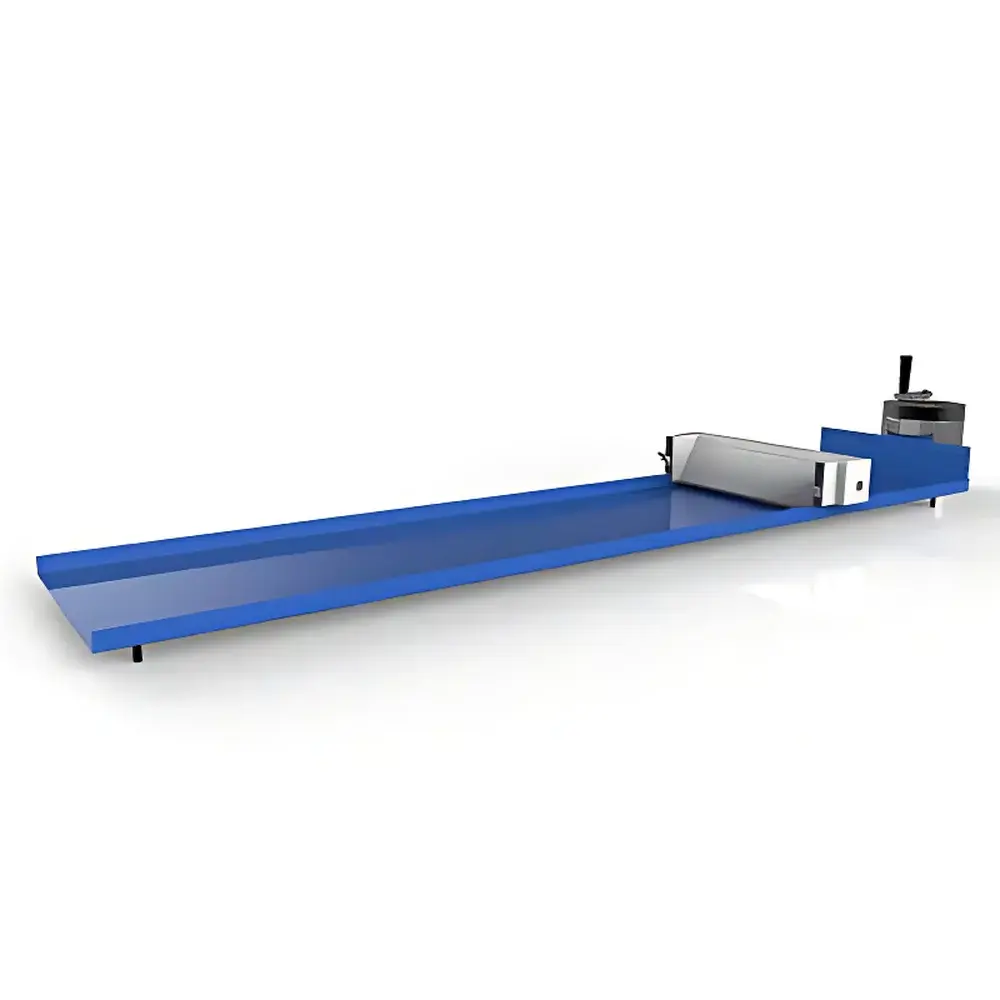
KEZHE SHANGHAI TD-I Manual Thin-Layer Chromatography (TLC) Plate Coater
| Brand | KEZHE SHANGHAI |
|---|---|
| Origin | Shanghai, China |
| Manufacturer Type | Direct Manufacturer |
| Model | TD-I |
| Plate Width Compatibility | 50 mm, 100 mm, 200 mm |
| Adjustable Coating Thickness Range | 0–2.5 mm |
| Plate Size Support | Standard 200 mm × 200 mm (customizable to 300 mm × 200 mm) |
| Construction | CNC-machined stainless steel and anodized aluminum components |
| Includes | Multi-size carrier tray, adjustable slurry reservoir, integrated mini slurry homogenizer, precision thickness gauge |
Overview
The KEZHE SHANGHAI TD-I Manual Thin-Layer Chromatography (TLC) Plate Coater is a precision-engineered laboratory tool designed for the reproducible, uniform preparation of silica gel, alumina, or other stationary-phase layers on glass, aluminum, or plastic backing plates. Unlike automated coaters requiring compressed air or programmable motion control, the TD-I relies on manual, operator-guided deposition—offering full tactile control over slurry flow, blade clearance, and coating speed. Its mechanical architecture is based on calibrated linear translation and fixed-gap doctor blade principles, ensuring consistent layer thickness across the entire plate surface. This device serves as a foundational sample preparation instrument in analytical chemistry laboratories where method development, validation, or small-batch TLC plate production demands high repeatability without reliance on complex electronics or software interfaces.
Key Features
- Precision CNC-machined frame with corrosion-resistant stainless steel guide rails and anodized aluminum structural components, ensuring long-term dimensional stability and resistance to solvent exposure.
- Interchangeable carrier trays supporting standard TLC plate widths of 50 mm, 100 mm, and 200 mm—each with positive mechanical registration to eliminate lateral misalignment during coating.
- Adjustable coating thickness mechanism with micrometer-graduated scale (0–2.5 mm range), enabling fine-tuned control of stationary phase loading for both qualitative screening and semi-quantitative analysis.
- Integrated mini slurry homogenizer included as standard equipment—designed to disperse silica gel suspensions uniformly and minimize particle aggregation prior to application, directly improving chromatographic resolution.
- Calibrated thickness gauge with hardened steel contact tips for post-coating verification, traceable to metrological standards used in GLP-compliant environments.
- Modular slurry reservoir with low-profile design and tapered outlet geometry to reduce meniscus-induced edge effects and ensure laminar flow across the blade interface.
Sample Compatibility & Compliance
The TD-I accommodates a wide range of commercially available TLC substrates—including precoated glass plates (e.g., Merck Silica Gel 60 F254), aluminum-backed sheets, and polyester films—as well as user-prepared supports. It is compatible with common stationary phases such as silica gel G, silica gel GF254, aluminum oxide, and cellulose, whether suspended in water, ethanol, or chloroform-based slurries. The device meets mechanical requirements outlined in ISO 17025:2017 for ancillary equipment used in accredited testing laboratories. While not an electronic instrument subject to electromagnetic compatibility (EMC) directives, its construction adheres to general laboratory safety standards per IEC 61010-1 for non-electrical lab apparatus. No electrical certification (e.g., CE, UL) applies due to absence of powered components.
Software & Data Management
The TD-I is a fully manual, non-electronic instrument and does not incorporate embedded firmware, digital controls, or data logging capabilities. As such, it requires no software installation, driver configuration, or cybersecurity protocols. All operational parameters—including blade height setting, tray positioning, and slurry volume—are recorded manually in laboratory notebooks or electronic lab notebooks (ELNs) in accordance with institutional SOPs. For laboratories operating under FDA 21 CFR Part 11 or EU Annex 11 requirements, documentation of coating parameters (e.g., thickness setting, batch number of slurry, ambient temperature/humidity) must be maintained as part of analytical method records. The absence of automation simplifies audit trails and eliminates concerns related to software validation.
Applications
- Routine preparation of TLC plates for pharmaceutical impurity profiling per USP and ICH Q5A guidelines.
- Method development workflows requiring iterative optimization of layer thickness and particle concentration to resolve structurally similar compounds (e.g., isomers, degradation products).
- Academic teaching labs where hands-on understanding of TLC fundamentals—including capillary flow dynamics, solvent front behavior, and Rf reproducibility—is prioritized over throughput.
- Preparative TLC plate fabrication for subsequent scraping and extraction, especially when customized plate dimensions (e.g., 300 mm × 200 mm) are required for large-scale isolation.
- Quality control laboratories performing identity testing of raw materials using pharmacopoeial monographs that specify manually prepared plates.
FAQ
Is the TD-I compatible with high-viscosity slurries such as polyacrylamide or chitin-based coatings?
Yes—the adjustable gap geometry and low-shear slurry delivery system support viscosities up to 1500 mPa·s when used with appropriate diluents and pre-homogenization.
Can the coating thickness be verified in real time during operation?
No real-time measurement is possible; however, the micrometer-adjusted blade position provides repeatable setup, and final thickness can be confirmed via calibrated calipers or profilometry post-drying.
Does KEZHE SHANGHAI provide calibration certificates for the thickness gauge?
Upon request, third-party calibration certificates traceable to NIM (National Institute of Metrology, China) are available at additional cost.
What maintenance is required for long-term accuracy?
Routine cleaning of the blade edge and reservoir with methanol followed by nitrogen drying is recommended after each use; annual inspection of micrometer thread wear is advised for high-frequency applications.
Is technical support available outside mainland China?
Yes—KEZHE SHANGHAI offers remote troubleshooting, English-language operation manuals, and video-based training sessions for international users.




