
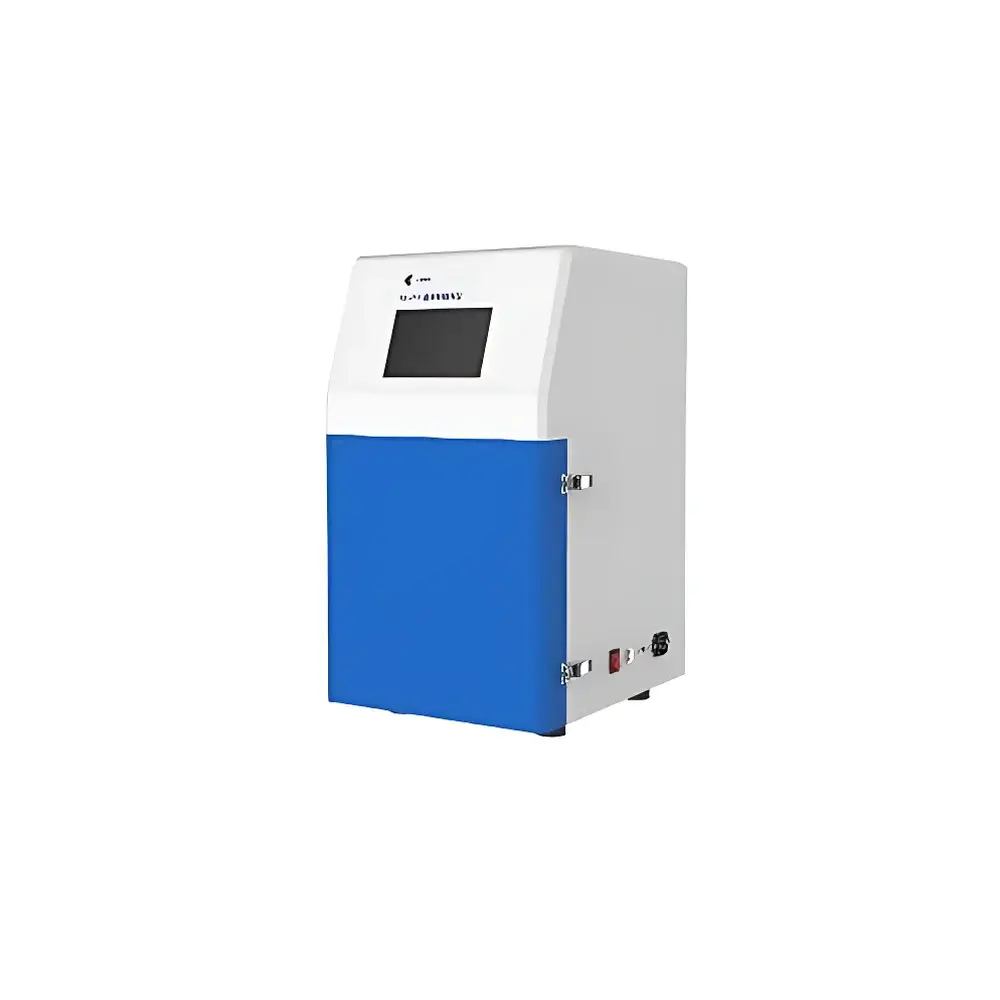
KEZHE SHANGHAI TK-20E Automated Thin-Layer Chromatography (TLC) Development Instrument
| Brand | KEZHE SHANGHAI |
|---|---|
| Origin | Shanghai, China |
| Manufacturer Type | Direct Manufacturer |
| Instrument Type | Automated TLC Development System |
| Model | TK-20E |
| Operation Mode | Fully Automatic |
| Maximum Plate Size | 200 mm × 200 mm |
| Development Distance Range | 40–180 mm |
| Development Distance Accuracy | ≤1 mm |
| Humidity Control Range | 10–90% RH (65–90% RH requires optional humidification module) |
| Gas Flow Rate | 0–16 L/min |
| Solvent Consumption | ≤20 mL per run |
| Interface | RS232 / USB |
| Temperature & Humidity Monitoring | Real-time onboard sensors |
| Compliance Support | GLP/GMP workflows and FDA 21 CFR Part 11 audit trail capability via software |
Overview
The KEZHE SHANGHAI TK-20E Automated Thin-Layer Chromatography (TLC) Development Instrument is an engineered solution for reproducible, condition-controlled planar chromatographic development. It operates on the principle of solvent front migration under precisely regulated environmental parameters—including vapor-phase saturation, relative humidity, temperature, and linear development distance—within a sealed, motorized development chamber. Unlike conventional manual or semi-automated TLC tanks relying on static salt-saturated chambers, the TK-20E employs dynamic vapor generation and active gas flow management to achieve rapid, continuous, and programmable humidity modulation. This architecture eliminates batch-to-batch variability caused by ambient fluctuations, operator technique, or inconsistent chamber equilibration—critical for method transfer, regulatory submission, and quality control laboratories operating under ISO/IEC 17025, USP , or ICH Q5A guidelines.
Key Features
- Fully automated sequence execution: pre-equilibration, vapor saturation, solvent front development, post-development drying, and environmental logging—all programmable and repeatable.
- Dynamic humidity control system enabling stepwise or gradient RH adjustment (10–90% RH), with stabilization achieved in ≤5 minutes—significantly faster than passive saturated-salt methods.
- Independent fluid handling pathways for mobile phase delivery and saturation vapor generation, preventing cross-contamination and ensuring stoichiometric fidelity during multi-solvent or gradient development protocols.
- High-resolution CCD-based imaging module integrated into the chamber lid, capturing real-time development progress and generating annotated digital chromatograms with calibrated distance markers.
- Flexible plate compatibility: accommodates standard and custom TLC plates up to 200 mm × 200 mm; no mechanical clamping or fixed cassette required—enabling rapid plate exchange and minimizing edge effects.
- Onboard high-accuracy temperature and humidity sensors (traceable to NIST-certified references), continuously logged with timestamps and exported in CSV or XML format.
- Low solvent consumption design (≤20 mL per development cycle), reducing hazardous waste generation and operational cost—particularly advantageous for chlorinated or high-purity eluents used in pharmaceutical impurity profiling.
Sample Compatibility & Compliance
The TK-20E supports silica gel, alumina, cellulose, reversed-phase (C18), and chiral stationary phase TLC plates from major suppliers (e.g., Merck, Analtech, Sorbent Technologies). Its closed-chamber architecture ensures consistent Rf values across batches and operators—essential for identity confirmation, purity assessment, and stability-indicating assays. The instrument meets functional requirements for Good Laboratory Practice (GLP) and Good Manufacturing Practice (GMP) environments: full electronic audit trail, user access control, electronic signatures, and data integrity safeguards compliant with FDA 21 CFR Part 11 when operated with the validated KEZHE TLC Workstation software. All firmware and software modules undergo periodic verification per ASTM E2500-13 (Standard Guide for Specification, Design, and Verification of Pharmaceutical and Biopharmaceutical Manufacturing Systems).
Software & Data Management
The KEZHE TLC Workstation software provides a validated Windows-based interface for method creation, instrument control, real-time monitoring, and report generation. Each development run generates a structured metadata file containing instrument ID, operator ID, timestamp, environmental logs (temperature/humidity vs. time), development distance profile, and raw CCD image. Data export formats include PDF (for regulatory submission), TIFF (for densitometry integration), and CSV (for LIMS ingestion). Audit trails are immutable and timestamped; all parameter changes are recorded with user context and reason-for-change fields. Software validation documentation (IQ/OQ/PQ protocols) is available upon request for regulated users.
Applications
- Pharmaceutical QC/QA: Identity testing of APIs and excipients per USP monographs; forced degradation product tracking; cleaning validation swab extract analysis.
- Natural product isolation: Fraction tracking during column chromatography fraction collection; polarity-based compound classification in herbal extracts.
- Forensic toxicology: Rapid screening of controlled substances and metabolites in biological matrices using derivatization-compatible plates.
- Food safety: Pesticide residue screening (e.g., organophosphates, carbamates) on silica plates with fluorescence detection.
- Academic research: Method development for 2D-TLC, overpressured layer chromatography (OPLC) pre-screening, and green solvent optimization studies.
FAQ
Does the TK-20E support gradient elution or multi-solvent development?
Yes—the instrument’s dual-reservoir fluid system allows sequential or simultaneous introduction of up to two immiscible solvents, enabling step-gradient or sandwich-layer development protocols.
Is hardware calibration traceable to national standards?
Temperature and humidity sensors are factory-calibrated against NIST-traceable reference instruments; calibration certificates are provided with each unit and can be re-verified using external probes per ISO/IEC 17025 procedures.
Can the CCD imaging system be used for quantitative densitometry?
The integrated CCD captures high-contrast grayscale images suitable for semi-quantitative Rf determination and spot presence/absence calls; for full quantitation, exported TIFF files are compatible with third-party densitometers (e.g., CAMAG Linomat, ImageJ with TLC plugin).
What maintenance is required for long-term reliability?
Routine maintenance includes quarterly cleaning of the solvent delivery lines and saturation chamber walls with methanol; annual verification of motor positioning accuracy and sensor drift using certified reference materials.
Is remote monitoring supported?
Yes—via USB or RS232 connection to a networked PC, the workstation software supports remote initiation, real-time status viewing, and alarm notification through configurable email/SNMP alerts.





