
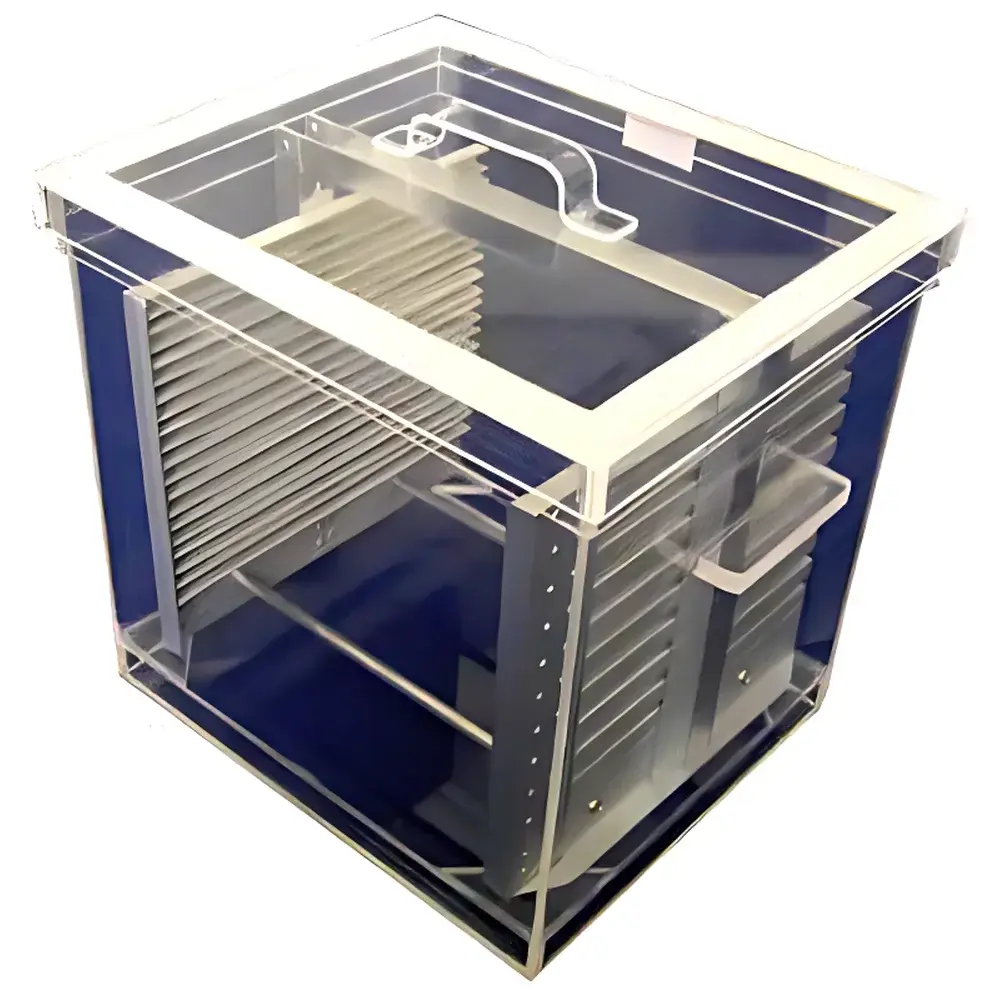
KEZHE SHANGHAI TK-II Thin Layer Chromatography Starter Kit
| Brand | KEZHE SHANGHAI |
|---|---|
| Origin | Shanghai, China |
| Manufacturer Type | Direct Manufacturer |
| Product Category | Domestic (PRC-Made) |
| Model | TK-II |
| Price Range | USD 1,400 – 4,200 (FOB Shanghai) |
| Instrument Type | TLC Ancillary Equipment Suite |
| UV Wavelengths | 254 nm & 365 nm |
| Max Plate Size Supported | 200 × 200 mm |
| Min Plate Size Supported | 25 × 75 mm (development), 50 × 50 mm (storage) |
| Imaging Platform | Integrated dark chamber with dual-band UV illumination |
| Resolution | Single-band spectral isolation via fixed-wavelength UV lamps |
| Scan Capability | Visual observation and photographic documentation only (no motorized scanning or densitometry) |
| Plate Handling | Manual positioning |
Overview
The KEZHE SHANGHAI TK-II Thin Layer Chromatography Starter Kit is an integrated, laboratory-validated ensemble of four core components engineered to support reproducible, compliant, and efficient thin-layer chromatographic workflows in academic, pharmaceutical QC, and industrial R&D settings. Unlike standalone instruments, the TK-II functions as a purpose-built ecosystem—combining controlled UV visualization, precision solvent development, standardized plate handling, and validated consumables—thereby minimizing operator variability and enhancing inter-laboratory comparability. The system operates on classical planar chromatography principles: separation occurs via capillary-driven mobile-phase migration across a stationary phase (e.g., silica GF254), with detection relying on UV-induced fluorescence quenching or direct absorption at 254 nm and 365 nm. No optical scanning, spectral acquisition, or quantitative densitometric analysis is performed by this kit; it is designed explicitly for qualitative identification, method development, and preparative fraction tracking under GLP-aligned manual protocols.
Key Features
- GoodSee-II Dark Chamber Imaging Station: A portable, light-tight enclosure equipped with dual-wavelength UV lamps (254 nm and 365 nm), enabling high-contrast visual inspection and digital photography of developed plates without ambient interference. Accommodates standard analytical (100 × 100 mm) to preparative (200 × 200 mm) plates.
- TK-10 Electronic Developing Chamber: A temperature-stable, sealed development tank featuring real-time solvent level sensing, digital display of run time and saturation status, and adjustable chamber geometry to ensure uniform solvent front advancement. Supports gradient and saturated-vapor development modes per ASTM D1298 and USP <621> guidelines.
- TB-2 Plate Storage & Conditioning Unit: A corrosion-resistant stainless-steel cabinet with precision-machined, height-adjustable aluminum racks. Designed for sequential post-development steps: rinsing, air-drying, thermal conditioning (up to 110 °C), and archival storage—all while maintaining plate flatness and edge integrity.
- Pre-Qualified TLC Consumables Pack: Includes certified blank glass plates (50 × 50 mm, 100 × 100 mm, 200 × 200 mm), batch-tested GF254 silica gel slurry (pH 5.5–6.5, particle size distribution ≤10 µm), calibrated capillaries (5 µL nominal volume, ±0.3 µL tolerance), stainless-steel scribing tool for uniform lane division, and metric-aligned spotting ruler (0.5 mm graduation, ±0.02 mm linearity).
Sample Compatibility & Compliance
The TK-II kit supports all standard TLC substrates—including silica gel, alumina, cellulose, and reversed-phase C18 plates—as long as physical dimensions fall within specified limits. It complies with fundamental requirements of ISO 17025:2017 (clause 6.4.3 on equipment suitability) and aligns with USP <621> “Chromatography” for manual plate development and visualization. While not inherently 21 CFR Part 11 compliant (as it contains no electronic records or audit trails), the kit facilitates traceable workflows when used with lab notebooks, timestamped photographs, and SOP-controlled procedures. All UV lamps meet IEC 62471 photobiological safety classification (Risk Group 2), and the TK-10 chamber incorporates solvent vapor containment features consistent with OSHA 1910.1200 (Hazard Communication Standard).
Software & Data Management
The TK-II Starter Kit is hardware-only and does not include embedded firmware, proprietary software, or network connectivity. Data capture is manual: users document results via calibrated digital cameras, annotated lab notebooks, or LIMS-integrated image repositories. The GoodSee-II chamber’s consistent illumination geometry enables repeatable photographic documentation suitable for semi-quantitative comparison across batches. For laboratories requiring regulatory-grade data integrity, the kit integrates seamlessly with third-party image analysis platforms (e.g., ImageJ with TLC Analyser plugin or commercial tools such as CAMAG WinCATS) when paired with external USB microscopes or flatbed scanners meeting ISO/IEC 17025 calibration traceability requirements.
Applications
- Routine identity testing of raw materials and excipients in pharmaceutical manufacturing (per ICH Q5, Q6A)
- Reaction monitoring in synthetic organic chemistry labs
- Purity assessment of natural product isolates and herbal extracts (in accordance with Chinese Pharmacopoeia Vol. IV and EP 2.2.27)
- Method scouting and optimization prior to HPLC method transfer
- Educational demonstrations of separation theory, Rf calculation, and mobile-phase selection
- Stability-indicating assays for forced degradation studies (acid/base/oxidative/thermal)
FAQ
Is the TK-II kit suitable for quantitative analysis?
No. It provides qualitative and semi-quantitative capabilities only. Quantification requires integration with densitometric imaging systems and calibration standards.
Can the TK-10 develop multiple plates simultaneously?
No. It is configured for single-plate development to ensure consistent solvent saturation and front uniformity, per USP <621> recommendations.
Are the GF254 silica gel batches certified for pharmacopeial use?
Yes. Each bottle carries a CoA referencing USP-NF monograph tests for fluorescence uniformity, binder content, and heavy metal limits (Pb, As, Cd, Hg).
Does the GoodSee-II chamber support white-light visualization?
No. It is optimized exclusively for UV-based detection. Visible-light inspection must be conducted separately under ambient or LED bench lighting.
What maintenance is required for long-term reliability?
UV lamp replacement every 1,000 hours of cumulative use; periodic cleaning of TK-10 chamber gaskets and TB-2 rack surfaces with isopropanol; annual verification of capillary volume accuracy using gravimetric calibration.




