
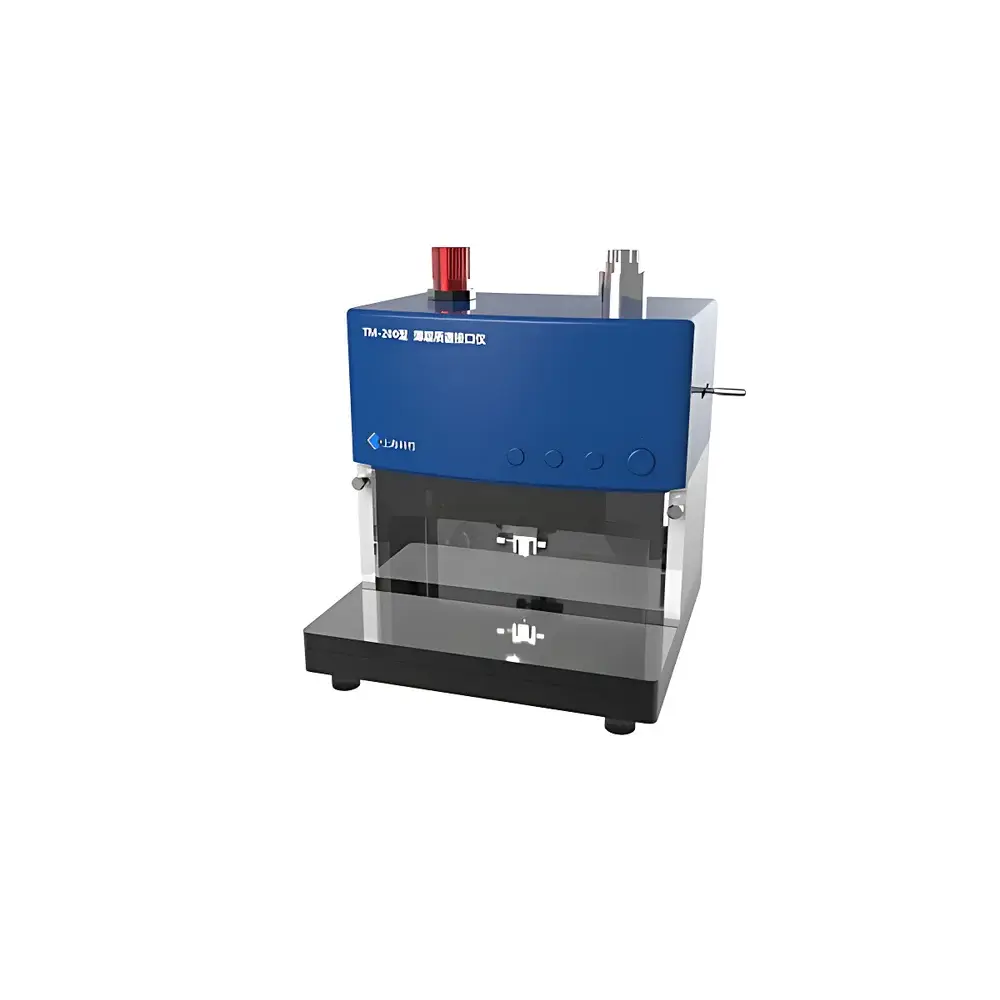
KEZHE SHANGHAI TM-200 Thin-Layer Chromatography–Mass Spectrometry Interface
| Brand | KEZHE SHANGHAI |
|---|---|
| Origin | Shanghai, China |
| Manufacturer Type | Direct Manufacturer |
| Product Category | Domestic |
| Model | TM-200 |
| Instrument Type | TLC–MS Interface |
| Measurement Mode | Transmission Absorption |
| Wavelength Range | 190–800 nm |
| Light Source | Laser |
| Laser Power | 5 mW |
| Spectral Bandwidth | 5 nm |
| Wavelength Accuracy | < 1 nm |
| Wavelength Repeatability | < 0.2 nm |
| Minimum Spatial Resolution | 25 µm |
| Imaging Wavelength | 254 nm |
| Maximum TLC Plate Size | 200 × 200 mm |
| Solvent Flow Rate | 0.05–0.3 mL/min |
| Pneumatic Source | N₂ or Compressed Air |
| Sealing Force | Up to 500 N |
| Extraction Probe Options | Ø4 mm, Ø5 mm (circular), 4 × 2 mm (elliptical) |
Overview
The KEZHE SHANGHAI TM-200 Thin-Layer Chromatography–Mass Spectrometry (TLC–MS) Interface is an engineered solution for direct, spatially resolved elution of analyte bands from silica- or alumina-coated TLC plates into downstream analytical systems—including quadrupole, ion trap, and time-of-flight mass spectrometers—or into collection vials for offline analysis. Unlike conventional scraping-based approaches, the TM-200 employs a laser-guided, pneumatically actuated micro-extraction probe to isolate discrete zones with sub-millimeter positional accuracy. Its core principle relies on controlled solvent delivery under defined pressure and flow dynamics, enabling localized dissolution of separated compounds directly from the stationary phase surface without mechanical disturbance or cross-contamination. Designed for laboratories performing natural product isolation, pharmaceutical impurity profiling, forensic screening, or metabolite identification, the TM-200 bridges the gap between planar chromatographic separation and high-sensitivity mass spectrometric detection—preserving chromatographic integrity while eliminating manual sample handling steps.
Key Features
- Laser-assisted visual targeting system (5 mW diode laser, 254 nm alignment wavelength) for precise spot selection on TLC plates up to 200 × 200 mm
- Pneumatically driven extraction head with adjustable sealing force (up to 500 N) ensuring consistent contact pressure across variable plate thicknesses and surface roughness
- Three interchangeable probe geometries: Ø4 mm and Ø5 mm circular tips for discrete spot elution; 4 × 2 mm elliptical tip optimized for narrow bands or streaked zones
- Programmable solvent delivery module with flow control range of 0.05–0.3 mL/min, compatible with common LC–MS solvents (e.g., methanol, acetonitrile, water, and volatile buffers)
- Integrated transmission-absorption optical path (190–800 nm) supporting real-time UV visualization and optional densitometric quantification prior to extraction
- Modular interface design enabling direct coupling to ESI or APCI sources via standard PEEK tubing, or offline collection into 1.5 mL autosampler vials
Sample Compatibility & Compliance
The TM-200 supports all commercially available pre-coated TLC plates (silica gel 60, aluminum oxide, cellulose, C18 reversed-phase) and accommodates both solvent-front migration and ascending/descending development protocols. It operates within ambient laboratory conditions (15–30 °C, <70% RH) and requires only a regulated nitrogen or compressed air supply (4–6 bar). The system complies with general laboratory safety standards for low-power laser Class 2 devices (IEC 60825-1) and meets mechanical stability requirements per ISO 17025 for traceable analytical instrumentation. While not certified for GMP-regulated environments out-of-the-box, its hardware architecture permits integration into GLP-compliant workflows when paired with audit-trail-enabled software and documented SOPs.
Software & Data Management
The TM-200 operates via a dedicated Windows-based control application that records extraction coordinates, solvent flow parameters, dwell time, and pneumatic actuation cycles. All operational metadata—including timestamp, operator ID, plate ID, and probe configuration—is embedded in exportable CSV or XML log files. The software supports batch mode operation for sequential extraction across multiple lanes and includes calibration routines for probe positioning repeatability (verified at ≤ ±5 µm over 100 cycles). For regulatory environments, optional software modules provide 21 CFR Part 11–compliant user authentication, electronic signatures, and immutable audit trails—fully configurable to align with internal quality management systems.
Applications
- Rapid identification of unknown components in herbal extracts or fermentation broths following TLC separation
- Targeted isolation of degradation products or synthetic by-products in pharmaceutical stability studies
- Forensic toxicology screening where minimal sample consumption and rapid turnaround are critical
- Preparative-scale band excision for subsequent NMR or chiral HPLC analysis
- Method development support for LC–MS method transfer from TLC-based scouting experiments
- Quantitative densitometry–guided extraction for calibration curve generation using internal standards spotted on the same plate
FAQ
Can the TM-200 be used with high-resolution mass spectrometers (HRMS)?
Yes—the interface delivers nanoliter-to-microliter volume eluates with minimal dilution, making it compatible with Q-TOF, Orbitrap, and FT-ICR platforms when coupled via low-dead-volume capillary connections.
Is solvent compatibility limited to organic solvents?
No—aqueous mobile phases containing up to 0.1% formic acid or 10 mM ammonium acetate are fully supported; however, high-salt buffers (>50 mM) are discouraged due to potential nozzle clogging.
Does the system require external vacuum or pumping?
No—the TM-200 uses positive-pressure solvent delivery and passive gravity-assisted flow for collection; no auxiliary pumps or vacuum manifolds are needed.
How is probe cleaning handled between extractions?
A built-in solvent rinse cycle (programmable duration and flow rate) flushes residual matrix from the probe interior; recommended rinse solvents include methanol, isopropanol, and dichloromethane depending on analyte polarity.
What maintenance is required for long-term reliability?
Annual verification of laser alignment, pneumatic seal integrity, and flow calibration is advised; consumables include O-rings, probe tips, and solvent filters—available as OEM kits with traceable lot documentation.
Related Products






